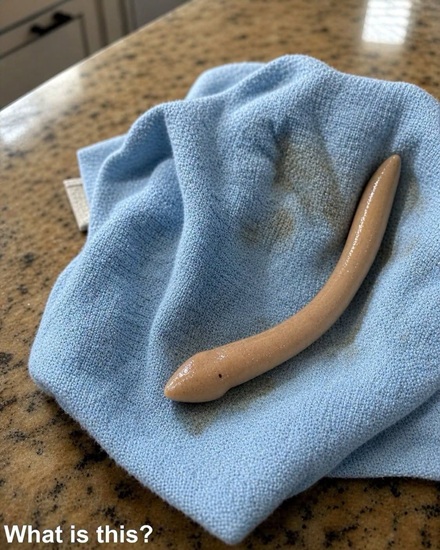
An ordinary bathroom is probably one of the last places where most people expect to encounter an unfamiliar living creature. That is what made one account shared online particularly unsettling: something dark and irregular was reportedly noticed lying on the bathroom floor and initially appeared to be nothing more than discarded material. From several steps away, there was little reason to assume otherwise. Bathrooms regularly accumulate small pieces of packaging, hair, lint, rubber, paper, and debris around cabinets, drains, and corners.
The strange object seemed small enough to fit comfortably into that explanation. Only after it was watched more carefully did the apparently harmless piece of “trash” begin to look considerably more unusual. According to the supplied account, the object was positioned slightly away from the brightest part of the room, making its shape difficult to understand at first glance. It appeared dark, uneven, and somewhat soft rather than flat and rigid like ordinary packaging.
The observer initially considered several mundane explanations, including the possibility that something had fallen from a cleaning product or broken away from another household object. Nothing about that first interpretation seemed unreasonable. Most people would probably make a similar assumption before imagining that an unfamiliar animal had somehow entered the room. The situation changed only because a second look made the object appear strangely organic.
The shape reportedly seemed thicker and more irregular than a piece of plastic or paper. Rather than having clean edges or the predictable surface of manufactured material, it appeared to have contours that suggested a small body. That observation created the first real uncertainty. The person looking at it could no longer comfortably dismiss it as ordinary debris, but there still was not enough information to know what it actually was. The bathroom remained quiet, and the object appeared motionless. For several moments, the entire mystery depended on nothing more than an unfamiliar shape on the floor.
That uncertainty was enough to make the observer begin inspecting the surrounding room. The areas behind and around the toilet were reportedly checked, followed by the space beneath the sink, the visible plumbing, the shower area, and the edges of the walls. Even the ceiling became part of the search as the person tried to imagine where the strange object could have originated. Nothing obvious appeared damaged or disturbed. No second creature was mentioned, and there was no clear trail pointing toward the object’s origin. Instead of providing reassurance, the otherwise ordinary bathroom apparently made the unfamiliar object seem even more out of place.
Then came the detail that changed the situation completely. The observer believed the object had moved. At first, that possibility was reportedly dismissed as imagination, which is understandable when someone has been staring closely at something unfamiliar. A shadow can change when a person shifts position, and even slight changes in perspective can make a stationary object appear different. The person therefore continued watching instead of immediately accepting that the object was alive. Eventually, however, another small movement reportedly became noticeable.
At that point, the explanation involving discarded household material became much harder to maintain. Trash does not contract, stretch, or independently change position. The observer reportedly moved backward rather than immediately trying to pick the object up. That response also prevented the situation from becoming more complicated before the creature could be identified. Handling an unknown animal with bare hands is generally unnecessary, especially when its species, condition, and possible defensive abilities are not known. Observation from a distance provided a much safer way to investigate.
A closer visual examination reportedly revealed that the surface did not look dry or artificial. Instead, the animal appeared soft-bodied and somewhat moist. Its body shape, texture, and movement eventually led the observer to begin comparing it with photographs of small invertebrates found in wet environments. According to the account provided, the creature was ultimately believed to be a leech. That identification fits the general appearance described, but the available material does not include an examination by a zoologist or other expert. For that reason, it is more accurate to say the animal was identified or suspected by the observer to be a leech rather than claiming a scientifically confirmed species identification.
Leeches are real animals belonging to a specialized group of segmented worms known as Hirudinea. They are related to other annelids, including earthworms, although their bodies and lifestyles can be quite different. Leeches occur in a variety of environments, and many species are associated with freshwater habitats such as ponds, streams, wetlands, and other moist places. Natural History Museum material, for example, lists leeches among the invertebrates that can inhabit ponds. Their ability to thrive around water helps explain why a wet-looking, soft-bodied animal might immediately bring a leech to mind.
The common idea that every leech is a blood-feeding parasite is not completely accurate. Many leech species do feed on blood, and some possess specialized structures that allow them to attach to vertebrate hosts. Other species have very different diets and prey on smaller invertebrates instead. The Natural History Museum notes, for example, that the horse leech Haemopis sanguisuga does not normally suck mammalian blood but instead eats softer animals such as worms, slugs, and snails. Therefore, identifying an animal generally as a leech does not automatically establish what it eats. A precise species identification would be necessary before making confident statements about its feeding behavior.
Blood-feeding leeches nevertheless possess fascinating biological adaptations. Some can use teeth or a proboscis to obtain a blood meal, while their muscular bodies can expand as they feed. They also have sensory abilities that help them detect potential hosts in their environments. Research and observations of certain terrestrial leeches have even shown surprisingly active movement, including jumping behavior documented in Madagascar. These biological details help explain why leeches are far more complex than the simple image of a motionless worm that many people carry in their minds. They are highly adapted invertebrates with different lifestyles across numerous species.
None of those facts, however, establishes exactly how the animal in the bathroom arrived there. The original account reportedly raised several possibilities, including a drain, plumbing opening, footwear, clothing, or accidental transport from somewhere else. Those possibilities may sound reasonable, but no evidence in the supplied narrative identifies one of them as the actual route. It would therefore be misleading to state that the creature definitely crawled through the plumbing. A bathroom contains moisture and multiple openings, but simply finding an organism there does not reveal its travel history. The precise route should remain unknown unless additional evidence becomes available.
Accidental transport is possible for many small organisms in everyday life. People move between outdoor and indoor environments on shoes, clothing, bags, pets, plants, tools, and countless other objects. Small animals can sometimes be transported without anyone noticing until they appear in an unexpected location. At other times, organisms enter buildings through cracks, gaps, drains, doors, windows, or other openings. Knowing that these routes exist still does not allow an observer to determine which one was responsible in a specific incident. This distinction between possibility and proof is important when describing unusual household encounters.
The bathroom environment itself probably contributed to the emotional effect of the discovery. Bathrooms are familiar spaces that people generally enter without thinking about wildlife. A creature seen beside a pond or stream might immediately seem connected with the surrounding ecosystem. The same animal lying beside a bathroom fixture can feel dramatically out of place. Familiar surroundings therefore change the way an encounter is perceived even when the organism itself is completely natural. What appears ordinary outdoors can become disturbing when discovered unexpectedly indoors.
The strange object’s movement was particularly important because it eliminated the easiest explanation. Until that moment, it could be treated as something that simply needed to be swept up or thrown away. Movement meant that the observer now had to consider the presence of an animal instead. That sudden change in interpretation is what makes the story memorable. One moment involved a piece of apparent debris, while the next involved questions about identity, origin, and whether approaching was sensible. The physical object had barely changed, but the observer’s understanding of it changed completely.
Stories like this frequently become exaggerated once they circulate online. A small unfamiliar organism can quickly be described as a dangerous parasite emerging from household plumbing even when the original evidence establishes far less. Dramatic captions tend to attract more attention than cautious identification. Yet a story does not need an invented threat to remain interesting. Unexpectedly discovering a leech-like animal on a bathroom floor is already unusual enough to generate curiosity. Accuracy requires resisting the temptation to fill every unanswered question with the most frightening possibility.
The supplied narrative does not identify an exact location for the incident. That missing information matters because leech species and other similar-looking invertebrates vary considerably across regions. Climate, surrounding habitat, local water sources, and geography could all help narrow down what kind of animal was encountered. Without a city, country, or biological identification, assigning a precise species would be guesswork. The most responsible version of the story therefore preserves that uncertainty. It describes what was reportedly seen without inventing a location or species.
This also means that no assumptions should be made about whether the bathroom had a plumbing problem. A single unidentified organism does not prove contamination, a broken drain, or an infestation. There is no information in the supplied account indicating that multiple creatures were present. There is also no report of structural damage or a wider household problem. The observer looked around the room and apparently found nothing else unusual. Turning one sighting into evidence of an infestation would go beyond what the story supports.
Likewise, there is no reason to claim that the animal was actively searching for a human host. Even among blood-feeding leeches, finding one indoors would not automatically reveal why it was moving in a particular direction. Animal behavior should be described from observations rather than human assumptions about intention. The account establishes movement, not a deliberate attempt to approach or attack someone. That distinction prevents ordinary animal behavior from being sensationalized. The creature was surprising, but surprise and danger are not the same thing.
A person encountering a small unidentified animal indoors can generally avoid unnecessary contact while trying to determine what it is. Taking a clear photograph may be more useful than touching it immediately. Images can be compared with reliable biological resources or shown to someone knowledgeable about local wildlife. If removal is necessary, appropriate precautions depend on the organism and circumstances. Bare-hand contact with unknown creatures is rarely required simply to satisfy curiosity. Distance provides time to make a more informed decision.
The story also illustrates how limited visual identification can be. Many small invertebrates share similar dark, elongated, or worm-like body shapes. Leeches, flatworms, earthworms, larvae, slugs, and other organisms can sometimes be confused by people who have not studied them. A wet or dimly lit bathroom makes the process even more difficult because color, texture, and small anatomical features may be hard to see. Internet image searches can suggest possibilities but are not equivalent to an expert examination. Confidence should therefore match the quality of the available evidence.
Leeches themselves form a diverse group. Some are fully aquatic, while others can occupy damp terrestrial environments. Different species feed differently, move differently, and interact with other animals in different ways. The Natural History Museum maintains significant scientific collections of Hirudinea precisely because the group is biologically diverse and scientifically important. Treating all leeches as interchangeable misses much of that diversity. It also encourages inaccurate claims whenever an unidentified worm-like animal appears in a viral post.
Freshwater habitats can support a surprisingly large number of organisms that most people rarely notice. Ponds alone may contain insects, larvae, snails, crustaceans, worms, leeches, amphibians, and many other animals. Some spend their entire lives underwater, while others use water only during particular stages of their development. Temporary bodies of water can also become populated surprisingly quickly. Natural History Museum research and educational material describe leeches among organisms found in established and temporary pond environments. That broader ecological context shows that they are ordinary components of many freshwater ecosystems rather than mysterious anomalies.
What makes an indoor encounter feel extraordinary is therefore the setting, not necessarily the animal. A leech in a pond may receive little attention. A suspected leech appearing on a clean bathroom floor creates an immediate mystery because it seems disconnected from its expected habitat. The human mind naturally begins searching for a pathway that explains the contradiction. Drains and pipes become obvious suspects because they are visible connections with water. Yet an obvious hypothesis should not automatically become a factual conclusion.
The observer in the account reportedly experienced exactly that uncertainty. Questions about the drain, plumbing, footwear, and accidental transport appeared only after the creature was recognized as something alive. None could be confirmed. The room offered no clear evidence pointing toward one explanation. In the absence of that evidence, the most accurate conclusion is simply that the route was unknown. Sometimes a story remains unresolved even after the central object has been identified.
That unresolved detail does not make the account incomplete. In fact, uncertainty is a normal part of real-world observation. Someone may identify an animal without ever discovering how it entered a building. Wildlife can travel through routes people never witness. Attempting to create a perfect explanation after the fact can easily introduce misinformation. A factual article should be comfortable stating when something cannot be established.
Another potentially misleading element is the phrase “blood-feeding creature.” Some leeches genuinely do feed on blood, but the description cannot safely be applied to this particular animal without knowing its species. As noted earlier, certain leeches prey on invertebrates instead. The organism in the bathroom may have belonged to a blood-feeding species, or it may not have. The supplied account does not provide enough information to decide. Calling it simply a suspected leech preserves the identification while avoiding a biological claim that has not been demonstrated.
If the creature really was a leech, its movement would not be unusual. Leeches are muscular animals capable of locomotion rather than passive objects that remain fixed in one place. Different species use their bodies and suckers in various ways to move through water or across surfaces. Certain species have even evolved more dramatic movement strategies. The apparently tiny movement noticed by the observer would therefore be entirely consistent with a living invertebrate. It was the observer’s expectation that made the movement surprising, not the biological ability itself.
The discovery also demonstrates how quickly a familiar room can feel unfamiliar once something unexpected appears inside it. The account describes corners, pipes, drains, and damp areas suddenly becoming sources of suspicion. Those features had existed before the animal was noticed, but their meaning changed once the observer began searching for an explanation. This reaction is psychologically understandable. Humans naturally become more attentive to their surroundings when they encounter something they cannot immediately identify. Yet heightened attention can also encourage assumptions unsupported by evidence.
That is why distinguishing direct observation from interpretation matters. The direct observations in the account include a dark irregular object on the bathroom floor, an apparently organic texture, and movement. The subsequent interpretation was that the creature resembled a leech after comparisons with online images. Speculation included possible entry through plumbing or accidental transport. Keeping those categories separate allows the reader to understand exactly what is known and what remains a possibility.
There is also no indication in the supplied account that anyone was bitten. No physical contact with the animal was described, and there is no report of injury or medical treatment. A responsible article should therefore avoid language suggesting that the observer narrowly escaped an attack. The story concerns an unexpected discovery rather than a documented medical incident. That difference is significant when presenting animal encounters accurately. Fear alone does not establish that someone was in immediate danger.
Likewise, nothing in the narrative establishes that the bathroom itself was unsafe to use after the creature was removed. A single animal does not automatically indicate a continuing health hazard. Any broader concern would depend on factors not supplied here, including the actual species, the building, local conditions, and whether additional organisms appeared. Those details would require their own evidence. Without it, the story should remain centered on the single encounter.
For readers, perhaps the most practical lesson is to avoid handling unfamiliar organisms until they can be identified. An unknown creature may be completely harmless, but there is little benefit in immediately touching it. Taking photographs, maintaining distance, and consulting reliable information can answer many questions without direct contact. If repeated sightings occur, local pest-control professionals, environmental authorities, or relevant specialists may be able to investigate depending on the circumstances. The appropriate response should be based on the actual situation rather than a viral headline.
The incident also offers an interesting reminder of how much wildlife exists beyond the animals people normally notice. Small invertebrates often live largely unseen around water, soil, plants, and damp environments. Their presence rarely becomes news because they are part of ordinary ecosystems. Only when one appears somewhere unexpected does it suddenly attract attention. A bathroom floor transformed an otherwise obscure animal into the center of a mystery. The biology remained ordinary even though the encounter felt extraordinary.
Understanding the likely animal can replace some of that mystery with curiosity. Leeches have existed for millions of years and have evolved a range of specialized lifestyles. Their anatomy and feeding adaptations are subjects of ongoing scientific interest. Some prey on other invertebrates, while others feed on vertebrate blood. Certain terrestrial species display surprisingly sophisticated sensory and movement behaviors. An organism that initially looks like an unsettling piece of debris can therefore lead directly into a fascinating area of zoology.
The account should nevertheless end where the evidence ends. Based on the supplied narrative, an unfamiliar soft-bodied organism was found on a bathroom floor and initially mistaken for trash. After movement was noticed, the observer examined it from a distance and compared its appearance with online images. The creature was then believed to be a leech. Its exact species and route into the bathroom were not established. No confirmed infestation, plumbing failure, attack, or injury was reported.
That factual sequence is compelling enough without embellishment. The power of the story comes from an ordinary moment changing unexpectedly. Something that seemed disposable turned out to be alive. A familiar bathroom briefly became the setting for an encounter with an animal normally associated with wetter, more natural environments. The observer’s curiosity eventually replaced the initial assumption that it was merely debris. The unanswered question of how it arrived there remains part of the mystery.
For anyone who experiences something similar, the best response is not panic but careful observation. Avoid unnecessary direct contact, keep children or pets from investigating the creature, and photograph it clearly if doing so can be done safely. Reliable identification is more useful than guessing from fear. Once the organism is known, decisions about removal or further investigation can be based on evidence rather than imagination. Most importantly, one unusual sighting should not automatically be transformed into claims about infestations, dangerous plumbing, or hidden threats.
In the end, the encounter demonstrates that even the most familiar spaces can occasionally contain something unexpected. The creature described in the account may have looked disturbing because it was discovered where nobody expected to see it. Yet if the identification as a leech was correct, it was not an unknown monster or mysterious new organism. It was a member of a well-established and diverse group of invertebrates that normally attracts far less attention. What turned it into a memorable story was not simply what it was, but the moment it moved and revealed that the “piece of trash” on the bathroom floor had been alive all along.
