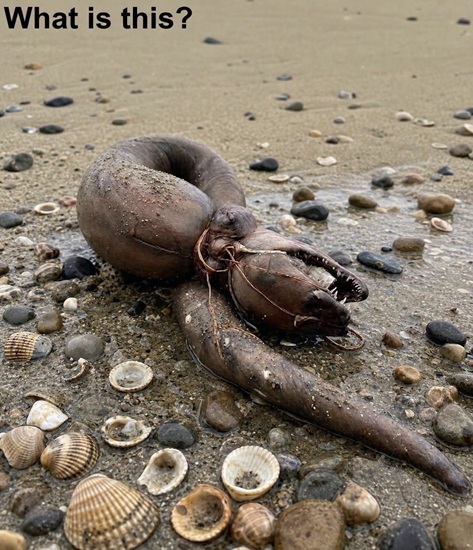
A peaceful walk along a beach can occasionally produce an unexpected encounter with marine life, particularly after tides, waves, or changing weather conditions bring animals and other material toward the shoreline. One widely shared account describes a beachgoer who was walking with a dog when an unusual elongated creature was noticed close to the water. Its appearance was immediately striking because of its long body, prominent mouth, and sharp-looking teeth. Rather than approaching or touching the animal, the observer reportedly remained at a distance and used a phone to examine and photograph it.
The creature was later described in the account as a dead moray eel. While the sight may appear alarming, moray eels are real marine animals whose anatomy can look particularly dramatic when one is encountered unexpectedly on land. The original account presents the discovery as something that happened during an otherwise ordinary walk near the shoreline. According to the narrative, the dog noticed something unusual and reacted to it, drawing attention toward the object lying near the water.
From a distance, the animal’s elongated shape made identification difficult. It did not resemble the fish many casual beach visitors are accustomed to seeing. Its open mouth and visible teeth contributed to an appearance that could understandably seem intimidating to someone unfamiliar with moray eels. The observer reportedly chose not to move closer immediately.
That was a sensible approach when dealing with an unidentified marine animal because appearance alone cannot reliably establish whether an animal is alive, injured, recently dead, or capable of causing injury. Instead, the person described using a phone camera and zoom function to obtain a closer visual impression without physically approaching the animal. Photographs were subsequently compared with images available online. According to the supplied account, those comparisons led to the conclusion that the creature was a moray eel.
Without the original specimen being examined by a qualified marine expert, however, a photograph-based identification should be described with appropriate caution. The account identifies the animal as a moray eel, but the supplied material does not include a documented examination by a marine biologist or wildlife authority. That distinction matters when attempting to present the story accurately. A visual match can provide a reasonable indication of an animal’s identity, but it should not automatically be elevated into a scientific confirmation when no expert identification is available.
Moray eels are members of the family Muraenidae and occur in marine environments in many parts of the world. There are numerous species, and their appearance varies considerably. Some are relatively small, while others can grow much larger. Their elongated bodies and lack of the prominent paired fins people commonly associate with many fish can give them an almost snake-like appearance. Despite that resemblance, morays are fish rather than marine snakes.
Their heads are among their most recognizable characteristics. Many moray species have relatively large mouths equipped with sharp teeth that help them capture prey. When seen underwater in their normal habitat, that anatomy may not appear particularly unusual to divers familiar with marine life. Encountering the same features unexpectedly on a beach can create a very different impression. An open mouth filled with visible teeth can make a dead or stranded animal look threatening even when it is no longer moving.
Morays are also sometimes photographed with their mouths repeatedly opening and closing underwater. To human observers, the behavior can look aggressive, as though the animal is continuously preparing to bite. In reality, mouth movements in morays are associated with moving water across their gills for respiration. Appearance and behavior should therefore not automatically be interpreted using human expressions such as anger or snarling.
That does not mean people should attempt to handle an unfamiliar moray. Wild animals should generally be given appropriate space, particularly when their condition is unknown. An animal lying motionless on the beach may not necessarily be dead, and approaching closely enough to touch it could create unnecessary risk. Teeth, spines, venom in certain other marine species, bacteria, or simple misidentification are all reasons to avoid casually handling unidentified wildlife.
If someone encounters an unfamiliar marine animal on a beach, observing it from a reasonable distance is usually preferable to immediately touching or moving it. Where appropriate, local lifeguards, wildlife authorities, park personnel, or marine-rescue organizations may be able to provide guidance. The correct organization will depend on the location and the type of animal involved. An observer should avoid assuming that an animal needs to be returned to the sea without first understanding what it is and what condition it is in.
Marine animals can reach beaches for many different reasons. Some die naturally offshore and are later carried toward land by waves and currents. Others may be injured, weakened, affected by environmental conditions, or stranded while still alive. Tides continually transport natural material along coastlines, including seaweed, shells, driftwood, dead fish, and occasionally larger animals. Finding an unusual creature near the water therefore does not necessarily indicate that anything extraordinary or mysterious has happened.
The unfamiliar appearance of moray eels helps explain why photographs of them can generate dramatic reactions online. Most people encounter fish in forms that are immediately recognizable: rounded or streamlined bodies, clearly visible fins, and relatively small mouths. A moray challenges that familiar picture. Its long muscular body, unusual head, and prominent teeth can make it appear almost prehistoric to someone seeing one for the first time.
Yet morays are ordinary members of marine ecosystems rather than mysterious creatures. They commonly occupy rocky areas, reefs, crevices, and other underwater habitats where their elongated bodies allow them to shelter in confined spaces. Many species spend substantial amounts of time partially concealed, with only their heads extending from a hole or crevice. This behavior contributes to the striking photographs divers sometimes capture.
Morays are predators and consume various marine animals depending on the species. Their diets can include fish, crustaceans, cephalopods, and other suitable prey. Their teeth and powerful jaws are adaptations that help them capture food. Those features are therefore functional parts of an animal adapted to its ecological niche rather than evidence of unusual aggression toward humans.
Some moray species also possess an extraordinary feeding adaptation known as pharyngeal jaws. In addition to their primary jaws, morays can use a second set of jaws located farther back in the throat to help move captured prey into the digestive system. Scientific research into this mechanism has made morays particularly interesting to researchers studying feeding adaptations in fish. It is another example of how an animal that appears frightening at first can become considerably more fascinating when its biology is understood.
Interactions between morays and humans usually occur underwater, particularly around reefs visited by divers and snorkelers. Morays are not animals people should deliberately provoke, feed, or handle. Bites can cause significant injuries, and anyone encountering a wild moray should respect its space. At the same time, presenting every moray as an animal actively hunting humans would be inaccurate.
The beach encounter described in the supplied account was different because the animal was reportedly found at the shoreline and believed to be dead. The dramatic appearance of the body was therefore the central reason it attracted attention. Waves moving around a motionless animal can sometimes create an illusion of movement, especially when the body is flexible. This can make it difficult for an untrained observer to determine from a distance whether an unfamiliar creature is truly lifeless.
For that reason, keeping physical distance while observing is a reasonable precaution. A smartphone camera can provide photographs without requiring someone to position a hand or foot next to an unidentified animal for scale. If identification is important, clear images showing the entire body and distinguishing features can sometimes help knowledgeable people assess what has been found.
Online identification should nevertheless be approached carefully. Search engines and social-media comments can return photographs of superficially similar species, and people without expertise may confidently provide incorrect answers. Marine organisms are exceptionally diverse, and unrelated animals can sometimes share surprisingly similar features. When certainty matters, identification from a qualified expert or relevant authority is more reliable than comments beneath a viral photograph.
The account provided here does not include the exact beach where the discovery allegedly occurred. It also does not identify the observer by name or provide documentation from a local wildlife organization confirming the animal. Those details should therefore not be invented simply to make the story appear more complete. Adding a fictional location, eyewitness name, expert quotation, or official response would transform an incomplete report into misinformation.
The same principle applies to the dog’s behavior. The narrative says that the dog reacted to the discovery, but it would be inappropriate to claim precisely what the animal understood or sensed. Dogs may stop, pull away, investigate, bark, or otherwise respond to unfamiliar smells and objects for numerous reasons. Describing an observed reaction is reasonable; assigning a specific thought or intention to the dog would be speculation.
Another important distinction concerns the dramatic language commonly used in social-media teasers. Phrases suggesting that a beachgoer discovered something terrifying or mysterious may encourage people to click, but they do not establish what the animal actually was. The useful information comes from identification and context rather than suspense alone. Once an animal is recognized as a known marine species, the discovery becomes an opportunity to learn about wildlife instead of treating it as an unexplained mystery.
Moray eels have existed as part of marine ecosystems for far longer than humans have been photographing them on beaches. Their unusual anatomy is well documented, and scientists have studied their feeding behavior, habitats, diversity, and evolutionary adaptations. A photograph can still be visually surprising without requiring supernatural or sensational explanations.
The incident also demonstrates how different an animal can appear outside its normal environment. Underwater, a moray emerging from a reef crevice fits naturally into the surrounding ecosystem. On wet sand beside a walking path or recreational beach, the same animal can look completely out of place. Context strongly influences how people interpret what they see.
Decomposition can further alter the appearance of marine animals that wash ashore after death. Color can fade, tissues can change, and body structures may become distorted. Damage from waves, scavengers, or time in the water can make identification more difficult. This is another reason viral photographs of dead marine animals sometimes produce imaginative but incorrect explanations.
Historically, unusual carcasses discovered on coastlines have occasionally been described as mysterious “sea monsters” before experts identified them as known animals. Decomposition can transform familiar species enough to confuse people who have never studied marine anatomy. Modern cameras and online databases make identification easier than it once was, but they do not eliminate the possibility of mistakes.
A responsible account should therefore separate three categories of information: what was reportedly observed, what was subsequently inferred, and what has been independently established. In this story, an elongated marine animal was reportedly noticed near the shoreline during a walk with a dog. The observer photographed it rather than immediately approaching it. The supplied narrative says that subsequent comparison led to the belief that it was a dead moray eel.
What cannot responsibly be added are details the source does not provide. There is no basis in the supplied material for naming a particular beach, claiming that authorities investigated the discovery, identifying a specific species of moray, or stating exactly how the animal died. Any of those details would require additional evidence.
The cause of death is particularly important not to invent. A dead marine animal may have died from disease, injury, predation, environmental stress, fishing activity, age, or numerous other causes before currents transported it ashore. A photograph of the body alone may reveal very little about what happened. Without an examination, assigning a cause would be speculation.
Likewise, finding a dead marine animal does not by itself indicate that local waters are unsafe. Beaches routinely receive biological material from surrounding marine ecosystems. Any broader safety concern would need to be supported by information from relevant local authorities rather than inferred from one animal.
For dog owners, unfamiliar material on a beach presents an additional practical consideration. Dogs are naturally curious and may attempt to sniff, lick, or pick up things they encounter. Keeping a pet under control around dead wildlife, unidentified fish, fishing equipment, or other unknown objects can prevent unnecessary contact. If a pet does interact with something potentially harmful, appropriate veterinary guidance may be necessary depending on the circumstances.
People should similarly avoid taking unusual wildlife home as a souvenir. Regulations concerning marine species vary by location, and some animals or animal parts may be protected. More importantly, an unidentified carcass may carry bacteria or other biological hazards. Photographing something interesting from a safe distance generally provides a better memory than physically handling it.
The story becomes more interesting when viewed through this educational perspective. Instead of simply asking whether the creature looks frightening, people can ask why a moray has such an unusual body, why its mouth appears open, what it normally eats, and how an offshore animal can eventually arrive on a beach. Each question leads toward established marine biology rather than speculation.
Morays belong to a highly diverse group, with species occurring in tropical and temperate waters around the world. Their colors and patterns range considerably, with some species displaying spots, mottling, stripes, or relatively uniform coloration. Size also differs significantly between species. This diversity makes it difficult to identify a particular moray species from a vague description alone.
Their elongated shape is particularly useful in complex underwater environments. Rather than relying on a broad body to maneuver through open water, many morays can move through narrow reef structures and rocky crevices. They often remain concealed while waiting for prey or sheltering from disturbance. Their anatomy is therefore closely connected with the environments they occupy.
To someone encountering one unexpectedly on land, however, those same adaptations can appear strange. The absence of familiar-looking fins, the long body, and the jaw structure can make the animal seem more like something from a fictional story than an ordinary fish. That reaction says more about human familiarity than about how unusual the animal actually is in its natural habitat.
This is one reason education can change the emotional response to wildlife. An unidentified creature may initially cause fear because a person does not know whether it presents a threat. Once its biology and normal behavior are understood, fear can often be replaced by caution and curiosity. Respecting an animal does not require portraying it as a monster.
The beachgoer in the supplied narrative reportedly experienced precisely that transition. The initial sight was unsettling because the animal was unfamiliar and visually intimidating. Photographs provided a way to investigate without immediately approaching. Comparison with known marine species then supplied a plausible identity.
Even after identification, however, the encounter could understandably remain memorable. Seeing a moray in an aquarium, documentary, or diving photograph is very different from unexpectedly finding one near the route of an ordinary morning walk. Surprise often contributes as much to an encounter as the animal itself.
Beaches are boundaries between two very different environments, which is part of what makes them so unpredictable. People standing on land are only a short distance from ecosystems containing countless species they may never normally see. Waves occasionally bring evidence of that hidden world directly onto the shore.
Most of those encounters involve familiar objects such as shells, seaweed, or small fish. Occasionally, something larger or less recognizable appears. When that happens, curiosity is natural, but careful observation is preferable to unnecessary interference.
The broader lesson is not that beaches hide mysterious monsters waiting for unsuspecting walkers. It is that coastlines are connected to complex marine ecosystems, and unfamiliar animals can occasionally appear where people are not accustomed to seeing them. The scientific explanation is usually more useful than the frightening first impression.
In the case described here, the animal was reported to resemble and ultimately be identified by the observer as a moray eel. Its long body and prominent teeth fit features associated with that group of fish. Without an expert assessment or additional source documentation, however, the identification should remain attributed to the account rather than presented as an independently verified species determination.
That careful wording does not make the story less interesting. A routine walk reportedly became an unexpected encounter with an animal normally associated with underwater habitats. The observer chose distance over direct contact, documented what was seen, and later attempted to understand it.
There is also no need to repeat the same headline claim numerous times to make the account compelling. Repetition can obscure the few facts actually available and make an article appear longer without adding useful information. Additional value should instead come from explaining the animal, providing appropriate context, and clearly identifying what remains unknown.
The most important unknowns in the supplied account include the exact location, the specific species, the cause of death, and whether any qualified authority examined the animal. Unless additional reliable information becomes available, those questions should remain unanswered. Responsible reporting sometimes means acknowledging the limits of what can be established.
For readers, the encounter offers a useful reminder about approaching unfamiliar wildlife. Keep an appropriate distance, prevent children and pets from handling an unknown animal, and follow guidance from local authorities when an animal appears injured, alive, protected, or potentially hazardous. There is rarely a benefit in taking unnecessary physical risks simply to obtain a closer photograph.
At the same time, unusual discoveries do not need to create panic. Oceans contain enormous biological diversity, and coastlines naturally receive material from those ecosystems. A strange-looking fish on the sand may be surprising, but appearance alone does not turn it into an unexplained threat.
Moray eels are a particularly good illustration of that principle. Their muscular bodies, large mouths, and sharp teeth can create an intimidating first impression. In their normal environment, however, these features are simply adaptations that help them survive, find shelter, and obtain food.
The account therefore has a more grounded conclusion than the dramatic opening might suggest. A beachgoer and dog reportedly encountered an unfamiliar marine animal close to the shoreline. Rather than touching it, the person observed and photographed it from a distance and later concluded through image comparison that it was a dead moray eel.
That conclusion transforms the episode from an apparent mystery into an encounter with known marine wildlife. Some uncertainty remains because the supplied story does not provide an expert identification, exact location, or cause of death. Those missing details should be acknowledged rather than filled with invented information.
What remains is a fascinating example of how quickly an ordinary morning can reveal something unexpected from the natural world. A creature that would look perfectly at home beneath the surface can appear startling when waves leave it on exposed sand. The encounter may have been unsettling, but it also offered a glimpse of the remarkable diversity existing just beyond the shoreline.
The ocean still contains countless animals that many people will never encounter outside photographs, documentaries, or aquariums. Occasionally, currents and tides bring one of those creatures into human view. When that happens, curiosity combined with sensible distance and accurate identification is far more valuable than fear or speculation.
In the end, the unusual shape reportedly discovered during the beach walk was not evidence of an unknown monster or mysterious phenomenon. According to the supplied account, it was believed to be a dead moray eel, an established group of marine fish whose distinctive anatomy explains much of its alarming appearance. The encounter remains remarkable precisely because something entirely natural can still look so unfamiliar when it appears unexpectedly at our feet.
