For almost forty years, there was one question I could never completely silence: what happened to my twin sister, Laura? She disappeared on the night of our sixteenth birthday, leaving behind a family that never learned how to live comfortably with the uncertainty. There was no goodbye that I could understand, no explanation left on the kitchen table, and no final conversation I could replay for answers. As the years passed, people gradually stopped asking me about her because they assumed time had softened the loss.
It had not. Time had simply taught me how to carry the question without allowing it to control every hour of my life. Laura and I had grown up doing almost everything together. Being twins meant people frequently confused us from a distance, although anyone who knew us well could tell us apart immediately. Laura was the more impulsive one, always ready to challenge rules or turn an ordinary afternoon into an adventure. I was more cautious and usually the person reminding her that consequences existed.
We argued the way sisters do, sometimes over important things and sometimes over things so ridiculous that neither of us could remember the reason an hour later. Yet beneath every disagreement was the certainty that we belonged in each other’s lives. Our sixteenth birthday began like so many birthdays before it. Our mother baked a cake, our father complained about having two teenage daughters becoming older at the same time, and Laura teased me for taking too long to choose what to wear.
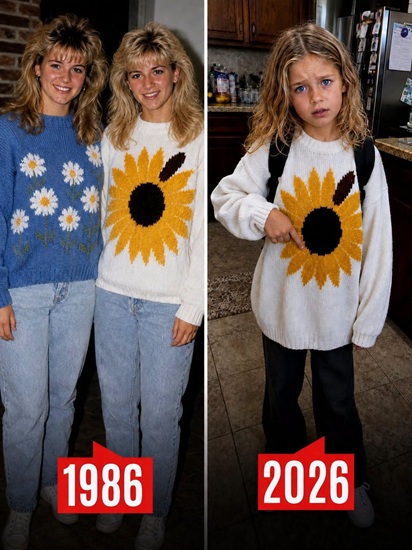
She had recently become attached to a cream-colored sweater decorated with a bright yellow sunflower. She loved it because our father had always called her his sunflower when we were children. On the inside of the sweater, our mother had stitched Laura’s initials in small thread so the garment would never be confused with anything I owned. I remember seeing her wear it that evening and thinking it suited her perfectly.
By the following morning, Laura was gone. At first, our parents assumed she had gone somewhere after an argument and would return once she had calmed down. Hours passed, and the worry became impossible to dismiss. Questions were asked, people were contacted, and every explanation seemed more frightening than the last. I remember staring at the front door and believing that if I watched it closely enough, Laura would eventually open it and complain about everyone making such a fuss. She never did.
The days immediately afterward became a blur of conversations I barely understood. Adults lowered their voices when I entered rooms, as though whispering could protect me from what was happening. I heard possibilities without knowing which ones were serious. Some believed Laura had run away voluntarily. Others wondered whether she had met with someone or been harmed. My parents asked me repeatedly whether she had said anything unusual, and I tortured myself trying to remember every conversation we had shared during the previous week. Nothing gave me the certainty I wanted.
For years, I blamed myself in small and irrational ways. I wondered whether I should have noticed something different in her mood. I replayed arguments and searched them for hidden messages that had not seemed important at the time. Perhaps I should have followed her. Perhaps I should have asked another question. Perhaps I should have refused to go to sleep that night. Rationally, I eventually understood that a sixteen-year-old girl could not have been expected to predict everything another sixteen-year-old was planning, even if they were twins.
Our family changed after Laura disappeared. My mother became quieter and developed the habit of looking through the window whenever a car slowed near the house. My father responded differently. He became stricter, more controlled, and increasingly uncomfortable whenever Laura’s name entered a conversation. At the time, I assumed this was simply his way of grieving. People respond to loss differently, and I believed his silence was the only way he knew how to survive the uncertainty.
Years turned into decades. I finished school, built a life, started a family, and eventually became a grandmother. Laura remained present in photographs and memories, but the urgency of the search gradually became part of the past. I learned that living did not mean forgetting her. It meant allowing myself to experience new relationships and new happiness without feeling guilty that Laura was not there to share them.
Even then, certain details could bring the past back instantly. A sunflower in a shop window could make me think of her. A teenage girl laughing with her sister could suddenly remind me of how easily Laura and I once laughed together. Sometimes I would see someone walking ahead of me who had Laura’s posture, and for one impossible second I would become sixteen again. Then the stranger would turn, and reality would return.
I had reached a point where I believed I had accepted that some questions might never be answered. Then one ordinary afternoon, my granddaughter Sophie walked through my door wearing a cream-colored sweater with a large yellow sunflower on the front. She was talking about school and barely noticed that I had stopped listening. I stared at the sweater until the room around me seemed to disappear. My mind rejected what my eyes were telling me because the possibility felt absurd.
“Sophie,” I finally said, “where did you get that?”
She looked down at the sweater and smiled as though nothing about it was unusual. She told me that a woman who worked at her school had given it to her. Sophie described the woman as a cleaner named Dolly who occasionally talked with students while working around the building. According to Sophie, Dolly had told her that the sweater had been stored for years and that she thought Sophie might like it. My granddaughter had accepted it without realizing that the garment meant anything to me.
I asked Sophie to take the sweater off so I could examine it. My hands were trembling before I even touched the fabric. The material was older and softer than I remembered, but the sunflower remained recognizable. I turned the collar over and searched the inside seam. There, faded but still visible, were the initials my mother had stitched decades earlier.
L.R.
Laura’s initials.
For several moments, I could not speak. Sophie became worried and asked whether something was wrong. I told her the sweater had once belonged to my sister, but even saying the sentence aloud felt impossible. Nearly forty years had passed since I last saw Laura wearing it. I had assumed the sweater disappeared with her forever.
Then Sophie remembered something else.
“Dolly told me you might know what to do with the flower,” she said.
I looked at her.
“What does that mean?”
Sophie explained that Dolly had pointed toward the sunflower and told her that if I ever saw the sweater, I should look underneath it. The message was so specific that my uncertainty disappeared. Whoever Dolly was, she knew that the sweater had a history. More importantly, she knew I was connected to that history.
I examined the sunflower carefully. At first, I saw nothing unusual. Then my fingers found a small seam hidden underneath part of the fabric design. Someone had created a tiny pocket behind the flower. I slipped two fingers inside and felt something hard.
I pulled out a small wooden sunflower.
The moment I saw it, I began crying.
Our father had carved two small wooden flowers when Laura and I were children. Mine had disappeared somewhere during adulthood, but Laura carried hers constantly for years. He had carved our initials into the back, and when I turned the wooden piece over, there was the same small “L” I remembered. There was no reasonable way to dismiss what I was holding.
The sweater had been Laura’s.
The wooden flower had been Laura’s.
And a woman named Dolly had deliberately arranged for both objects to reach me.
I barely slept that night. Every possibility I had imagined over the previous forty years returned at once. Had Dolly known Laura? Was she a friend? Had Laura given her the sweater? Was Laura still alive? The most frightening possibility was also the one I was almost afraid to hope for.
The following day, I asked Sophie to show me where Dolly usually worked at the school. I did not want Sophie involved in a complicated family mystery, so I went there alone. The building looked completely ordinary, which somehow made everything feel stranger. Children moved through the corridors, teachers carried folders, and somewhere inside that ordinary routine was a woman who apparently knew something about the most painful mystery of my life.
When Dolly finally walked toward me, I knew before either of us spoke that she recognized me. She stopped several steps away and stared. Her face changed as if she were looking at a person she had known from photographs rather than someone she had met before.
Then she said my name.
“You must be Claire.”
Nobody had introduced us.
I felt my entire body become cold.
“How do you know who I am?”
Dolly looked toward an empty classroom and asked whether we could speak privately. I followed her, barely aware of my surroundings. Once the door closed, I placed the wooden sunflower on a desk between us.
“Tell me where you got this.”
Dolly stared at it for several seconds.
“From my mother,” she said.
I asked her mother’s name.
She hesitated.
Then she said it.
“Laura.”
I sat down because I was no longer certain my legs would support me.
For almost forty years, I had imagined every possible ending to my sister’s story. I imagined tragedy because that was easier than endless uncertainty. I had imagined her living somewhere under another name, but I never allowed myself to believe that possibility for very long. Hope can be painful when there is nothing to support it.
Now a woman I had never met was telling me that Laura was her mother.
“She’s alive?” I asked.
Dolly nodded.
The answer should have brought immediate joy. Instead, it brought a flood of emotions so complicated that I could not separate them. Relief was there, but so was anger. Confusion arrived beside happiness. I wanted to laugh, cry, ask a hundred questions, and demand to know why nobody had told me sooner.
Dolly began explaining slowly.
According to her, Laura had left home intentionally when she was sixteen. She had become involved with a boy our family strongly disapproved of, and after a series of arguments she convinced herself that leaving was the only way to take control of her life. At sixteen, she believed she could begin again somewhere else and eventually return when everyone had calmed down.
Life did not follow the plan she imagined.
Laura and the boy remained together for a period of time, but the relationship eventually ended. By then, Laura had already been away from home long enough that returning seemed increasingly difficult. Shame, stubbornness, and fear made every month of silence create another obstacle.
Eventually, Laura became a mother.
Dolly was her daughter.
I stared at the woman sitting opposite me and began noticing details I had somehow missed earlier. The shape of her eyes reminded me of Laura. The way she held her hands while explaining something was almost identical. Once I knew what I was looking for, the resemblance became impossible to ignore.
“Why didn’t Laura come home?” I asked.
Dolly told me that she did.
Years after disappearing, Laura had returned to our hometown with Dolly, who was still a child at the time. She had apparently gathered enough courage to approach the family home because she wanted to reconnect. She wanted to see me. She wanted Dolly to know her relatives.
My father answered the door.
What happened next changed everything I thought I understood about the decades after Laura disappeared.
According to Dolly, my father refused to let Laura inside. He told her that too much damage had been done and that returning would reopen wounds everyone had spent years trying to survive. He believed I had rebuilt my life and feared that Laura’s sudden return would destroy whatever stability I had created.
He told her to leave.
And then he kept the encounter secret.
I could barely process the story.
All those years when I wondered whether Laura was dead, our father had known she was alive.
He knew she had a daughter.
He knew she had tried to return.
And he never told me.
I asked Dolly whether she was certain.
She explained that Laura had remembered the conversation clearly and had spoken about it many times. After being rejected, she believed the message was unmistakable. She convinced herself that I either knew and wanted nothing to do with her or had moved on so completely that contacting me would only cause pain.
Neither assumption was true.
I had never stopped wondering.
“Why send the sweater now?” I asked.
Dolly explained that Laura had kept it for decades. She also kept the wooden sunflower because it represented one of the few childhood memories she could hold in her hand. As Laura grew older, she apparently became more willing to talk about the past but still lacked the courage to contact me directly.
Dolly had recently discovered that Sophie was my granddaughter.
The connection seemed almost impossible, but communities and schools create unexpected intersections. Once Dolly realized who Sophie was, she understood that she had found a way to open a door without forcing Laura to walk through it herself. The sweater became the message.
I asked where Laura was.
Dolly would not immediately tell me.
She explained that her mother was frightened. Laura had spent decades believing she had lost the right to return to my life. Even after learning that our father’s version of events might not have represented my feelings, she was afraid that I would reject her.
That possibility hurt almost as much as everything else.
“I never stopped looking for her,” I said.
Dolly’s eyes filled with tears.
“I know that now,” she answered.
The next person I needed to see was my father.
He was an old man by then, far removed from the strict parent I remembered from childhood. Age had softened his voice and slowed his movements. Yet when I placed the wooden sunflower on the table in front of him, I watched something change in his face.
He knew immediately.
“Where did you get that?” he asked.
I did not answer.
Instead, I asked one question.
“When did you know Laura was alive?”
His silence became the answer before he said anything.
I felt decades of grief transforming into anger.
“You knew.”
He closed his eyes.
“Claire—”
“You knew she came back.”
My father tried to explain that the situation had been complicated. He said Laura appeared unexpectedly after years of silence and brought a child with her. He was angry, frightened, and still carrying the pain of what her disappearance had done to our family.
He believed he was protecting us.
That sentence made me furious.
“Protecting me from what? My own sister?”
He said he believed I had finally begun to move forward. I had built friendships, finished school, started working, and created a future. He feared Laura’s return would pull me back into the grief that had dominated our family for years.
He also admitted something harder.
He was still angry with her.
After years of fearing the worst, discovering that Laura had chosen to leave felt like betrayal to him. When she finally returned, he reacted from that anger rather than from compassion. He told himself he was protecting the family, but part of him wanted Laura to experience the consequences of leaving.
Then time did what time often does.
One bad decision became harder to correct with every passing year.
The longer my father kept the secret, the more impossible admitting it seemed.
He told himself Laura would eventually contact me directly.
She never did.
Laura believed she had been rejected.
I believed she was missing.
And my father stood between those two beliefs, carrying the truth alone.
I did not forgive him immediately.
I am not sure forgiveness should ever be rushed simply because someone finally admits the truth.
I told him exactly what those decades of uncertainty had been like. I described birthdays when I wondered where Laura was. I told him about seeing strangers who resembled her and following them with my eyes. I told him about every major life event when I imagined the empty space where my twin should have been.
He cried.
I had rarely seen my father cry.
“I thought I was protecting you,” he repeated.
“You protected me from the truth,” I answered. “Those aren’t the same thing.”
For several weeks afterward, my emotions changed constantly. Some mornings I woke up feeling enormous relief because Laura was alive. Other days anger was stronger. I had lost almost forty years with my sister, not because contact was impossible, but because fear, pride, and misunderstanding had kept everyone apart.
I also had to confront my own expectations.
For decades, I imagined that finding Laura would solve something inside me immediately. I believed that if I ever learned the truth, the uncertainty would disappear and peace would follow automatically.
Reality was more complicated.
Answers do not erase lost years.
Truth does not restore birthdays, holidays, conversations, or ordinary afternoons that never happened.
Knowing what happened gave the past a shape, but it did not rewrite it.
Dolly remained in contact with me. At first, our conversations were cautious because neither of us knew what role we were supposed to have in each other’s lives. She was my niece, but we were strangers. I wanted to know everything about her, yet I also understood that family relationships cannot be created instantly simply because biology says they exist.
We started slowly.
She told me about her childhood.
I told her stories about Laura as a girl.
Some stories made Dolly laugh because she recognized the same behavior in her mother. Others made her emotional because they described a version of Laura she had never known.
Through Dolly, I began learning about the decades I had missed.
Laura had worked several jobs, moved more than once, raised her daughter, made mistakes, recovered from some of them, and created a life far away from the sixteen-year-old girl frozen in my memory.
That realization mattered.
For nearly forty years, Laura remained sixteen in my mind.
Now I had to understand that she had aged just as I had.
She had become a mother.
She had experienced joys and losses I knew nothing about.
She had become a complete adult without me.
And I had done the same without her.
Eventually, Dolly told me that she had spoken with Laura about me.
My sister was not ready to meet.
Years earlier, that answer would have destroyed me.
This time, I understood it differently.
Laura had spent decades carrying her own version of the story. She believed she had abandoned us and later been rejected when she tried to return. She had built an entire life around the assumption that the door to her childhood family was permanently closed.
Opening that door again would take time.
So I wrote her a letter.
I did not accuse her.
I did not demand an explanation.
I simply told her the truth.
I told her I had never known she returned.
I told her I had never stopped wondering where she was.
I told her that I had been angry, hurt, confused, and relieved all at once since learning she was alive.
Most importantly, I told her that if she ever wanted to contact me, the choice was hers.
There would be no deadline.
There would be no punishment.
There would simply be a place for her if she wanted it.
Dolly delivered the letter.
For weeks, nothing happened.
Then one afternoon, I received an envelope.
There was no return address.
Inside was a photograph of two sixteen-year-old girls standing beside our father in the backyard.
Laura and me.
On the back, someone had written three words.
“I remember too.”
I recognized her handwriting.
I cried, but this time the tears felt different from the ones I had shed while sitting beside the window all those years ago.
The message was not a reunion.
It was not an apology.
It was not a promise.
But it was contact.
For the first time in nearly forty years, my sister had reached toward me.
I wrote another letter.
She eventually wrote again.
Slowly, cautiously, a conversation began.
We did not pretend the missing decades could be repaired with a few sentimental sentences. There were difficult questions. There were misunderstandings. There were moments when one of us needed time before responding.
But there was also recognition.
The sister I remembered still existed somewhere inside the woman writing to me.
She remembered the stupid songs we invented as children.
She remembered the hiding place behind our grandparents’ shed.
She remembered the wooden sunflowers our father carved.
She remembered our sixteenth birthday.
And she remembered leaving.
Laura eventually told me that she had regretted leaving almost immediately but had been too frightened to return. Each passing day made the decision feel more permanent. By the time she attempted to come home years later, she had created an entire story in her mind about what everyone must think of her.
Our father’s rejection confirmed her worst fears.
She did not know that he had never told me.
Once we understood that, much of the tragedy became painfully clear.
We had both spent decades acting on incomplete information.
I believed Laura had vanished completely.
Laura believed I knew she had returned and wanted nothing to do with her.
Neither belief was true.
One conversation decades earlier might have changed everything.
But that conversation never happened.
That fact taught me something I had resisted for most of my life.
Peace is not the same as getting the ending you wanted.
Sometimes peace begins when the story finally becomes understandable.
I could not recover the forty years Laura and I lost.
I could not make my father answer the door differently.
I could not stop the sixteen-year-old version of Laura from leaving.
I could not make myself notice what she was planning.
The past remained the past.
What I could change was what happened next.
I stopped waiting for some perfect reunion that would erase every painful year.
Instead, I allowed the relationship to become whatever Laura and I were capable of building now.
That approach felt gentler.
It also felt more honest.
Sophie still wears the cream sweater occasionally.
The first time I saw her wearing it after everything came to light, I expected the sight to hurt.
Instead, I smiled.
The sweater no longer represented only the night my sister disappeared.
It represented the strange path by which the truth finally returned.
A sixteen-year-old girl once walked away wearing it.
Nearly four decades later, my granddaughter carried it back into my house.
Hidden beneath the sunflower was the tiny wooden object our father had carved long before any of us understood how complicated our family would become.
The flower survived.
So did Laura.
So did I.
Our family did not emerge from the truth unchanged.
My relationship with my father became more complicated because I could no longer see his decisions as simply protective. He had acted from love, fear, anger, and pride at the same time. Understanding those motives helped me see him more clearly, but understanding is not the same as saying the decision was right.
Laura had also made choices that caused enormous pain.
She knew that.
I knew it.
Neither of us needed to pretend otherwise.
But people are more than the worst decisions they make at sixteen.
They are also what they learn afterward.
They are the lives they build.
They are the courage they eventually find to reopen a door they once believed was closed.
I no longer spend evenings watching the front door and imagining Laura appearing unexpectedly.
That was something the younger version of me did because uncertainty left no other place for hope to go.
Now I know where my sister is.
I know she survived.
I know she became a mother.
I know she remembered me.
Those truths are enough to allow me to live differently.
Perhaps one day she will walk through my door.
Perhaps our reunion will feel awkward rather than cinematic.
Maybe we will cry.
Maybe we will laugh.
Maybe we will sit silently because forty years is too much to summarize in one afternoon.
I no longer need to predict exactly how it will happen.
There is room for whatever comes next.
That is the peace I spent most of my life trying to find.
It did not arrive because the past was fixed.
The past cannot be fixed.
It arrived because secrecy finally became truth, uncertainty became understanding, and the sister I thought I had lost forever became a real person again instead of a question.
For nearly forty years, I believed the most important question was, “What happened to Laura?”
Now I understand that there was another question waiting behind it.
“What do we do once we finally know?”
My answer is simple.
We keep living.
We tell the truth.
We allow people to be more complicated than the roles they played in our memories.
We forgive when we are ready, without pretending that forgiveness erases consequences.
We make space for relationships that may begin again slowly.
And we stop believing that peace requires the past to become perfect.
Some endings never become perfect.
Sometimes the gift is simply discovering that the story was not over after all.
