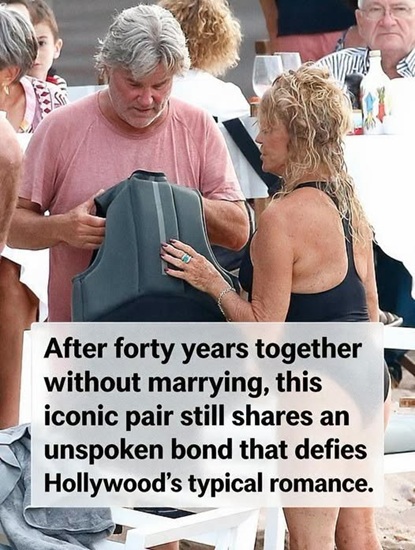
Goldie Hawn and Kurt Russell have one of the longest-running partnerships among major Hollywood stars, yet they have never felt the need to formalize their relationship through marriage. The two actors have been together since 1983, building a shared life that has now lasted for more than four decades. During that time, they have raised a blended family, supported one another through changing careers, worked together on screen, and experienced the ordinary changes that come with growing older together.
Their decision not to marry has naturally generated questions because many long-term couples eventually decide to make their relationship legally official. Hawn, however, has repeatedly explained that she does not view a marriage certificate as the foundation of commitment. For her and Russell, remaining together has been based more on choice, compatibility, family, affection, and preserving a sense of individual identity. Their story stretches back further than the beginning of their romance.
Hawn and Russell first encountered one another when they were young performers working on Disney’s The One and Only, Genuine, Original Family Band, which was released in 1968. At that stage of their lives, there was no serious romance between them, and both continued along separate professional and personal paths. Years later, they reconnected while working on Swing Shift, the 1984 film directed by Jonathan Demme. By then, both had considerably more life experience behind them, including previous marriages. Their renewed connection developed into a relationship in 1983 and eventually became one of Hollywood’s most enduring partnerships.
The date traditionally associated with the beginning of their relationship is February 14, 1983, Valentine’s Day. Their romance developed during the period when Russell was involved with Swing Shift, a movie Hawn was producing and starring in. Hawn later recalled that Russell invited her to go dancing because the two needed to work on the Jitterbug for the production. Instead of beginning with an elaborate celebrity date, the evening involved going to the Playboy Club in Westwood, where there was a big band and they could dance together. Hawn remembered the experience as fun and spontaneous, and the evening became part of the couple’s frequently retold origin story. Their early chemistry eventually continued beyond the professional environment of the film.
Hawn has also described another memorable part of that early evening. After dancing, she wanted Russell to see a house she was having renovated, but getting inside proved less straightforward than expected. The unusual episode became one of those stories the couple could later look back on with humor rather than treating their beginning as a perfectly planned Hollywood romance. That spontaneity is significant because it fits with the way Hawn has often described their relationship more generally. She has not portrayed their partnership as something built according to a rigid formula or predetermined list of milestones. Instead, their history developed gradually through shared experiences, attraction, family life, and repeated decisions to remain together.
By the time Hawn and Russell became a couple, both already understood what legal marriage could involve. Hawn had previously been married to actor and director Gus Trikonis and later to musician and actor Bill Hudson. Russell had previously been married to actress Season Hubley, with whom he had a son, Boston. Those earlier relationships meant that neither Hawn nor Russell was approaching marriage as an unexplored institution. Both had experienced not only marriage but also divorce, giving them personal reasons to consider whether marrying again was necessary for the relationship they were beginning together. Hawn has specifically connected their decision with those past experiences when discussing why they chose a different path.
Hawn expressed that idea particularly clearly during an appearance on ITV’s Loose Women. When discussing her long partnership with Russell, she joked that she believed she would have been divorced long ago if they had married. She went on to explain that she chose to stay and Russell chose to stay, emphasizing the value she places on that continuing decision. Her point was not that marriage is inherently unsuccessful or inappropriate for everyone. Rather, she was describing what had worked for the two of them personally after their previous experiences. Their relationship therefore became a partnership they considered complete without needing to add a wedding ceremony simply because others expected one.
Hawn offered an even more detailed explanation during her 2023 conversation with Chris Wallace. Asked directly why she and Russell had never married, she turned the question around and asked why they should have done so. She spoke about the difficulties that can accompany divorce, including financial disagreements, legal complications, conflict between former partners, and the effect separation can have on children. Hawn was speaking from her own perspective rather than presenting marriage or divorce as identical experiences for everyone. She also made clear that nobody beginning a relationship can know with certainty what will happen decades later. In her view, not marrying allowed the couple to preserve an element of personal freedom that continued to matter to her.
One of the most revealing parts of that interview concerned independence. Hawn explained that she liked being able to wake up and decide whether the relationship was still where she wanted to be. She described independent thinking as important because it allows someone to maintain an individual sense of self inside a long partnership. That does not mean she views commitment casually or expects people to leave whenever a relationship becomes difficult. In the same conversation, she acknowledged that relationships contain hurdles, disagreements, and periods when two people do not see everything in the same way. Her emphasis was on remaining emotionally connected without believing that either person has to surrender personal identity.
This philosophy helps explain why describing Hawn and Russell as unwilling to commit would be inaccurate. Their relationship has continued for more than 40 years, encompassing major career changes, raising children, becoming grandparents, and decades of shared personal history. They have remained together without using legal marriage as the central measure of whether the partnership is serious. In practical terms, their lives have included many of the things commonly associated with marriage: a shared family, a home life, joint responsibilities, and long-term support. The important difference is that they chose not to turn the relationship into a legal marriage. Their longevity makes it difficult to confuse that choice with an absence of commitment.
Family became particularly important because both entered the relationship as parents. Hawn had Oliver and Kate Hudson from her marriage to Bill Hudson, while Russell had Boston Russell from his marriage to Season Hubley. Hawn and Russell later welcomed a son together, Wyatt Russell, in 1986. Their household therefore developed into a blended family involving children from their previous relationships as well as the child they shared. Over the years, Russell became an important parental figure in the lives of Hawn’s children, particularly Kate and Oliver. The family’s continued closeness has remained a prominent part of Hawn and Russell’s story.
Hawn has said that Russell’s approach to her children mattered enormously when their romance was beginning. She recalled watching the way he behaved with Oliver and Kate when they came to the set and being impressed by how naturally he related to them. Russell already understood parenthood because of his relationship with Boston, making the creation of a blended family a shared responsibility rather than something entirely new to him. That family dimension helped transform an early romance into something considerably more substantial. Years later, Kate Hudson has frequently identified Russell as a central parental figure in her upbringing. The relationships created within the household demonstrate that the couple’s partnership extended far beyond the two people at its center.
Wyatt’s arrival added another connection to the family Hawn and Russell were building. Born in 1986, he later followed his parents into acting, just as Kate and Oliver also developed careers in entertainment. Boston, by contrast, has generally maintained a more private public profile. Today, the larger family also includes grandchildren, adding another generation to the household Hawn and Russell originally brought together in the 1980s. Recent coverage in 2026 continues to describe Hawn and Russell as longtime partners and as active members of their expanding family. Their relationship therefore spans not merely years on a calendar but multiple generations of family life.
Their children also played a role in discussions about whether Hawn and Russell should eventually marry. In the Chris Wallace interview, Hawn said they had actually asked their children what they thought about the possibility. According to Hawn, the children preferred their parents’ relationship the way it already was. She connected that reaction partly with the fact that the children had experienced divorce within their family histories and understood that legal marriage does not automatically guarantee stability. Again, this was a description of one family’s experience rather than an argument against marriage in general. For Hawn and Russell, there was simply no sense that something essential was missing from the partnership they had already created.
Another important part of Hawn’s explanation concerns the difference between emotional commitment and legal obligation. Marriage can carry profound emotional, cultural, religious, and practical meaning for many couples, but Hawn has never suggested that those meanings are necessary for everyone. She has instead focused on whether two people remain compatible, communicate, respect each other’s differences, and continue wanting the relationship. In previous interviews, she has described successful partnership in terms of two people maintaining their individuality while supporting the shared life they have created. That approach places less emphasis on reaching a formal milestone and more emphasis on how the relationship actually functions over time. For Hawn and Russell, the arrangement has proved sustainable for decades.
The couple’s careers make the duration of their partnership especially noticeable. Both Hawn and Russell became major stars, meaning their family life developed alongside filming schedules, travel, publicity appearances, career uncertainty, and constant media attention. Hawn’s career includes an Academy Award-winning performance in Cactus Flower as well as movies such as Private Benjamin, Death Becomes Her and The First Wives Club. Russell’s career spans Disney productions, action films, comedies and dramas, including Escape from New York, Big Trouble in Little China, Backdraft and many others. Maintaining a private partnership while both individuals had highly visible careers inevitably required balancing work with home life. Their public success never eliminated the need to manage the ordinary responsibilities of being partners and parents.
Hawn and Russell also appeared together professionally after becoming a couple. One of their best-known collaborations is the 1987 romantic comedy Overboard, which later developed a lasting audience. Decades afterward, they worked together again in Netflix’s The Christmas Chronicles films, with Russell portraying Santa Claus and Hawn appearing as Mrs. Claus. Their ability to share the screen while maintaining a private partnership added another dimension to their relationship. They have not spent their entire careers working as a package, however, and both preserved individual professional identities. That balance between shared experiences and independent lives mirrors the philosophy Hawn has described in interviews.
Independence, in Hawn’s telling, should not be confused with emotional distance. Her comments suggest something closer to allowing both partners to remain recognizable as individuals even after decades together. Two people can share a family, memories and responsibilities without needing to agree on everything or become identical in their thinking. Long-term relationships inevitably involve differences because the people inside them continue developing over time. Hawn has openly acknowledged that relationships are difficult and that disagreements are unavoidable. What matters to her is maintaining enough individual identity that affection and partnership remain choices rather than something taken entirely for granted.
The idea of choice has appeared in Hawn’s comments for years. On Loose Women, she said that she chose to stay and Russell chose to stay. During her later interview with Wallace, she again returned to the idea of waking up and deciding whether she wanted to remain in the relationship. Those statements offer perhaps the clearest explanation for why a wedding never became a priority for them. Hawn appears to find emotional significance in knowing that both partners continue participating because they want the shared life they have created. The partnership, from her perspective, does not need a legal marriage to make that decision meaningful.
That does not mean the relationship has been effortless. No partnership lasting from 1983 into 2026 could remain exactly as it was when it began. Careers evolve, children become adults, families expand, health and priorities change, and people themselves develop through different periods of life. Hawn has spoken openly about relationships having ups and downs rather than portraying hers as an uninterrupted romantic fantasy. Russell has likewise discussed the importance of shared experience and enjoying life together. Their longevity should therefore be understood as a long process rather than evidence that they discovered a perfect formula that other couples can simply copy.
Humor and enjoyment have also repeatedly appeared when Hawn discusses Russell. In an earlier CNN interview, she explained that partners need to like being together even though they will not necessarily like one another every moment of every day. She highlighted joy, laughter, intimacy and raising their family when discussing what had supported their relationship. More recently, she has again discussed kindness, laughter and accepting differences as important elements of a lasting partnership. These observations are consistent with the broader picture she has given over many years. Marriage itself has never been the factor she identifies as responsible for keeping the relationship intact.
This distinction is important because Hawn and Russell’s story is sometimes presented as though it proves that unmarried relationships are more successful than marriages. Their experience cannot establish such a universal conclusion, and Hawn’s own comments are fundamentally about what works for them. Millions of couples consider marriage deeply meaningful and build lasting relationships within it. Others choose long-term partnership without marrying, while still others follow completely different family structures. Hawn and Russell simply provide a highly visible example of a relationship that did not require marriage to endure. Their history is an alternative model, not evidence that one model is inherently superior to another.
Time has become perhaps the strongest evidence of the seriousness of their commitment. A wedding ceremony happens on a particular day, but a relationship continues through thousands of ordinary days afterward. Hawn and Russell have spent more than four decades experiencing those ordinary days together while raising children and moving through different stages of their careers. That shared history existed regardless of whether they ever exchanged wedding vows. By 2026, current reporting continued to describe them as partners and members of the same close blended family. Whatever label is applied, their relationship has clearly developed far beyond a temporary Hollywood romance.
Their relationship also demonstrates why family labels can become more complicated than biology alone. Russell did not become Kate and Oliver Hudson’s biological father, but he became an important parental figure in their upbringing. Hawn became part of a family that also included Russell’s son Boston. Wyatt then became the child Hawn and Russell shared together. Over decades, those connections expanded again through marriages, partnerships and grandchildren. What began as two actors dating eventually became an extensive blended family whose relationships cannot be summarized simply by looking at marriage certificates.
The fact that Hawn and Russell still appear together publicly also helps separate their story from nostalgia about a relationship that existed only in the past. They have attended events together and continued supporting their family and professional lives into recent years. Their partnership was already notable after 20 or 30 years, but passing the four-decade mark placed it in a much smaller group of celebrity relationships. That longevity does not mean every moment has been easy or that outsiders know the details of their private life. It simply confirms that the relationship itself has endured. Current coverage in 2026 continues to identify Russell as Hawn’s longtime partner.
Hawn’s reasoning also reflects the impact her previous marriages had on her thinking. She has never hidden the fact that those experiences influenced her skepticism about marrying again. When Wallace asked whether avoiding marriage was meant to make a public statement against society’s expectations, Hawn rejected that characterization. She did not describe herself and Russell as trying to lead a movement or persuade other people to reject marriage. Their decision was personal and developed from their histories, their children and the way they wanted their own relationship to function. That makes the story less about rebellion and more about two people deciding which structure worked for them.
For Hawn, having the freedom to remain herself has been especially important. She has built a career independently, raised children, produced films, pursued charitable and educational work and maintained interests outside her partnership. Russell likewise has had a lengthy career and identity separate from Hawn’s. Their relationship brought those lives together without requiring either person to become defined exclusively through the other. Hawn’s emphasis on independent thought reflects her belief that a healthy partnership should leave room for both individuals to continue being themselves. After decades together, that principle remains central to the explanation she gives when people ask why they never married.
There is also something revealing about the fact that the question continues to follow them. If Hawn and Russell had married years ago, few people would repeatedly ask why they had chosen marriage. Because they did not, the absence of a wedding became a defining feature of media coverage surrounding the couple. Yet from their perspective, there appears to be no unfinished milestone waiting to be completed. They already built the family, accumulated decades of memories and created a shared life. Marriage was therefore not treated as the final step required to make the partnership legitimate.
Their story has lasted long enough to encompass several very different eras of Hollywood. When the romance began in 1983, both were already recognizable performers, but neither could have predicted how their lives would look more than 40 years later. They could not have known how their careers would develop, what paths their children would take, or how the entertainment industry itself would change. They simply continued building their lives together. Over time, the unconventional arrangement stopped appearing temporary and became the normal structure of their family. That continuity is one reason their relationship continues attracting public interest.
Hawn and Russell’s approach can also be viewed through the distinction between a wedding and a relationship. The first is an event and legal status; the second requires continuing interaction between two people. Marriage can provide important legal rights, cultural meaning and emotional significance, but it does not remove the need for communication, respect or effort. Remaining unmarried does not remove those needs either. Hawn’s public comments repeatedly return to the quality of the relationship itself rather than the label placed on it. Her view is that the bond has to work in everyday life regardless of what paperwork exists.
The couple’s experience also illustrates how a blended family can develop gradually rather than through one formal moment. Oliver, Kate, Boston and Wyatt came into the family through different relationships, yet over time they became part of the same larger family network. Russell’s role with Hawn’s older children was built through years of parenting rather than through a biological connection. Hawn’s relationship with Russell likewise became part of Boston’s broader family life. The absence of a marriage ceremony did not prevent those relationships from becoming significant. Their family developed because the people involved continued investing in those connections.
After more than four decades, perhaps the simplest answer to the marriage question is the one Hawn herself has repeatedly offered: they did not believe they needed to do it. Their relationship was already serious. Their family was already established. Their lives were already deeply connected. Marriage might have changed their legal status, but Hawn did not believe it was necessary to create the commitment they already experienced. For the couple, continuing to choose the relationship became more meaningful than satisfying an outside expectation.
That personal philosophy should not be transformed into advice telling other couples what to do. Marriage remains enormously meaningful for many people, while others find that a different arrangement suits their circumstances better. Relationships involve personal, legal, financial, cultural and sometimes religious considerations that vary from one couple to another. Hawn and Russell’s experience tells us what worked for Goldie Hawn and Kurt Russell, not what must work for everyone. Their longevity makes the story interesting because the unconventional choice proved sustainable for them. It does not make their choice a universal prescription.
What can be said with confidence is that their partnership has endured. They began dating in 1983, built a blended family, welcomed Wyatt together, supported one another’s careers and continued their relationship through more than four decades of life. Hawn has repeatedly explained that independence and freedom of choice are important parts of the arrangement. She has also emphasized family, laughter, compatibility and the reality that relationships require ongoing work. None of those qualities depends automatically on possessing or avoiding a marriage certificate. They depend on what the people inside the relationship actually do.
Goldie Hawn and Kurt Russell therefore stand as one prominent example of a long-term partnership that followed its own structure. They did not marry, but they did not treat their relationship as temporary. They maintained separate identities while creating a shared family life that eventually extended to children and grandchildren. Hawn’s explanation has remained remarkably consistent: she values being able to stay because she wants to stay rather than because she believes a formal status alone should determine the relationship. More than four decades after their romance began, that choice continues to define one of Hollywood’s longest-running partnerships. Their story is ultimately less about rejecting marriage than about finding a form of commitment that worked for the two people living it.
