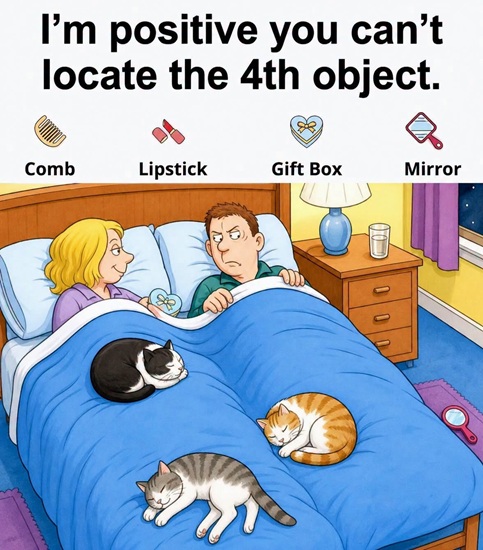
t first glance, there seems to be almost nothing unusual about the bedroom scene. A husband and wife are surrounded by three cats that have apparently made themselves completely comfortable on the bed. The wife appears relaxed, while the husband looks noticeably less patient with whatever is happening around him. Everything seems familiar enough to understand within a second or two. There is a bed, furniture, fabric, people and pets. Yet somewhere inside that ordinary-looking arrangement are four small hidden objects that are meant to test how carefully viewers are actually looking.
The challenge works because the hidden objects are not necessarily concealed behind something else. Instead, they are designed to blend into the visible environment. Their colors may resemble the materials surrounding them, while their shapes may echo folds, shadows or ordinary details already present in the room. This makes the puzzle very different from simply searching for an object that has been covered. The objects can technically be visible while still being extremely difficult to recognize. The difficulty comes from perception rather than complete physical concealment.
That distinction explains why someone can look directly at the right area several times without realizing the answer is there. Human vision does not process every part of a scene with equal attention. The brain quickly identifies the largest and most familiar elements before deciding which smaller details deserve additional examination. In a bedroom, the major categories are immediately obvious. People recognize the bed, the couple, the cats and the surrounding furniture almost automatically. Once those large elements are understood, smaller visual irregularities can disappear into the background.
This is one reason hidden-object puzzles can become surprisingly frustrating. The viewer may believe that careful searching should produce an immediate answer. Yet simply looking at the scene for longer does not always improve recognition. If the eyes continue following the same pattern across the picture, they may repeatedly skip the same small areas. The brain begins treating the entire image as familiar. After a while, even unusual details can start looking ordinary because they have already been mentally classified as part of the scene.

The three cats are likely among the strongest distractions in the picture. Animals naturally attract visual attention because people instinctively notice faces, eyes, paws and movement-related shapes. Even in a still image, the viewer may spend more time examining the cats than studying the background around them. Their fur also creates complex patterns of light and dark. Those patterns can make small nearby objects harder to distinguish. Anything positioned close to a paw, tail or patch of fur may be incorrectly interpreted as part of the animal.
The cats also add humor to the scene, which can make them even more distracting. While the human characters may appear involved in some kind of frustrating search, the cats seem perfectly comfortable. They look as though the bed belongs to them and everyone else is simply sharing their territory. This creates a small visual story before the viewer even begins searching for the hidden items. Humor captures attention, and attention directed toward the cats is attention temporarily taken away from the puzzle itself.
The husband’s expression creates another distraction. Human faces are among the first things most viewers notice in an image. If a person looks angry, confused, irritated or amused, the brain immediately tries to understand the emotion. That response is useful in everyday life because reading facial expressions helps people understand social situations. In a visual puzzle, however, it becomes another way of redirecting attention. The viewer may spend valuable time studying the husband’s reaction instead of the small details surrounding him.
His apparent frustration may even influence the way the viewer searches. Seeing someone who looks impatient can create the impression that the answer should be obvious. The viewer may then scan the room more quickly, expecting to find the missing objects almost immediately. Fast searching often makes camouflage more effective rather than less. Small details require slow attention. The more someone rushes, the easier it becomes for the brain to classify the hidden items as ordinary parts of the background.
The wife creates the opposite effect. She appears calm enough to suggest that nothing about the situation is particularly urgent. That contrast can make the scene feel like a small domestic comedy. The husband seems increasingly bothered, while she looks comfortable and untroubled. Viewers may even imagine that she already knows where everything is hidden. Whether or not that is actually part of the puzzle’s intended story, the difference in their expressions adds another layer of visual entertainment.
A useful first strategy is to temporarily ignore all of the main characters. Instead of focusing on the husband, wife and cats, viewers can direct their attention toward areas that initially appear unimportant. The edges of the bed are a good example. Corners, seams, narrow spaces and overlapping surfaces often receive very little attention during an initial scan. Puzzle designers can take advantage of this by placing small items exactly where the eyes are least likely to linger.
Fabric is especially useful for visual camouflage. Blankets, sheets, clothing and pillows naturally contain folds, wrinkles and changing shades of color. A small object placed near a seam can easily resemble part of the textile. A straight edge may disappear among other lines, while a curved object may look like an ordinary fold. The brain already expects fabric to contain irregular shapes. That expectation makes it easier for something unrelated to blend in.
Instead of looking at the bed as one large surface, it can help to divide the fabric into smaller visual sections. Examine one pillow at a time. Follow the edge of each blanket. Look closely where one textile overlaps another. Study places where light creates a darker fold. This slower method forces the eyes to inspect details that would otherwise be grouped together as “bedding.”
Wooden surfaces can create another effective hiding place. Wood grain naturally contains lines, knots, streaks and variations in color. A tiny brown or dark object can disappear almost completely against that background. Furniture also tends to be recognized as a single solid object rather than something people inspect line by line. Once the brain identifies “wooden table” or “bed frame,” it often stops looking for additional information within that surface.
A better strategy is to examine wooden details individually. Follow the outside edge of a piece of furniture. Look around handles, joints and corners. Compare natural grain patterns with shapes that appear slightly more regular. A hidden object may reveal itself not because its color is different, but because its outline does not quite match the natural texture around it.
The same principle applies to dark areas. Shadows are commonly treated as visually empty space. People see darkness and assume there is less information there. Puzzle designers can use that habit to hide small dark objects inside larger dark regions. The item may technically be visible, but the surrounding shadow prevents the viewer from mentally separating it from the background.
When searching shadows, outlines become more useful than color. Look for a border that seems unusually straight or smooth. A tiny curve inside a dark area may indicate something separate from the shadow itself. Moving attention from the center of the darkness toward its edges can also help. Sometimes only a small portion of the hidden object needs to become recognizable before the whole shape suddenly becomes obvious.
Areas around the cats deserve similar treatment. It is useful to stop thinking of each cat as one complete animal and instead examine the boundaries around its body. Look carefully where the fur touches the blanket. Study the space beneath or beside paws. Examine tails, ears and darker patches without assuming every small mark belongs to the animal. A hidden object positioned near a cat can take advantage of the viewer’s expectation that irregular shapes are simply part of the fur.
Overlapping objects are particularly difficult. When two surfaces touch, the brain often merges them into one visual relationship. A small object placed at that boundary can become extremely hard to notice. The edge of a blanket touching a cat, for example, already contains several colors and textures. Adding another tiny shape may not create enough contrast to attract attention. The viewer must deliberately inspect the transition rather than relying on a quick glance.
Another useful approach is to divide the entire picture into a grid. Instead of scanning randomly, begin in the upper-left corner. Move slowly across the top portion before dropping down to the next section. Continue until the whole image has been examined. This technique prevents the eyes from repeatedly returning to the most interesting parts of the scene.
Random searching often creates the illusion of thoroughness. Someone may spend several minutes looking at the image while actually examining only the same few regions. The human eye naturally jumps toward faces, contrast and recognizable shapes. A structured left-to-right or top-to-bottom search forces attention into quieter areas. It may feel slower, but it is generally more systematic.
Searching for shape rather than identity can also help. If viewers already know what the four missing objects are, they may hold a very specific mental picture of each one. That expectation can become a disadvantage if an item is rotated, partly obscured or shown from an unusual angle. The brain may reject the correct shape because it does not match the expected orientation. Looking for basic geometry avoids that problem.
A circular edge, straight line or unusual corner may reveal an object before the object itself becomes recognizable. Something rigid hidden among soft fabric can stand out because its geometry feels different. A small regular shape inside a naturally irregular texture deserves attention. Once the outline is noticed, the brain may suddenly identify the full item.
Size expectations can also cause problems. People often imagine hidden objects as being larger than they really are. If the puzzle describes four objects without clearly emphasizing their scale, viewers may search for items large enough to recognize instantly. The actual details could be far smaller. Adjusting expectations about size can therefore make the search easier.
Zooming can help, but it can also create new problems. When an image is enlarged too much, viewers may lose the relationship between the object and the surrounding scene. A shape that becomes clearer may still be difficult to identify because its context has disappeared. It is useful to alternate between a close view and the full picture. Each scale reveals different information.
A wide view helps identify unusual color relationships and areas of visual imbalance. A close view reveals edges, textures and small shapes. Moving between the two can break the brain’s established interpretation of the scene. Something invisible at one scale may suddenly become obvious at another. This is one reason digital visual puzzles can sometimes be easier than printed versions.
Taking a break can be surprisingly effective as well. After staring at one image for too long, the brain becomes increasingly confident that everything it sees belongs where it is. Familiarity makes camouflage stronger. Looking away for even a minute can interrupt that process. When the viewer returns, the scene feels slightly new again.
The first few seconds after returning may be particularly useful. Attention has not yet settled into the old scanning pattern. An object ignored dozens of times can suddenly appear obvious. This phenomenon explains why some people find the final answer immediately after giving up temporarily. The puzzle did not change; their perception did.
Finding the first hidden object often creates a burst of confidence. Suddenly, the viewer understands one of the camouflage techniques and may believe the rest will follow quickly. Sometimes that happens. More often, however, the remaining objects use different forms of disguise. The strategy that worked once may not work again.
For example, the first object might blend through color. The second may be difficult because of shape. The third might sit beside a visually dominant subject such as a cat or human hand. The fourth may simply occupy a place almost nobody thinks to inspect. Different tricks prevent the puzzle from becoming repetitive.
This variety is usually what makes the final hidden item especially difficult. Once three objects have been found, the viewer becomes convinced that the same search methods should reveal the fourth. Repeated scans produce nothing. Confidence slowly turns into frustration. Eventually, some people begin wondering whether the fourth object actually exists.
That moment is one of the reasons these puzzles become so addictive. The viewer has already invested enough time to feel close to completion. Giving up with only one item left feels unsatisfying. Every additional minute increases the desire to finish. The challenge becomes psychological as much as visual.
The brain’s natural filtering system is largely responsible. Human vision receives an enormous amount of information every second. Processing every detail equally would be inefficient. Instead, the brain prioritizes what seems important and simplifies the rest. This is extremely useful in everyday life.
A person walking into a bedroom does not need to consciously analyze every thread in the blanket or every line in the wood grain. They need to know where the bed is, who is present and whether anything requires immediate attention. Hidden-object puzzles deliberately make the unimportant details important. The brain must temporarily abandon its normal shortcut.
Familiar environments strengthen this effect. Bedrooms contain objects people have seen thousands of times. Nothing seems to require careful inspection. The brain can categorize the room almost instantly. That makes it easier for an unusual detail to be classified incorrectly.
A strange or unfamiliar environment might actually encourage closer attention. When people do not immediately understand what they are seeing, they inspect more carefully. Familiarity produces confidence, and confidence can reduce observation. A bedroom therefore creates excellent conditions for hiding tiny visual surprises.
The puzzle becomes particularly effective when nothing looks obviously wrong. A brightly colored object sitting alone on a white surface would be found immediately. The hidden items must feel visually compatible with the room. Their colors, orientation and position should make them seem like natural parts of the environment.
When camouflage works well, the eyes genuinely see the hidden object while the brain assigns it the wrong identity. It becomes “part of the blanket,” “part of the wood,” “part of the cat” or simply “shadow.” The object does not become visible when found. It was always visible. What changes is the interpretation.
That moment of reinterpretation produces the satisfying reaction familiar to anyone who enjoys visual puzzles. One second, nothing is there. The next, the object seems impossible to miss. After recognition, the brain can no longer return easily to its earlier interpretation. The answer becomes permanent.
This often leads to the classic question: “How did I not see that?” The viewer may have looked directly at the same spot five or ten times. Vision was never the problem. Recognition was. The experience offers a small demonstration of how strongly expectations influence perception.
People often assume eyesight functions like a camera, recording everything accurately before the brain examines it. In reality, perception is far more selective and interpretive. The brain continuously decides what visual information means. Hidden-object puzzles turn that normal process into entertainment.
The cats remain excellent examples of how attention can be manipulated. Their faces naturally attract the viewer. Their paws and tails create complicated outlines. Fur introduces colors and textures that can hide other shapes. Even people who are not particularly interested in cats may still look at the animals before examining the furniture.
The humans function similarly. Faces are almost impossible to ignore. The emotional contrast between the frustrated husband and calm wife provides a narrative that competes directly with the search task. Viewers want to understand why the characters look the way they do. That curiosity makes the puzzle more entertaining while simultaneously making it harder.
The room itself therefore works like a collection of distractions layered over a much smaller challenge. The eye is given dozens of places it would rather look than the exact places containing the answers. This is clever because the puzzle does not have to hide an object completely. It only needs to make something else more interesting.
A useful advanced technique is to identify which areas feel the least interesting. Ask which part of the image you have barely examined. Perhaps it is a narrow section behind a pillow. Perhaps it is a small wooden edge. Maybe it is the area directly beneath an animal. Those neglected places are often worth checking first.
Another strategy is to reverse the normal scanning direction. If you naturally look from left to right, try right to left. If you normally start with the top half, begin at the bottom. Changing direction disrupts habitual eye movements. The same scene can suddenly feel less familiar.
Turning the image slightly can sometimes help as well if the viewing platform allows it. Rotation makes familiar objects temporarily harder to recognize. That sounds counterproductive, but it can reduce the brain’s tendency to label the background automatically. Hidden geometric shapes may become more noticeable when the normal scene loses some of its meaning.
Another approach is to temporarily ignore color. Concentrate only on edges and boundaries. Follow every place where one shape meets another. This can expose objects whose color has been perfectly matched to their surroundings. Camouflage based on color becomes weaker when the viewer focuses on geometry.
The reverse strategy can also work. Ignore shape and look for subtle color differences. A hidden object may follow the outline of a nearby feature while having a slightly different tone. Small variations can become more noticeable when the viewer deliberately stops asking what each shape represents. Pure visual comparison can sometimes succeed where object recognition fails.
Lighting plays an important role too. Bright regions naturally attract attention, while darker areas receive less. A puzzle designer can therefore place a hidden detail near a strong highlight and rely on contrast elsewhere to draw the eye away. Looking immediately beside the brightest parts of the scene may reveal areas previously ignored.
The same is true of visual centers. Most viewers initially look near the middle of an image. Hidden objects placed closer to edges may receive much less attention. Corners and margins should therefore never be skipped. The area near the border of the picture can be surprisingly productive.
It is also worth checking spaces between larger objects. The brain often treats narrow gaps as empty background rather than meaningful areas. A small item can fit into such a space without attracting attention. Look between pillows, beside furniture and around overlapping bodies. Negative space can hide information just as effectively as a patterned surface.
Do not assume that every hidden object is shown in a familiar orientation. Something normally vertical may be lying sideways. A recognizable top may be partially hidden while the less familiar bottom is visible. Rotation can transform even a common household object into a confusing shape. Searching by category alone may therefore fail.
Partial visibility creates another difficulty. A puzzle may reveal only enough of an object for it to be technically identifiable. The rest can merge into another shape or sit behind a larger element. Viewers searching for a complete outline may overlook it entirely. Look for fragments that appear slightly unnatural.
The final object often exploits exactly this expectation. After finding several complete-looking items, viewers assume the last should be equally recognizable. Instead, it may reveal only a small portion. Once that portion is correctly interpreted, the rest becomes mentally reconstructed.
Patience is therefore more useful than speed. These challenges are not tests of how fast someone can move their eyes. They are tests of whether someone can interrupt normal visual habits. Slow observation gives the brain time to reconsider its first interpretation.
There is no need to feel frustrated if the answer does not appear immediately. Difficulty is the entire point of the puzzle. If all four objects could be found during the first glance, the image would provide very little entertainment. Effective camouflage should make viewers question themselves.
The best puzzles usually create several stages of confidence. At first, the viewer believes the task will be easy. Then the first search fails. One object is eventually discovered, restoring confidence. Another remains impossible, bringing frustration back.
This cycle keeps people engaged. Each discovery proves the puzzle is solvable. Each missing item suggests there is still something the eyes have not understood. The reward comes from changing perception rather than learning new information.
Visual puzzles also work well socially. Two people looking at the same picture may notice completely different objects first. One person’s brain may be especially sensitive to geometric shapes, while another notices color variations more quickly. Comparing discoveries can reveal how differently people process the same image.
Someone may find three objects immediately and miss the easiest one. Another person may see the supposedly difficult item first. This does not necessarily say much about overall intelligence or eyesight. It mostly reflects differences in attention, expectation and scanning habits.
For that reason, the puzzle should be treated as entertainment rather than a serious diagnostic test. Finding hidden objects quickly does not prove superior vision, and struggling does not indicate a medical problem. These images are deliberately constructed to exploit ordinary features of perception. Difficulty is expected.
The bedroom scene adds charm because it tells a story while presenting the challenge. Without the people and cats, the image could simply be a collection of objects. The characters create humor and personality. Viewers are not merely searching a room; they are observing a small domestic moment.
The husband’s apparent impatience may even mirror the viewer’s experience. At first, his frustration is amusing. After several minutes searching for the final object, it may become surprisingly relatable. The viewer begins to understand his expression.
The wife remains the calm counterpoint. Whether intentionally or not, she seems to represent the person who has already solved the puzzle. Her relaxed appearance can make viewers feel as though the answer should be easy. That subtle psychological pressure adds another layer of entertainment.
And the cats remain entirely unaffected. They have no interest in whether humans find four hidden objects. Their only concern appears to be staying comfortable on the bed. That indifference provides perhaps the funniest part of the scene.
Before giving up, one final systematic scan is worth attempting. Begin at one corner and move slowly. Do not allow the eyes to jump back toward faces. Follow every visible boundary. Inspect fabric, furniture, fur and shadow separately.
When reaching the cats, look at the spaces immediately around them rather than only at their bodies. When examining fabric, look for straight edges or regular shapes that do not belong. When checking wood, search for outlines that interrupt the natural grain. In shadows, focus on borders rather than darkness.
Then change scale. Look at the entire picture for a few seconds. Zoom closer again. Sometimes the last object becomes noticeable only after switching perspectives.
If nothing appears, take a short break. Allow the image to leave your immediate visual memory. Return without trying to remember where you already searched. Treat the room as though you are seeing it for the first time.
That fresh look may be all that is necessary.
Once all four objects have finally been identified, the puzzle changes completely. The bedroom no longer looks mysterious. The hidden items suddenly seem obvious, and it becomes difficult to understand why they were so challenging moments earlier.
That transformation is the real appeal of the exercise.
The room never changed.
The cats never moved.
The husband and wife remained exactly where they were.
The hidden objects were visible from the beginning.
Only the viewer’s perception changed.
And that is what makes a well-designed visual puzzle so satisfying.
It takes a completely ordinary scene and demonstrates how easily the human brain can overlook information that is sitting directly in front of it.
So before deciding that the fourth object is missing, give the bedroom one more careful look.
Ignore the obvious characters.
Study the quiet spaces.
Examine every unusual edge.
Question every shape that seems just slightly out of place.
Somewhere in the scene, four tiny objects are waiting to be recognized.
The difficult part is not making them appear.
They are already there.
The challenge is convincing your brain to finally notice them.
