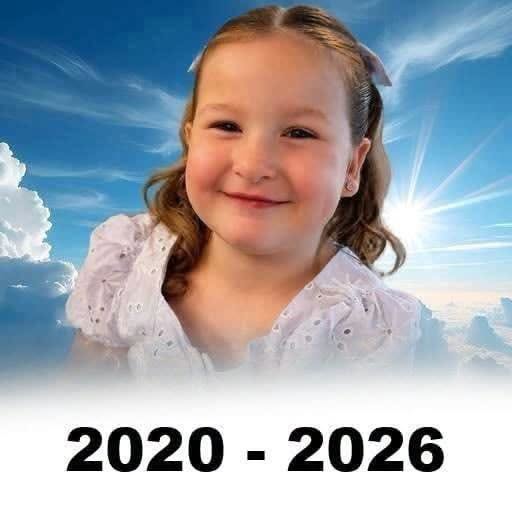
Emersyn Paisleigh Bridgers, affectionately known as Emmy, was only six years old when her life ended unexpectedly on July 27, 2026. She had recently completed kindergarten at Euharlee Elementary School in Georgia and was preparing for the milestone of entering first grade. Rather than thinking about hospitals, investigations or medical records, the child had been focused on the ordinary excitement surrounding a new school year. She expected to return to a familiar school environment and continue learning alongside classmates she already knew.
Bartow County Schools later remembered her as a particularly caring and outgoing student. Her sudden death left family members, teachers and classmates confronting a loss that had arrived with little warning. Only weeks before her death, Emmy had celebrated graduating from kindergarten. For a six-year-old, moving from kindergarten into first grade represented an important new beginning. The school district said she was excited about continuing with Mrs. Rose and many of the classmates she had come to know during the previous school year. She had even selected a rose-themed outfit to wear to the upcoming school Open House.
That small childhood decision later became one of the most poignant details shared by the school. It represented plans that seemed completely ordinary until circumstances changed without warning. According to reporting based on information from her family and local authorities, Emmy had been scheduled for a tonsillectomy on July 27. A tonsillectomy is a procedure in which the tonsils are surgically removed, but in Emmy’s case the planned operation ultimately did not take place.
Bartow County Coroner Joel Guyton told WSB-TV that investigators were waiting for medical records to determine what treatment she received before her death. That distinction is essential when discussing the case accurately. Describing her death as the result of the tonsillectomy would imply that surgery occurred, something the coroner specifically said had not happened. Some early accounts and fundraising descriptions linked Emmy’s death to complications surrounding what the family understood would be a routine tonsil procedure.
Those accounts helped explain why the case was initially discussed in connection with surgery. However, news reports later emphasized that the scheduled procedure itself was not performed. That means the precise medical sequence cannot responsibly be reconstructed from assumptions alone. The unanswered questions concern what happened before the planned operation, what treatment was provided and what ultimately caused her death. Those questions require medical evidence rather than speculation.
The Georgia Bureau of Investigation became involved through the autopsy process. WSB-TV reported that the GBI was conducting an autopsy while the Bartow County Coroner’s Office sought Emmy’s medical documentation. At that stage, authorities had not publicly announced a definitive cause of death. An autopsy can help investigators understand medical findings, but its interpretation may also depend on toxicology, medical history and records concerning treatment before death. Until authorities release conclusions, assigning a specific cause would go beyond what was publicly established. That uncertainty should remain clear in any responsible account of Emmy’s story.
Her death came immediately before what should have been a very different period for the family. The beginning of first grade normally brings school supplies, new routines, photographs and anticipation about the months ahead. Emmy had already been thinking about those experiences. Her rose-themed outfit demonstrated just how specific those plans had become. She knew where she expected to be and who she expected to see. Instead, her school community began the new academic year remembering a student who was no longer able to return.
The Bartow County School System’s remembrance focused heavily on Emmy’s personality rather than the circumstances of her death. Her teacher, Mrs. Rose, affectionately called her “Little Momma.” The nickname reflected the way Emmy looked after classmates and tried to help people around her. School officials said she had a talent for making other children feel included. They also described her as willing to lend a helping hand whenever someone needed one. Those characteristics had already made the young student memorable within her classroom.
The district also remembered Emmy as unusually social and affectionate. Its tribute said she readily formed friendships and was known for greeting others warmly. Her smile and enthusiasm were among the qualities school staff highlighted after her death. For adults who knew her primarily through school, these ordinary interactions became central memories. The tribute was not about academic achievements or awards alone. It concentrated instead on the way Emmy treated other people during the short time she had with them.
There was evidence of that reputation even before the tragedy. Euharlee Elementary School had previously recognized Emersyn among kindergarten students selected as Wildcats of the Month for modeling kindness toward others. That earlier recognition adds independent context to the later descriptions of her caring personality. It shows that kindness was not simply language added to a memorial after her death. The school had already publicly acknowledged her positive behavior while she was a student. For a child so young, that recognition had special meaning.
Her older sister Jordan Thompson was also part of Emmy’s family life. An earlier obituary for Emmy’s father identifies Jordan and Emersyn as sisters. Later accounts describing Jordan’s reaction to Emmy’s death portrayed their relationship as exceptionally close. Jordan remembered Emmy not primarily through the investigation surrounding her final day but through the years they spent together as sisters. She described a child whose happiness, laughter and affection had shaped family life. The personal memories provide another perspective on a story that otherwise risks becoming dominated by medical questions.
Jordan’s reflections emphasized how much time the sisters had shared. According to published accounts of her remembrance, Emmy wanted to imitate her older sister and frequently accompanied her. Jordan also said she had been given the privilege of helping choose Emmy’s full name. Those are deeply personal details that reveal the relationship behind the public headlines. To Jordan, Emersyn Paisleigh Bridgers was not simply the six-year-old whose death prompted an autopsy. She was the younger sister who had been part of everyday family routines for her entire life.
Official records also provide several basic facts about Emmy’s life. Her obituary identifies her full name as Emersyn Paisleigh “Emmy” Bridgers and says she was born on April 1, 2020, in Marietta, Georgia. She was six when she died on July 27, 2026. The obituary describes her as a student at Euharlee Elementary School and emphasizes the warmth of her personality. These details place the tragedy within a very short life that nevertheless had already created meaningful relationships. Emmy had only recently reached the age when children begin forming lasting memories of school and friendships.
One public detail requires especially careful wording because sources are not entirely consistent about circumstances immediately surrounding her death. Local reporting confirms that she had been scheduled for surgery that did not ultimately occur, and that the coroner was seeking medical records concerning treatment she received. A funeral-home obituary states that Emmy died on July 27 and lists her place of death as her residence. Because of that discrepancy, it would be irresponsible to assert a precise hospital death timeline unless authorities provide a definitive account. The safer factual statement is that she died on July 27 after having been scheduled for the procedure earlier in the circumstances under review.
This difference illustrates why accuracy is particularly important when reporting sudden deaths. An early description can easily become repeated until it is treated as established fact. If the original assumption is incomplete, repetition can unintentionally create misinformation. Emmy’s case attracted attention partly because her family believed they were dealing with a routine medical situation. But that does not allow outsiders to determine the medical cause. Only the evidence collected through records, forensic examination and official review can do that.
A tonsillectomy being scheduled does not prove that the planned surgery caused what followed. The coroner’s statement that the procedure was not carried out makes that point especially important. There may have been treatment or events before surgery, but the complete medical sequence had not initially been released publicly. Without those records, it would be inappropriate to identify a particular medication, reaction or medical error as the cause. None should be invented simply to make the story seem complete.
The role of the autopsy is therefore important but should not be overstated. An autopsy is a medical examination intended to help determine why and how someone died. It can reveal anatomical findings and other evidence that may not have been apparent beforehand. Investigators can compare those findings with medical records and information surrounding the person’s final hours. However, the existence of an autopsy does not itself indicate wrongdoing. In an unexpected death, it can simply be part of the process of obtaining reliable answers.
The family’s desire for clarity is understandable regardless of what the investigation ultimately determines. When someone enters a medical setting expecting an ordinary procedure and the day ends very differently, relatives naturally want a complete explanation. That need should not be confused with a conclusion about fault. A family can ask difficult questions without those questions themselves proving negligence. Investigators likewise can review a death thoroughly without their involvement establishing criminal or medical misconduct.
The most responsible coverage therefore leaves room for the evidence to determine what happened. It does not declare a complication from surgery when authorities say the surgery did not occur. It does not identify an unnamed medication or treatment as responsible. It does not accuse a hospital, physician, nurse or other professional without findings supporting such an accusation. It simply reports that Emmy’s death was unexpected, that medical records were being reviewed and that an autopsy was being conducted.
At the same time, Emmy’s life should not disappear beneath the investigation. The school district’s tribute provides an important counterbalance to the medical questions. Emmy had just completed an entire kindergarten year filled with ordinary childhood experiences. She had classmates she cared about and adults who knew her personality well enough to give her an affectionate nickname. She had plans for the next school year. She had clothing chosen for an event she expected to attend.
The rose-themed outfit became particularly symbolic after her death because it had been connected to Mrs. Rose. The district said Emmy was looking forward to continuing her education with the teacher and familiar classmates. Choosing clothing associated with her teacher reflected the affection she apparently felt toward the classroom environment. Before the tragedy, it was simply a sweet preparation for Open House. Afterward, it became a reminder of an event she would never attend. That transformation gives an ordinary childhood detail extraordinary emotional weight.
A first-grade classroom was also preparing to begin without someone who had expected to occupy one of its seats. For young classmates, understanding such a loss can be especially difficult. Six-year-olds may comprehend absence without fully understanding the permanence or circumstances of death. Teachers and families often have to explain grief using language suited to each child. The school system’s public remembrance focused on Emmy’s kindness and the positive memories she created rather than complicated medical questions. That emphasis kept attention on the child her classmates actually knew.
Calling Emmy “Little Momma” captured one of the clearest images of her personality. According to the district, Mrs. Rose used the nickname because Emmy naturally looked after other children. She tried to include people rather than leaving them on the outside. She noticed when classmates needed help and was willing to offer it. Those may appear to be small behaviors, but they are significant qualities in a kindergarten classroom. They explain why her absence was noticed so strongly by the adults who taught her.
Her previous recognition as a Wildcat of the Month reinforces that picture. Euharlee Elementary’s earlier post listed Emmy among kindergarten students recognized for modeling kindness. The recognition occurred while school life was continuing normally, before her death transformed public attention around her name. It therefore provides a valuable contemporaneous record of how the school viewed her. Her reputation for kindness was part of her everyday life rather than something constructed only afterward.
The school’s language also indicated that Emmy moved comfortably among other people. Staff described a child who made friends easily and approached others openly. At six, social confidence can look as simple as offering a hug, joining another child’s activity or helping someone who is struggling. These interactions are rarely recorded in official documents. Yet after a young person’s death, they often become among the memories families and teachers value most. Emmy’s school tribute preserved exactly those kinds of details.
Outside the school, support for the family emerged quickly. A fundraiser was established, while local reporting said Alvis Miller & Sons Funeral Home offered to handle Emmy’s funeral arrangements without charging the family. Practical assistance can become significant during a sudden bereavement because relatives may be facing logistical responsibilities while still trying to understand what happened. Financial support cannot answer medical questions or lessen the reality of the loss. It can, however, reduce some immediate practical pressure.
The funeral home’s involvement also connected with the formal remembrance of Emmy’s life. Its obituary recorded her name, age, birthplace, school and family connections. Such records provide a different kind of documentation from news reporting. News reports concentrate on the unusual circumstances surrounding the death. An obituary is centered more directly on the person who lived. Both forms of information are valuable, but they answer different questions.
For Emmy’s relatives, no official finding can fully describe what was lost. An autopsy may ultimately explain a biological cause of death. Medical records may establish a sequence of events. Authorities may clarify what treatment occurred before the scheduled operation was canceled or did not proceed. Those findings are important for understanding the final day. They cannot explain what it meant to have Emmy as a daughter, sister, classmate or friend.
This distinction matters in reporting on the death of a child. It is easy for an investigation to become the entire story because unanswered questions naturally attract attention. But the final hours of a person’s life are only one part of that person’s identity. Emmy had six years of relationships and experiences before July 27. The people closest to her remember those years rather than only the circumstances being examined by authorities.
Her kindergarten graduation is one such memory. Graduations at that age are modest events, but children often experience them with enormous pride. They mark the completion of a first significant chapter of formal schooling. Family photographs, certificates and celebrations can become treasured records of the occasion. For Emmy’s relatives, those recent memories took on an entirely different significance only weeks later. The child pictured preparing for the future suddenly became someone they had to remember.
The timing also intensified the grief experienced by the school. The academic calendar was moving forward even though Emmy could not. Teachers still had classrooms to prepare and other students to welcome. Families were still buying school supplies and planning for Open House. Ordinary preparations continued around a community coping with an extraordinary absence. The contrast between those two realities was reflected directly in the school district’s tribute.
For the public, Emmy’s story also demonstrates why terminology matters when reporting medical events. Saying that someone died “after going in for” an operation is not the same as saying that someone died “from” the operation. The first describes chronology. The second assigns causation. In Emmy’s case, authorities specifically reported that the planned surgery did not occur, making the distinction particularly important.
Similarly, describing a procedure as routine does not tell us what happened in an individual case. Families may reasonably use the word because a procedure is commonly performed. That description should not be converted into an assumption about either safety or fault in one patient’s circumstances. Individual medical events can involve many factors that are invisible to outside observers. Only an appropriate review of the specific evidence can establish what happened.
No responsible account should use Emmy’s death to make broad claims about tonsillectomies in general. Her case was an individual tragedy whose precise cause was under investigation in the reporting available publicly. Drawing universal conclusions from an unresolved case would go beyond the evidence. The appropriate focus is the confirmed sequence and the unanswered questions specific to Emmy. Broader medical conclusions require broader medical evidence.
The same restraint applies when discussing the people involved in her care. There was no publicly established basis in the reporting reviewed here for accusing an individual medical professional of wrongdoing. The presence of an investigation should not be treated as evidence of guilt. Investigations exist precisely because authorities need to determine facts before conclusions are reached. Preserving that principle protects both accuracy and fairness.
At the same time, waiting for evidence does not minimize the family’s loss. Uncertainty can itself be deeply painful. Relatives may replay the day repeatedly, trying to understand where circumstances changed. Medical language can feel inadequate when the person at the center of the questions was a six-year-old child. That is why transparency and careful documentation matter so much in unexpected deaths. Clear answers, when available, can at least establish what occurred.
Until those answers are available, the strongest facts surrounding Emmy are the simplest ones. She was six years old. She attended Euharlee Elementary School. She had finished kindergarten and expected to begin first grade. She had already selected a rose-themed outfit for Open House. She died suddenly on July 27, 2026.
Authorities also confirmed important limits on what could be said about that final day. A tonsil procedure had been scheduled but was not ultimately performed. The Bartow County Coroner’s Office was seeking medical records to understand what treatment Emmy received before her death. The GBI was conducting an autopsy. Those facts provide the framework for the investigation without pretending that its eventual conclusion was already known.
Everything beyond those confirmed details requires caution. A social-media post, fundraiser or early headline can contain incomplete information, especially during the first days after an unexpected death. That does not mean the people sharing those accounts intend to mislead anyone. They may simply be working with the information available to them at the time. Responsible later reporting should update the wording as official information becomes available.
This is especially important because several headlines initially described Emmy’s death in connection with surgical complications. Some reports correctly qualified those statements as information originating from a fundraiser or the family rather than an official medical finding. Later local reporting provided the crucial clarification that the scheduled surgery had not actually occurred. When two descriptions appear to conflict, the official statement should be clearly distinguished from the earlier account.
The eventual cause of death should therefore come from official findings rather than a reconstruction assembled from headlines. If investigators release additional conclusions, those findings can be reported at that time. Until then, phrases such as “died from a tonsillectomy” should be avoided. Accuracy is particularly important because such wording could wrongly imply negligence or a specific medical mechanism. Emmy’s family deserves answers based on evidence rather than speculation.
Her remembrance does not need speculation to be powerful. The verified details already tell a deeply affecting story. A child had finished kindergarten. She was excited about her next teacher and classmates. She had picked out clothing for an upcoming school event. Adults at her school knew her as someone who cared for other children.
A previous school recognition shows that kindness had become part of Emmy’s reputation while she was alive. That is a meaningful detail because it shifts attention away from the circumstances of her death and toward the choices she made in daily life. Children communicate character through simple actions rather than formal statements. They share, help, include and comfort. Emmy’s teachers apparently noticed those behaviors often enough to recognize them publicly.
The nickname “Little Momma” captured that same instinct in a way people around her could understand. It suggested someone who naturally watched over others despite being only six herself. A child does not need decades of life to leave recognizable qualities behind. Sometimes personality is apparent very early. Emmy’s school remembrance suggests that hers certainly was.
Her smile was another detail repeatedly highlighted by the school. Such descriptions can sound simple until a person is gone. Then ordinary characteristics become particularly vivid memories. The way someone laughed, greeted a classmate or entered a classroom can suddenly matter enormously. These are things an investigative report cannot preserve. Families, teachers and friends do.
Jordan’s memories similarly preserve the role Emmy played at home. Published accounts describe her speaking of Emmy as a beloved younger sister who wanted to follow her example. Their relationship existed far beyond the public circumstances of July 27. Sisters share rides, conversations, routines, disagreements and private jokes that outsiders never see. Those experiences are the real substance of family memory.
The family had already experienced loss before Emmy’s death. Public obituary records show that her father, Carlie “CJ” Milford Bridgers III, died in August 2020, when Emmy was still an infant. His obituary identifies Emersyn and Jordan among his children. That background is relevant to understanding the family structure but should not be used to sensationalize Emmy’s death. It simply confirms another piece of the family’s documented history.
For the people at Euharlee Elementary, Emmy will likely remain connected with a particular period of school life. Kindergarten classmates may remember her through games and classroom routines. Teachers may remember her willingness to help. Staff may remember the child whose personality led to an affectionate nickname. The school district’s public tribute ensured that those memories became part of the record rather than allowing the circumstances of her death to define everything.
The rose-themed outfit similarly represents more than clothing. Before July 27, it was part of a child’s excitement about returning to school. After her death, it represented a future that never arrived. This is why apparently minor details are often so powerful in stories of sudden loss. They show how normal life appeared immediately beforehand.
There is also a lesson here about respecting grieving families while public interest grows around an unexplained event. People may understandably want to know what happened. That curiosity should not turn into unsupported accusations or theories. The family can seek answers while outsiders remain cautious. Empathy and evidentiary restraint can exist together.
For media outlets and social-media users, that means attribution is essential. A family statement should be described as a family statement. A fundraiser’s account should be identified as coming from the fundraiser. A coroner’s statement should be identified as an official statement. An unresolved question should remain described as unresolved. Doing so prevents different levels of information from being mixed together as though all were equally confirmed.
That careful approach also reduces the risk of misleading readers about medical care. When a child dies unexpectedly around the time of a scheduled procedure, fear can spread quickly. People may begin drawing conclusions about the procedure itself before investigators understand the individual case. Emmy’s story should not be used to frighten families facing unrelated medical decisions. The evidence available does not support such a generalized conclusion.
Nor should the absence of immediate answers be interpreted as evidence of concealment. Medical and forensic reviews can require records, laboratory testing and expert interpretation. The fact that authorities were waiting for information indicates that the process was incomplete at the time of the reports. The responsible response to incomplete evidence is patience in drawing conclusions, not certainty unsupported by facts.
For Emmy’s loved ones, however, the passage of investigative time exists alongside immediate grief. Officials can wait for records because accuracy requires it. Families still wake up each day without the person they lost. These are different experiences of the same event. One depends on careful procedure, while the other is intensely personal.
Community support cannot resolve those medical questions. It can still matter in practical ways. Expressions of sympathy, assistance with funeral arrangements and respectful remembrance can reduce some of the burden surrounding a sudden death. Local reporting confirmed that the funeral home handling Emmy’s arrangements offered its services to the family without charge. That gesture became one concrete form of support during an extraordinarily difficult period.
The school system’s response represented another form of support. Rather than speculating about the investigation, it concentrated on the student its employees and children knew. The district remembered her kindness, friendships and enthusiasm about beginning first grade. It acknowledged the painful reality of starting the school year with her seat empty. That was a remembrance grounded in the school’s own experience of Emmy.
This distinction is useful when considering how Emmy’s story should continue to be told. Medical conclusions belong to the officials and professionals reviewing the evidence. Memories belong to the people who knew her. Journalism can accurately report both without confusing the two. The investigation asks how she died; remembrance asks who she was.
Who she was, according to the school, was a young girl who cared about classmates and made people feel included. She was preparing to grow into a first grader. She had a teacher she apparently adored enough to choose an outfit connected with her name. She had family members who saw far more of her personality than any public account could capture. She had already left impressions that adults around her considered worth sharing publicly.
The medical investigation may ultimately add an important final chapter to the public record. It may clarify what happened after Emmy arrived for the planned procedure, why the operation did not take place and what caused her death. Until those conclusions are publicly confirmed, they should not be guessed. A careful account can acknowledge unanswered questions without pretending to solve them.
Emmy’s story is therefore both unfinished and complete in different ways. The investigation was unfinished because important medical answers remained outstanding in the publicly available reporting. Her impact on the people who knew her, however, was already clear. Teachers remembered compassion. Classmates had experienced her friendship. Her family remembered a child they loved.
A cause-of-death finding, whenever officially established, may provide the factual explanation relatives and the public have sought. It will not replace the memories that preceded the final day. No medical terminology can describe a kindergarten graduation, a contagious laugh or a carefully selected outfit for first grade. Those details belong to a different part of Emmy’s story.
For that reason, the fairest way to remember Emersyn “Emmy” Bridgers is not to reduce her life to an unresolved medical event. She was a six-year-old student with plans for school and relationships that mattered deeply to the people around her. Her death appropriately raised questions that authorities were working to answer. But those questions should be pursued without turning speculation into fact.
What can confidently be said is that Emmy died on July 27, 2026, shortly before she was expected to begin first grade. A planned tonsillectomy had not been carried out, according to the Bartow County Coroner’s Office. Medical records were being sought and a GBI autopsy was underway as officials worked to understand the circumstances. Meanwhile, her school remembered a child whose kindness had already earned her both affection and recognition.
The unanswered medical questions deserve accurate answers rather than theories. The family’s grief deserves privacy and respect rather than sensationalism. The professionals involved deserve not to be assigned responsibility without evidence. And Emmy deserves to be remembered as more than the final day of her life.
Her short life contained kindergarten classrooms, friendships, family relationships and the ordinary anticipation of becoming a first grader. The rose-themed outfit waiting for Open House became a painful reminder of everything that was expected to come next. Yet the memories shared by her school show that Emmy had already contributed something meaningful during the six years she was here. She made other children feel included, offered help and brought warmth to the people around her.
Those qualities provide a more lasting picture than any headline about her death. Investigations are designed to establish facts, and those facts matter greatly. But the person at the center of the investigation should never disappear beneath the process. For Emmy’s family and school community, she remains the little girl they knew long before anyone outside that circle learned her name.
Until additional official findings are released, restraint remains the most accurate approach. There should be no assumption that the tonsillectomy caused her death because authorities said it was not performed. There should be no unsupported claim about a medication, medical complication or individual mistake. There should only be a clear acknowledgment that a six-year-old died unexpectedly and that officials were working to determine why.
Emersyn Bridgers had been preparing for an ordinary next chapter: first grade, familiar classmates and another year with Mrs. Rose. Instead, those plans became memories before the school year began. Her story now carries two responsibilities for anyone telling it publicly. The first is to preserve the truth by distinguishing confirmed facts from unanswered questions. The second is to remember the child herself—the kind, affectionate “Little Momma” whose teachers said had an unusual ability to care for others.
Whatever the official medical findings ultimately establish, they will describe only one part of her story. Emmy’s family will remember a daughter and sister. Her teachers will remember a student who helped classmates. Her school will remember the little girl excited about first grade and the rose-themed outfit she never had the chance to wear to Open House.
That is why the most responsible account ends where the verified evidence ends. Emersyn “Emmy” Bridgers died at six years old on July 27, 2026. She had been scheduled for a medical procedure that authorities said did not take place. An autopsy and review of medical records were part of the effort to understand what happened. Until an official conclusion establishes more, anything beyond those facts should remain clearly identified as uncertain.
And beyond that investigation stands the part of the story about which those who knew her were already certain. Emmy was deeply loved. She was remembered for kindness, an easy ability to make friends and a desire to look after other children. She had only six years, but the people around her had already found reasons to remember her. That is the legacy reflected most clearly in the words of her school and family.
