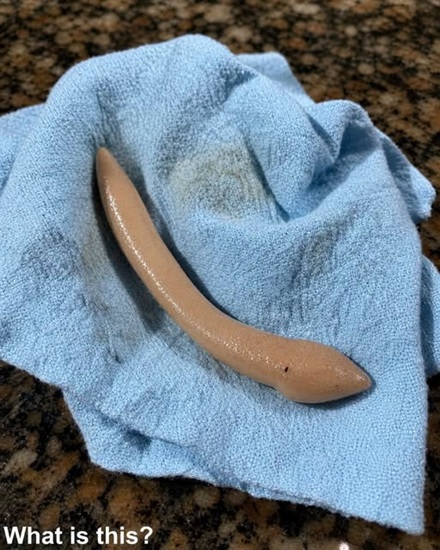
An ordinary visit to a bathroom can become surprisingly memorable when something completely unexpected appears on the floor. In this case, what initially looked like a small piece of debris turned out to have characteristics suggesting that it was a living creature. The dark object was soft-looking, flexible and difficult to identify at first glance. It did not immediately resemble the insects or other small animals commonly noticed inside homes. That uncertainty transformed an otherwise routine moment into a strange household mystery.
What followed was an attempt to determine what the creature was and, just as importantly, how it might have ended up inside. At first, there was little reason to believe the object was alive at all. Its dark color and irregular shape made it easy to mistake for a piece of rubber, dirt or material that had broken away from something nearby. Bathrooms contain countless small objects that can end up on the floor, from pieces of packaging to fragments of seals and other household materials. Seeing something unfamiliar therefore does not automatically suggest an animal.
Only a closer look made the original explanation seem less convincing. The possibility that it was alive suddenly became much harder to dismiss. That realization immediately changed the way the room felt. A bathroom that had seemed completely familiar only moments earlier suddenly contained something unexplained. The floor, fixtures, towels and damp corners all became part of the mystery. The object itself was small, but the questions surrounding it were much larger. Had it been there for minutes or hours? Had anyone else walked past without noticing it? There was no obvious answer.
The creature’s appearance made identification particularly difficult. It did not have obvious legs, wings or a hard shell that would make it easy to classify as a familiar household insect. Instead, its body appeared flexible and somewhat rubbery. That unusual form made several ordinary explanations seem possible before an animal was seriously considered. Something that does not fit a familiar category can seem more unsettling precisely because the brain cannot identify it immediately. Uncertainty often creates more discomfort than recognition.
Once there was reason to think the object might be alive, attention naturally shifted toward the rest of the bathroom. Areas that had previously received little consideration were suddenly examined more carefully. The space around fixtures seemed worth checking. Corners and gaps near the floor attracted attention. Damp areas appeared more significant than they had minutes earlier. Even familiar plumbing suddenly became part of the list of possible explanations.
It is important, however, not to convert those possibilities into facts. Simply finding a creature on a bathroom floor does not prove that it came through a drain or traveled through the plumbing. Without directly observing its route into the room, the exact point of entry remains unknown. It might have reached the bathroom in a number of ways, including being carried indoors accidentally. The available information does not establish which explanation is correct. Any specific route should therefore remain a possibility rather than a conclusion.
That distinction matters because stories about unusual animals found indoors can quickly become exaggerated. Once a creature is discovered near a sink, shower or drain, it can be tempting to assume that the plumbing must be responsible. Yet proximity alone does not demonstrate how an animal arrived. A bathroom contains water and damp surfaces, but it is also a room visited regularly by people who may unknowingly carry small organisms or material from outdoors. Openings elsewhere in a building can also provide possible entry routes for small animals. Without evidence, certainty would be misleading.
The next logical step was identification. Photographs provided a way to compare the strange creature with images of known animals. Its shape was not typical of common household insects, which narrowed some possibilities. There were no obvious legs or wings, and its body seemed capable of stretching or changing shape. Eventually, comparison with photographs led to the conclusion that it appeared to be a leech. That provided a name for the mysterious object, although identification from an image alone should still be treated with appropriate caution.
Learning that it appeared to be a leech changed the emotional reaction once again. The creature was no longer simply an unidentified dark object. Leeches have a reputation that immediately creates strong reactions in many people. Their association with blood-feeding is widely recognized, in part because certain leech species have been used historically and in modern medical contexts. However, leeches are biologically diverse, and not every species feeds on blood. Some feed on other invertebrates rather than vertebrate blood.
Leeches belong to a group of segmented worms related to earthworms. Their bodies are usually flexible, and many species use suckers to attach themselves to surfaces or hosts. They can contract and extend their bodies as they move, which helps explain why a leech can look surprisingly different depending on its position. Some may appear short and thick at one moment and longer and thinner when stretched. This changing shape can make identification more difficult for someone who has never encountered one before. It can also contribute to the impression that the creature resembles wet rubber.
Many people associate leeches primarily with ponds, streams, marshes and other wet environments. Numerous species are aquatic or closely connected with freshwater habitats, while some species can live in moist terrestrial environments. Moisture is therefore an important part of the ecology of many leeches. That makes a damp-looking creature in a bathroom seem superficially plausible. But again, habitat preference does not tell us precisely how one individual reached a particular bathroom. The mystery of its arrival remains separate from its identification.
The Smithsonian has documented the remarkable diversity of leeches and the different ways they feed. Blood-feeding species can attach to a host and use specialized mouth structures to obtain blood. Their saliva can contain anticoagulant substances that help prevent blood from clotting while they feed. Other leeches are predators rather than blood feeders. This diversity is one reason broad statements about all leeches should be avoided. The animal group is more varied than its popular reputation suggests.
Historically, blood-feeding leeches became famous because physicians used them extensively in bloodletting practices. Medical ideas centuries ago were very different from modern medicine, and doctors once believed removing blood could help with a wide variety of illnesses. The historical use of leeches contributed enormously to their reputation. Today, specially selected medicinal leeches still have limited medical applications under professional supervision. Their modern medical use is very different from the broad bloodletting practices of earlier centuries.
None of that history makes unexpectedly finding a possible leech on a bathroom floor less surprising. People generally expect to encounter unusual wildlife outdoors rather than inside private living spaces. Context strongly influences emotional reactions. Seeing a small creature beside a pond can feel completely normal. Seeing what appears to be the same kind of animal beside a bath mat can feel unsettling. The animal has not necessarily become more dangerous; the environment has simply made its presence unexpected.
Bathrooms can intensify that feeling because people associate them with cleanliness and privacy. Most people enter without carefully examining every corner first. They walk barefoot, leave towels nearby and regularly touch fixtures and surfaces without thinking much about them. Discovering an unfamiliar living creature interrupts that sense of routine. Suddenly the room is no longer perceived only as a controlled indoor environment. It becomes a place containing an unanswered question.
After an unexpected discovery, the mind naturally begins searching for possible explanations. A drain may become the first suspect because water and pipes are immediately visible. Someone might then wonder about a gap beneath a door or an opening around plumbing. Another possibility is accidental transport on clothing, footwear or another object. Each explanation can sound plausible when considered separately. The problem is that plausibility is not the same as evidence.
That uncertainty can make people inspect the room much more carefully than usual. Corners are checked for movement. Towels may be shaken before use. The floor is scanned before anyone steps onto it. Spaces around the sink, toilet, tub or shower suddenly attract attention. Even if nothing else is discovered, the original incident can temporarily alter normal habits.
The reaction is understandable from a psychological perspective. Humans are particularly attentive to unfamiliar living things appearing unexpectedly in personal spaces. When the object cannot initially be identified, the uncertainty can amplify the response. Once it receives a name, some uncertainty disappears, but another form of concern may replace it. People begin thinking about the animal’s behavior, habitat and possible route indoors. Identification solves one question while creating several new ones.
The most persistent question is often whether there could be another one. Finding a single unfamiliar creature does not by itself demonstrate an infestation. One individual could represent an isolated event. Nevertheless, it is natural for a person to inspect nearby areas after such a discovery. The possibility of additional animals can be difficult to ignore until the area has been checked. That does not mean an infestation actually exists.
Language is important here because dramatic household stories can easily make isolated incidents sound more serious than they are. There is no evidence in the described discovery proving that multiple leeches were present. There is also no established evidence that the building’s plumbing system contained them. The known observation is much narrower: an unusual creature was found on a bathroom floor and was subsequently thought to resemble a leech. Everything beyond that requires additional evidence. Keeping the distinction clear prevents a strange story from becoming misinformation.
If an unusual creature is discovered indoors, photographing it from a safe distance can sometimes help with later identification. Clear images showing overall shape, size and visible features are generally more useful than blurry or distant photographs. Location and environmental context can also matter because different species live in different regions and habitats. A specialist may sometimes be able to identify an animal more reliably than an ordinary image search. In uncertain cases, professional identification is preferable to absolute claims based solely on appearance.
For the person making the discovery, however, scientific precision may not be the first thought. The immediate reaction is often much simpler: What is that? The answer can feel urgent because the creature is inside a familiar living space. A few seconds of uncertainty can feel much longer when an object unexpectedly begins moving. What originally looked like debris suddenly becomes something requiring attention. That change in perception explains much of the unsettling effect.
The bathroom itself may then appear different even after the creature has been removed. A shadow beneath a cabinet can attract a second glance. A dark mark near the shower may briefly resemble another animal. A wet towel touching the floor can suddenly look suspicious from the corner of the eye. None of these things necessarily represents a real threat. They simply illustrate how one surprising experience can temporarily sharpen awareness.
Everyday sounds can become more noticeable as well. Water moving through pipes may receive more attention. A dripping faucet can seem louder than before. Small movements caused by airflow or water can trigger another look toward the floor. The bathroom has not necessarily changed physically. What has changed is the observer’s expectation.
This heightened awareness normally fades as time passes without another discovery. Familiar routines gradually return. The floor is no longer inspected every few seconds, and ordinary shadows once again look ordinary. Still, particularly vivid experiences can remain memorable for a long time. That is especially true when the original mystery is never fully explained. Not knowing exactly how the creature arrived leaves part of the story unresolved.
One of the more interesting aspects of the incident is how something physically small can have such a large psychological impact. The creature did not need to be large or aggressive to transform the mood of the room. Its unexpected presence was enough. Humans often respond strongly when the boundary between outdoor wildlife and indoor living space seems to disappear. A single unfamiliar animal can therefore feel far more significant indoors than it would outside.
The shape of a leech can add to that reaction. Unlike many insects, it does not present the familiar outline of six legs and a clearly divided body. Its flexible form can appear almost object-like when it is still. When it begins moving, the contrast becomes striking. An apparently lifeless piece of material suddenly behaves like an animal. That transformation can be startling even for someone who is not normally afraid of small creatures.
Movement is also useful during identification. Leeches can use their body and suckers in distinctive ways, alternately extending and contracting themselves. Depending on the species and surface, this movement may appear more like stretching or looping than the crawling of an insect. Observing movement along with body shape can therefore provide additional clues. Even so, reliable species-level identification may require expertise. A photograph rarely reveals every characteristic a zoologist would use.
The word “leech” itself can produce more fear than the actual circumstances justify because of cultural associations. Stories, films and historical accounts frequently emphasize blood feeding. Yet the biological reality is much broader. Many leeches play ordinary ecological roles in aquatic and wetland food webs. They can act as predators, parasites or prey depending on the species. Like many organisms that people find unpleasant, they are still parts of functioning ecosystems.
Blood-feeding species do possess fascinating adaptations. Some use jaws or other specialized structures to obtain a meal, while anticoagulant compounds help maintain blood flow during feeding. These biological features have made leeches subjects of medical and zoological research for generations. Their unusual feeding mechanisms are scientifically interesting even if they make many people uncomfortable. Understanding the animal often reduces some of the mystery surrounding it. Knowledge does not necessarily make someone eager to find one in a bathroom, however.
Another misconception worth avoiding is that every leech encounter is automatically a medical emergency. The circumstances of an encounter matter. Simply seeing an apparent leech on a floor is different from finding one attached to a person. If a person has an actual health concern following contact with an unfamiliar organism, professional medical guidance is more appropriate than relying on social-media speculation. A household story cannot determine an individual’s medical needs. The safest information is the information supported by the circumstances actually known.
Similarly, unusual wildlife sightings should not automatically be interpreted as evidence that a home is dirty. Small animals can occasionally enter buildings for many reasons unrelated to housekeeping. Moisture, accidental transport, environmental conditions and structural openings can all potentially play roles depending on the species and situation. Without identifying the route of entry, blaming cleanliness would be unsupported. A surprising encounter can happen even in a well-maintained space.
The location of the discovery still matters when deciding what to inspect. Checking visible gaps, standing water and obvious moisture problems can be a reasonable household response to an unexplained small animal. Persistent moisture can also create conditions attractive to many organisms, not just leeches. Repairing leaks and keeping rooms reasonably dry are generally sensible home-maintenance practices. Those steps do not prove the origin of the particular creature. They simply reduce avoidable moisture and make unusual activity easier to notice.
If repeated unexplained organisms appear near a drain or plumbing fixture, the situation becomes different from a one-time sighting. Multiple observations could justify investigating the source more carefully. A qualified pest, wildlife or plumbing professional may be able to identify an environmental or structural issue if one exists. One isolated discovery, however, does not establish such a problem. The evidence should guide the level of concern.
The incident also demonstrates why photographs circulating online should be treated carefully. An image can show the appearance of a creature, but it does not automatically reveal where the photo was taken, how the animal arrived or what happened before and afterward. Captions can add claims that are impossible to verify from the picture alone. Responsible reporting separates what is visible from what has merely been suggested. That approach is particularly useful for unusual animal stories.
In this case, the visual description supports the impression of a dark, soft-bodied creature unlike an ordinary insect. The subsequent comparison with photographs reportedly suggested a leech. What remains unknown is its precise species and route into the bathroom. There is no need to invent those missing pieces to make the story interesting. The uncertainty itself is what made the discovery so memorable.
That approach also prevents unnecessary alarm. A headline can describe an unsettling discovery without claiming that household drains everywhere are filled with leeches. The story concerns one unusual encounter, not evidence of a widespread threat. Keeping the scale accurate matters. Dramatic presentation should never expand an isolated observation into a universal warning.
People encountering similar animals may live in completely different environments from the one described. Leech species occur in many parts of the world and occupy a variety of habitats. Local climate, water sources and species distribution can all influence what animals are present. For that reason, advice pretending that every sighting has the same explanation would be unreliable. Identification and context should come first.
This also means there is no reason for an article about the incident to present itself as a local warning to residents of any particular place unless a verified location and genuine local issue are involved. The story can be told neutrally as an unusual household discovery. That framing preserves the interesting elements without implying that the writer speaks for a community or has evidence of a regional problem. It is simply an account of an unexpected animal encounter and the questions it raised.
The psychological side of the story remains perhaps the most relatable part. Most people have experienced the moment when something familiar suddenly looks unfamiliar. A coat on a chair can resemble a person in dim light. A shadow can briefly look like an insect. In this case, the process happened in reverse: something that initially seemed like an ordinary object eventually appeared to be alive. That reversal is what gave the discovery its unusual tension.
Once the creature was thought to be a leech, earlier observations could be interpreted differently. Its rubber-like appearance suddenly made sense. Its lack of legs no longer seemed mysterious. The shape could be understood as part of a flexible worm-like body rather than broken household material. Identification reorganized the entire experience. Details that had seemed confusing now appeared connected.
Still, recognition did not answer the question of arrival. That unresolved element continued to make the event strange. It is often easier to accept an unusual animal outdoors because its presence has an obvious environmental explanation. Indoors, people immediately search for an entry point. When none is visible, uncertainty remains. A small mystery can therefore persist long after the animal itself is gone.
It is possible to acknowledge that mystery without turning speculation into fact. The creature could theoretically have reached the room through several pathways, but no pathway was observed. It could have been transported inadvertently. It might have entered from an opening elsewhere. Other possibilities may exist depending on the building and local environment. None can be selected confidently from the information available.
The same principle applies to the fear that somebody may have stepped on or touched it. The thought occurred because the creature was small and easy to overlook. But there is no evidence in the account establishing that such contact occurred. What the concern reveals is how uncertainty affects imagination. Once an unexpected organism is noticed, the mind starts reconstructing the period before it was discovered.
People may wonder who last entered the room. They may try to remember whether towels had been moved or whether anything unusual had been noticed earlier. These questions are ordinary attempts to build a timeline. Often, however, there is simply not enough information to produce one. A creature can remain unnoticed precisely because nobody was looking for it. Retrospective attention cannot always solve that problem.
The possibility of additional creatures can produce similar reasoning. A person may inspect under objects and around fixtures, expecting another discovery. When none appears, that provides some reassurance but does not mathematically prove that nothing else exists. In ordinary life, absolute certainty is rarely possible. People generally return to routine when repeated inspections reveal nothing unusual. Practical evidence gradually replaces imagined possibilities.
The story therefore becomes less about danger than about surprise. There is no need to exaggerate the animal’s behavior to understand why the discovery was unsettling. A small living organism appearing in a private indoor environment is enough to create a strong reaction. The gap between expectation and reality drives the experience. The bathroom was supposed to contain predictable household objects, not an unidentified flexible animal.
Unexpected encounters with nature frequently create exactly this reaction. Frogs, geckos, spiders, insects and other small animals can all generate surprise when they appear inside buildings. The level of concern often depends on familiarity. Someone accustomed to a particular species may react calmly, while another person encountering it for the first time may be alarmed. Recognition strongly influences perceived risk. Unidentified animals naturally produce more uncertainty.
That is another reason accurate identification matters. Knowing what an organism is can help separate reasonable precautions from imagined danger. It can also reveal whether the animal is likely to be a harmless visitor, a pest or something requiring professional attention. Image comparisons can provide a starting point. Expert identification is preferable when certainty matters.
For leeches specifically, species-level differences are important. The group contains hundreds of species with varied diets and ecological roles. Some consume blood from vertebrates. Others feed on small invertebrates or different prey. Assuming that every animal called a leech behaves identically would therefore be inaccurate. The broad reputation of the group should not substitute for identification of the individual species.
Their habitats are varied as well. Freshwater ecosystems are particularly well known for leeches, but terrestrial species also occur in humid environments in parts of the world. Some can move outside water for periods of time. These biological facts make their ecology more interesting than the simple stereotype of a creature permanently sitting at the bottom of a pond. They also show why environmental context matters when one is found unexpectedly.
What cannot be inferred, however, is that ordinary household plumbing is a normal habitat for every leech. That would be an unjustified generalization. A creature found near plumbing may have reached the area independently of the pipes. Without direct evidence, the drain should remain only one possible explanation among several. Responsible storytelling should make that limitation explicit.
The same caution should apply to claims of infestation. An infestation implies more than a single unexplained animal. It suggests repeated or established presence. Nothing in the described incident establishes that. A homeowner may understandably fear the possibility, but fear should be described as a reaction rather than reported as a confirmed condition. This difference keeps the account accurate.
After the immediate discovery, ordinary cleaning and inspection can restore some sense of control. Looking around the floor and fixtures can confirm whether anything else is visible. Addressing obvious leaks or persistent standing water is sensible for many reasons. Keeping an eye on the area over the following days can reveal whether the event repeats. If nothing else appears, the incident may simply remain an unexplained one-time encounter.
Repeated sightings would provide new information. At that point, documenting when and where the creatures appear could help identify a pattern. Clear photographs could assist identification. A relevant professional could then examine the environment rather than relying on guesses. Evidence gathered over time is far more useful than assumptions made from a single encounter.
For the original discovery, however, the lasting impact was primarily psychological. The room had acquired a new association. A previously ignored corner could now remind someone of the strange creature. The floor might receive a quick glance before bare feet touch it. Those behaviors are not proof of continuing danger. They are normal responses to a memorable surprise.
Eventually, familiarity usually reasserts itself. Days pass without another incident. The bathroom returns to being simply a bathroom. The drain becomes an ordinary drain again. Towels stop receiving suspicious inspections. Yet the original story remains easy to remember because it involved such a sudden shift from ordinary to strange.
The memorable sequence begins with something apparently insignificant. A dark object lies on the floor. It is assumed to be trash. A closer look raises doubts. Movement or other characteristics suggest life. Identification then transforms an unimportant object into a recognizable animal.
That sequence is effective precisely because no dramatic embellishment is necessary. The creature does not need to chase anyone or emerge theatrically from a pipe. The genuine uncertainty is enough to make the encounter interesting. In fact, leaving unknown details unknown makes the story more credible. Reality often contains unanswered questions.
The incident is also a reminder of how much biological diversity exists around human environments. Animals do not recognize the psychological boundary humans draw between “inside” and “outside.” Small organisms can occasionally appear where people do not expect them. Most such encounters are brief and isolated. Their unusual location is what makes them noteworthy.
Leeches themselves are fascinating examples of that diversity. Some species have specialized feeding adaptations that scientists continue to study. Others occupy ecological roles as predators or prey. They have existed far longer than modern bathrooms or plumbing systems. Their reputation may be unpleasant, but biologically they are simply another diverse group of animals adapted to particular environments.
Medical history has made them especially famous. The practice of bloodletting gave medicinal leeches a cultural identity that persists today. Modern reconstructive medicine can still use specially raised medicinal leeches in specific circumstances under professional supervision, particularly when clinicians need to relieve venous congestion in certain tissues. That highly controlled medical use should not be confused with a random wild leech encounter. The contexts are entirely different.
For an ordinary homeowner, the practical lesson is much simpler. An unfamiliar animal should first be identified as accurately as possible. Avoid assuming its origin without evidence. Observe whether the discovery repeats. Address obvious environmental problems such as unnecessary standing water or leaks when they exist. Seek appropriate professional help if repeated sightings or a genuine health concern develops.
There is little value in turning one unexplained event into a frightening universal warning. The available account does not establish that bathrooms generally attract leeches or that people should expect them to emerge from drains. It documents a strange individual discovery. The unusual nature of that discovery is enough to make it worth discussing. Accuracy does not make the story less interesting.
The distinction between observation and interpretation is central throughout the story. The observation was an unfamiliar, soft-bodied creature on a bathroom floor. Photograph comparison suggested that it resembled a leech. The interpretation involved questions about plumbing, moisture and possible routes indoors. Those questions are understandable, but they remain questions.
That distinction also protects readers from misinformation. Online stories often become more dramatic as they are repeated. “A leech was found near a drain” can gradually become “leeches are coming through bathroom drains,” even when nobody established such a route. Repetition can make speculation sound like fact. Clear wording prevents that transformation.
A responsible account therefore does not need to claim that the animal posed a major threat. It can acknowledge the discomfort of discovering it while remaining factual about what is known. The creature’s identity was inferred from visual comparison. Its precise origin remained unknown. There was no confirmed infestation described. Those limitations belong in the story rather than being hidden.
The experience still had an obvious emotional effect. A room associated with ordinary routines suddenly required close inspection. Familiar objects temporarily became suspicious. The possibility of another creature occupied attention. That psychological shift is genuine even when no further danger is discovered. It explains why such small household incidents can become memorable stories.
The bathroom floor itself played an important role. A similar organism encountered beside a stream would probably attract curiosity rather than shock. Indoors, the same shape creates a conflict with expectation. Tiles, sinks and towels belong to a controlled human environment. A strange living organism appears out of place. Surprise emerges from that mismatch.
This is why the first assumption was reportedly that the object was debris rather than an animal. The brain initially interpreted it according to the setting. Household floors contain household debris. Only additional observation challenged that interpretation. Once it did, every detail suddenly took on a different meaning. The strange shape became evidence of a living body rather than damaged material.
The final identification brought both relief and discomfort. Relief came from finally having a plausible name for what had been found. The uncertainty of complete unfamiliarity disappeared. Discomfort came from the associations attached to leeches. Knowing more did not necessarily make the discovery pleasant. It simply made it understandable.
Understanding is still valuable. It prevents imagination from filling every gap with increasingly alarming possibilities. A leech is an unusual animal to find in a bathroom, but it is still a biological organism rather than something mysterious or supernatural. Its presence has some physical explanation even if that explanation was never observed. Not knowing the route does not mean an extraordinary explanation is required.
The sensible conclusion is therefore measured rather than sensational. Something unusual appeared on a bathroom floor and was initially mistaken for debris. Closer examination suggested that the object was alive, and image comparison led to the belief that it was a leech. The discovery prompted understandable questions about how it reached the room. No evidence established a specific route.
That unresolved question became the most memorable part of the experience. If someone had seen the creature being carried inside, the incident would have had a clear explanation. If it had been observed entering through a visible gap, the mystery would have ended quickly. Instead, it seemed simply to have appeared. The missing beginning left the story incomplete.
One strange encounter can therefore change the way a familiar room is viewed, at least temporarily. Drains receive another glance. Corners are checked. Damp areas attract attention. Ordinary routines become slightly more cautious. Eventually those habits may fade, but the memory of the initial discovery remains.
The incident demonstrates something simple about human perception. Familiar spaces feel safe partly because they are predictable. When something unexpected breaks that pattern, even briefly, people become much more attentive to their surroundings. The change may have little to do with objective danger. It comes from realizing that the environment contained something that had previously gone unnoticed.
In the end, there is no need for an elaborate conclusion. The creature appeared to be a leech, but the precise circumstances surrounding its arrival were not established. Leeches are real animals with diverse lifestyles, and not every species behaves in exactly the same way. Finding one indoors can be surprising without automatically indicating a larger problem. The facts are unusual enough without adding unsupported claims.
Perhaps that is what makes the discovery so memorable. It began with a dark shape that seemed too insignificant to deserve attention. A closer look transformed it into something alive. Identification provided one answer while leaving another unanswered. The creature itself was small, yet the uncertainty surrounding it changed the entire atmosphere of the room.
For anyone who has ever found an unfamiliar animal where it clearly did not seem to belong, the reaction is easy to understand. The first instinct is curiosity, followed by identification and then a search for an explanation. Sometimes every question can be answered. Sometimes only the identity becomes clear. In this case, the route into the bathroom remained uncertain.
What can be said confidently is considerably simpler than the possibilities the imagination can create. An unusual soft-bodied creature was discovered. It was examined and compared with images. It appeared consistent with a leech. The exact way it reached the bathroom could not be established from the available information.
That may not provide the dramatic explanation some readers expect, but it is the most responsible one. Unknown details should remain unknown until evidence becomes available. A drain is a possibility, not a proven route. An infestation is a fear, not an established fact. One animal is evidence of one observed animal.
And that is ultimately what separates an interesting strange-discovery story from misinformation. The surprise can remain. The discomfort can remain. The mystery can remain. But speculation does not need to be converted into certainty for the story to hold attention.
A small, dark creature on an ordinary bathroom floor was enough to turn a routine moment into an unforgettable one. It prompted questions about wildlife, moisture, household spaces and the things people normally overlook. It also offered a simple reminder that homes are not perfectly isolated environments. Unexpected visitors can sometimes appear without an immediately obvious explanation.
Afterward, the bathroom may eventually have returned to normal, but the memory was unlikely to disappear quite as quickly. The next dark shape would probably receive a closer inspection. The next damp corner might attract another glance. And for some time, the floor would no longer be taken entirely for granted.
Sometimes the strangest discoveries are not dramatic at all. They are quiet, small and almost overlooked. Their impact comes from appearing somewhere they were never expected. Once noticed, they can transform an ordinary room into the setting of a mystery.
In this case, learning that the creature appeared to be a leech answered the most immediate question. It did not establish where it came from, how long it had been there or whether its appearance would ever be repeated. Those unanswered details should not be filled with invented explanations. They are simply the limits of what is known.
That measured conclusion preserves both the truth and the unusual nature of the incident. A mysterious shape was discovered in an everyday place. It was initially mistaken for something harmless and inanimate. Closer inspection changed that impression completely. And even after a likely identification was found, one question remained: how did it get there?
