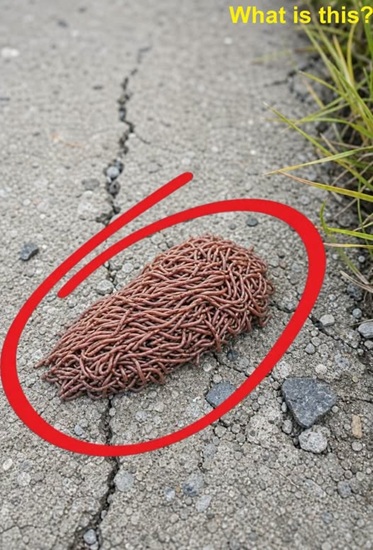
At first glance, a strange moving mass on wet ground can be difficult to identify. From several feet away, dozens of small bodies pressed together may look more like discarded material, tangled roots, or wet debris than living animals. The impression can become even more confusing when the entire cluster appears to move at once. Rather than seeing individual creatures immediately, the eye notices the outline of one larger shifting object. A closer look can reveal that the apparent single organism is actually made up of many separate animals moving over and beneath one another.
One natural explanation for such a scene is a dense gathering of earthworms. Earthworms normally spend much of their lives in or close to the soil, meaning people often notice them individually rather than in large concentrations. Rain can change that. After wet weather, earthworms are commonly seen on lawns, paths, driveways, and other exposed surfaces. University extension sources specifically note that earthworms may emerge on rainy days, particularly when soil conditions become very wet.
Seeing many worms together can look dramatically different from seeing a single earthworm. Their long segmented bodies overlap, curve, and slide around one another. Because each animal moves independently while remaining surrounded by others, the entire group can appear to pulse or ripple. What seems from a distance to be one moving heap may therefore be the combined motion of many separate worms.
Earthworm movement is produced through coordinated contraction and relaxation of their segmented bodies. Tiny bristlelike structures help them grip surfaces while moving. When many worms occupy the same small patch of wet ground, those individual movements become visually difficult to separate. Instead of following one animal, a viewer may see continuous movement across the whole cluster. Penn State Extension describes earthworms as segmented invertebrates that move through sequential contractions and use small bristlelike organs to grip surfaces.
Rain is closely connected with many familiar encounters between humans and earthworms. After a storm, worms often become visible on sidewalks and lawns where they are normally hidden. One traditional explanation is that saturated soil forces them upward because underground oxygen becomes limited. Penn State Extension notes that worms can move to the surface when soil becomes saturated and that excessive waterlogging can eventually be harmful.
However, the full explanation is more complicated than the common claim that every worm on the surface after rain is escaping immediate drowning. Research summarized by the U.S. Department of Agriculture has noted that some earthworms can survive submerged in oxygenated water for surprisingly long periods. Scientists have proposed several explanations for rainy-weather surface activity, including reduced oxygen in flooded soil and the opportunity to travel more efficiently across cool, moist ground.
That means a photograph or video of earthworms after rainfall generally cannot establish exactly why every individual worm emerged. Some may be responding to changing oxygen conditions. Others may be moving across the surface because moisture makes travel easier and reduces the danger of drying out. The specific behavior can also depend on the species, soil conditions, temperature, and intensity of rainfall.
Moisture is essential to earthworms because they exchange gases through their skin. Their skin needs to remain moist for respiration to function effectively. At the same time, soil that is heavily waterlogged can create poor underground conditions, especially when oxygen becomes limited. Illinois Extension explains that worms require moisture but that excessive water can interfere with respiration, helping explain why large numbers may appear above ground after heavy rainfall.
This relationship with moisture also explains why earthworms usually avoid hot, dry surfaces. A worm exposed to dry air or direct sunlight can lose moisture through its skin. Wet, overcast conditions therefore provide a safer opportunity for some worms to travel above ground. That is one reason a lawn or pavement may suddenly contain many worms after rain even though few were visible the previous day.
The surface appearance can be surprising precisely because so much earthworm activity normally occurs unnoticed. Earthworms tunnel through soil, consume organic material, and influence soil structure without attracting much human attention. Their burrows can improve water infiltration and create spaces that help gases move through soil. Penn State Extension describes earthworms as important contributors to soil porosity, water movement, and nutrient cycling.
University of Minnesota Extension similarly describes nightcrawlers as earthworms that naturally aerate soil and help water and oxygen penetrate the ground. Their feeding and waste products also contribute to nutrient recycling. For a lawn or garden, the presence of common earthworms is therefore often associated with biological activity in the soil rather than with an emergency.
There are thousands of earthworm species worldwide, and they do not all behave exactly alike. Some spend most of their time near leaf litter or the upper layers of soil. Others form horizontal burrows, while species such as nightcrawlers can create deeper vertical tunnels. Their response to rainfall can therefore vary considerably.
This variety is another reason an unidentified mass of worms should not automatically be assigned a dramatic explanation. Without examining the animals or knowing the location, species identification may be impossible. A viewer may be able to recognize that the creatures are worms while still being unable to determine exactly what kind they are.
Certain invasive worms can also behave differently from familiar European nightcrawlers. For example, Asian jumping worms are known for unusually energetic thrashing when disturbed and can be found in leaf litter, gardens, and lawns. University of Illinois Extension notes that adults may also be seen on pavement and sidewalks after rain.
That does not mean every active cluster after rain consists of jumping worms. Identification requires examining characteristics such as body color, behavior, and the clitellum, the band around a mature earthworm’s body. A blurry image or distant video usually does not provide enough information for a reliable species-level conclusion.
The appearance of a worm cluster may also be intensified by the reflective quality of wet skin. Earthworms naturally have moist skin, and rain adds water to the surrounding soil and pavement. Under certain lighting, dozens of overlapping bodies can therefore create a shiny, almost uniform surface. From a distance, the individual segments may disappear visually.
Once movement begins, the illusion becomes stronger. A worm at the bottom of the cluster may push against several others. Another may crawl across the top. Several may contract at approximately the same time. Those movements produce small changes in shape across the group, creating the impression that the entire mass is expanding and contracting.
That effect can seem unsettling without requiring anything abnormal or dangerous to be happening. Humans are good at recognizing familiar shapes when they appear in expected contexts. A single earthworm on a garden path is immediately recognizable. Dozens tangled into a compact group do not resemble the mental image most people associate with an earthworm.
The same perceptual effect occurs with many animals. A large flock of birds can look like one changing shape in the sky. A dense school of fish can appear to move as a single organism. Groups of insects can form patterns that hide the boundaries between individuals. Worms packed closely together can create a similar visual illusion at ground level.
Rain can make these encounters much more noticeable because it brings normally hidden soil animals to the surface. University of Minnesota Extension specifically notes that earthworms tunnel underground but can appear above ground on rainy days, particularly during spring.
The ecological role of earthworms is also more complicated than the simple idea that all worms are automatically beneficial everywhere. In gardens and agricultural soils that have long contained earthworms, their burrowing can aid aeration and influence nutrient cycling. In some North American forests, however, introduced earthworm species can alter leaf litter and soil ecosystems that evolved without them.
For an ordinary yard, identifying the species and ecological context matters more than reacting to the appearance alone. A dramatic-looking cluster is not automatically evidence of a dangerous infestation. In many cases, surface worms after rain will eventually move away, return to suitable soil, or unfortunately dry out if conditions become hot and sunny.
If worms are found on pavement after rain, moving them is usually unnecessary unless there is a specific reason to do so. Handling wildlife without need can injure animals, and species identification may matter in regions where invasive worms are being monitored. Local extension services can provide guidance when unusually large numbers repeatedly appear or when an invasive species is suspected.
A photograph can sometimes help specialists identify an unusual worm. Clear images showing overall body color and the band around the body are more useful than distant photographs of an entire cluster. For suspected invasive jumping worms, Illinois Extension specifically recommends clear photographs, including a close view of the body band, when reporting sightings in areas where they have not previously been confirmed.
People should also avoid automatically applying pesticides simply because earthworms appear after rainfall. Common nightcrawlers and many other earthworms play important roles in lawns and soil. University of Minnesota Extension specifically advises tolerating nightcrawlers whenever possible rather than applying pesticides to remove them.
If an unusually large concentration occurs repeatedly in one location, it may be worth examining the environmental conditions. Extremely wet soil, drainage problems, irrigation, organic material, or favorable habitat can influence worm activity. Improving drainage may make sense for the health of plants and soil if waterlogging is persistent, but treating the worms themselves as the source of the water problem would reverse cause and effect.
The biology of waterlogged soil helps explain why this distinction matters. Soil contains spaces that normally hold both water and air. Heavy rainfall can fill many of those spaces with water. When air-filled pores disappear, oxygen availability underground can decline. Organisms that depend on oxygen must respond to those changing conditions.
Earthworms do not have lungs like humans. Gas exchange takes place through their moist skin. This makes the surrounding environment particularly important. Their bodies require moisture, but they also require access to oxygen. Soil conditions therefore have to provide an appropriate balance.
Experiments and field observations show that some worms can survive underwater if enough dissolved oxygen is available. This is why the simple statement that rain makes earthworms instantly drown is inaccurate. USDA researchers have described surface emergence after rain as a question with several possible explanations rather than a fully settled single mechanism.
One proposed benefit of surfacing during rain is movement. Traveling through underground soil requires considerable effort. A wet surface may allow an earthworm to cover a greater horizontal distance while remaining moist. That movement could help individuals reach new feeding areas or habitats.
Rain also reduces one of the biggest dangers of surface travel: dehydration. On a hot sunny day, exposed worms can lose water rapidly. During cool rainfall or immediately afterward, the ground remains wet enough for surface movement to be more viable.
This is why discovering many worms after a storm should not automatically be interpreted as witnessing animals in their final moments. Some individuals may indeed be experiencing stressful waterlogged conditions, and worms trapped on exposed pavement can later die as the surface dries. But others may simply be taking advantage of wet conditions to move.
The phrase “desperate knot” therefore sounds more certain than the biology allows. A cluster can certainly appear dramatic, and individual worms may be under environmental stress. Without additional evidence, however, it is not possible to state confidently that every animal in such a cluster is clinging to the others in an intentional effort to avoid suffocation.
Earthworms are not generally known for forming emergency social groups in the way mammals might huddle for warmth. Their bodies can accumulate in the same favorable location because environmental conditions affect them simultaneously. When many individuals emerge from nearby soil, chance and physical crowding can produce dense clusters.
Research has also documented aggregation and group behavior in certain earthworm contexts, but the exact reason for any specific roadside or backyard cluster cannot be diagnosed visually without more information. A careful account should therefore separate what is directly observable from what is merely hypothesized.
What can be observed is movement.
A dense collection of earthworms can overlap closely.
Rain commonly brings earthworms to the surface.
Their combined motion can make the cluster resemble one pulsing organism.
Those facts are enough to explain why someone encountering such a scene might initially fail to recognize what they were seeing.
The surprise is especially understandable when the location is familiar. People tend to pay little attention to ordinary ground around a house unless something changes. A strange shape that begins moving suddenly forces attention toward a part of the environment that usually functions only as background.
Once the individual worms become visible, the mystery disappears even if the image remains unusual. A natural phenomenon can look strange without being mysterious. The unfamiliarity comes from seeing familiar animals arranged in a way people rarely notice.
Earthworms spend much of their lives performing ecological work below the surface. They consume dead organic material and soil and produce casts containing processed material. Their burrowing changes the physical structure of soil. Research continues to examine how these activities influence soil aggregates, nutrients, and moisture under different environmental conditions.
Earthworm casts themselves can take several forms and interact differently with rainfall. Scientific studies have examined how repeated wetting and drying affects casts and nutrient dynamics. These processes demonstrate that rainfall influences much more than whether worms become visible; it can also alter the structures worms create in the soil.
The broader lesson is that the soil beneath an ordinary yard is biologically active. Fungi, bacteria, insects, worms, plant roots, and many other organisms interact there. Most of that activity occurs without being obvious to people walking above it.
Rain temporarily changes what can be seen.
A lawn that seemed empty the day before may suddenly contain worms, insects, fungal growth, or other signs of underground life. These appearances can seem sudden even though the organisms were already present.
That helps explain why an ordinary morning can unexpectedly turn into a memorable wildlife observation. Nothing exotic has to arrive from somewhere else. Weather conditions can simply reveal animals that were nearby all along.
Recording an unfamiliar animal from a respectful distance can be useful when identification is uncertain. Photographs allow closer inspection without repeatedly touching or disturbing the animals. They can also be shared with extension specialists, natural-history organizations, or knowledgeable local experts when a reliable identification is needed.
Online image searches, however, should be treated cautiously. Many unrelated wormlike animals resemble one another in low-quality images, and viral posts frequently attach dramatic explanations to ordinary wildlife. A match based only on appearance does not necessarily establish species or behavior.
Reliable sources such as universities, government agricultural agencies, museums, and established natural-history organizations are more appropriate for understanding unfamiliar wildlife behavior. They can also distinguish between observations that are well established and explanations that remain debated.
In the case of earthworms after rain, the well-established observation is straightforward. Worms frequently become more visible on the surface during or after wet weather.
The reason can involve saturated soil and reduced oxygen, but scientists have also proposed movement and dispersal as important explanations.
That nuance makes the phenomenon more interesting rather than less.
The worms are not behaving randomly in a lifeless environment. They are responding to moisture, oxygen, temperature, soil structure, and other conditions that humans rarely notice directly.
Their appearance after rain is therefore a visible sign of changes occurring beneath the ground.
A dense cluster makes those changes impossible to ignore.
From several feet away, the worms may look like an unidentified heap.
Closer inspection reveals individual segmented bodies.
Understanding their biology turns an unsettling mystery into a recognizable natural event.
Yet knowing the answer does not necessarily make the visual effect ordinary.
Dozens of worms moving simultaneously can still look remarkably strange.
The scene is an example of how scale and context change perception.
One earthworm looks familiar.
Many earthworms tangled tightly together can look almost alien.
There is no contradiction between those reactions and scientific understanding.
Nature frequently produces patterns that seem unusual simply because people do not encounter them often.
A backyard after rainfall can provide one of those moments without requiring a rare species or unexplained phenomenon.
It may simply reveal animals that normally remain below the observer’s feet.
If the worms are common local species and are not trapped somewhere dangerous, the best response may be simply to leave them alone and allow conditions to change naturally.
If the animals appear to be an invasive species or repeatedly occur in unusual numbers, a local university extension or environmental agency can provide more specific guidance.
What should be avoided is turning an uncertain observation into a confident biological claim without evidence.
The sight of worms following rain is real and well documented.
The idea that every surface worm is actively drowning is too simplistic.
The claim that a particular cluster is intentionally “clinging together to survive” also requires evidence that a photograph alone cannot provide.
A factual explanation is still compelling without those additions.
Wet conditions changed the environment.
Earthworms emerged.
A large number happened to occupy a small visible area.
Their overlapping movements created the appearance of a single living mass.
The apparent mystery therefore came not from an unknown creature but from an unusual arrangement of familiar ones.
That is what makes observations like this memorable.
People often imagine that surprising encounters with nature require remote forests, oceans, or unfamiliar countries.
In reality, ordinary yards contain ecosystems operating continuously beneath the surface.
A heavy rain can briefly expose that hidden activity.
Something that initially resembles discarded debris can begin moving.
Closer inspection can transform uncertainty into recognition.
And recognition can lead to a better understanding of animals that normally receive little attention.
Earthworms may not be dramatic in the conventional sense, but they play important roles in many soils and respond closely to environmental conditions.
Their sudden appearance after rainfall is one of the few times that underground life becomes immediately visible to almost anyone.
A dense gathering amplifies that effect dramatically.
The final explanation is therefore less frightening than the first impression.
There is no need to invoke an unknown organism or supernatural phenomenon.
The moving heap can be explained by ordinary earthworms occupying the same wet patch of ground and moving simultaneously.
What remains extraordinary is how unfamiliar ordinary nature can appear when it is seen from a new angle.
A yard can look unchanged for years and still contain layers of activity that pass unnoticed.
Rain can reveal some of that activity in minutes.
And once someone has noticed it, they may understandably pay more attention to what appears beneath their feet after the next storm.
The experience becomes a useful reminder to distinguish observation from interpretation.
Seeing worms tangled together is an observation.
Knowing that worms often surface during wet weather is supported by biological research.
Claiming exactly what each worm was experiencing internally would require evidence that an image cannot provide.
Keeping those distinctions clear allows a human-interest story to remain engaging without drifting into misinformation.
In the end, the most accurate explanation is also surprisingly simple. Earthworms commonly appear above ground after rain, particularly when soil becomes saturated or surface conditions are favorable for movement. A large number emerging in the same location can create a dense, shifting cluster whose individual bodies are difficult to distinguish at first.
What looks like one strange organism may actually be dozens of familiar ones.
The rain did not create them.
It simply made them visible.
And for anyone encountering such a mass unexpectedly, that can be enough to make an ordinary patch of ground look completely unfamiliar.
