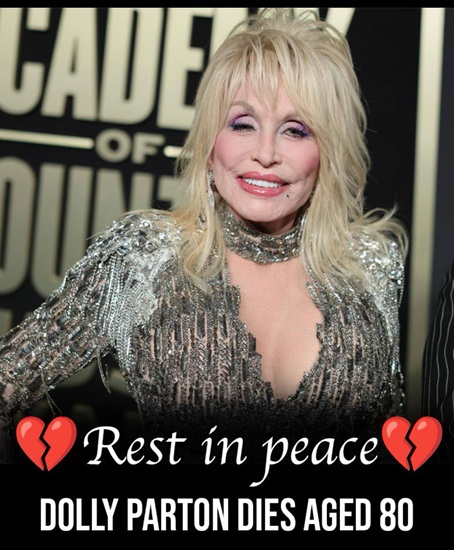
Dolly Parton, the legendary singer, songwriter, actress, businesswoman and philanthropist whose extraordinary career made her one of the most recognizable figures in American entertainment, has died at the age of 80. Her death was announced on Tuesday, August 25, 2026, bringing an outpouring of remembrance for an artist whose influence extended far beyond country music. Parton spent decades writing and performing songs that became part of popular culture while building an entertainment and business career that reached audiences around the world.
Her nephew Bryan Seaver announced her passing on behalf of the Parton and Owens families. Seaver, the son of Parton’s sister Cassie, had also worked for many years as the singer’s head of security. His announcement made clear that the responsibility of publicly sharing the news was one Parton herself had discussed with him years earlier. Parton’s death marks the end of a career that stretched across roughly seven decades and crossed boundaries between country, pop, film, television, theater and philanthropy.
Few performers managed to remain as recognizable across generations while maintaining such a strong connection to their musical roots. Her songs could be humorous, heartbreaking, autobiographical or uplifting, but storytelling remained at the center of her work. That ability helped turn compositions including “Jolene,” “Coat of Many Colors,” “I Will Always Love You” and “9 to 5” into enduring classics. Her distinctive voice and songwriting were accompanied by a deliberately glamorous public image, but Parton repeatedly demonstrated that there was considerable creative and business intelligence behind the rhinestones. Over time, she became not merely a successful country performer but an international cultural figure.
Dolly Rebecca Parton was born on January 19, 1946, in rural East Tennessee and grew up in a large family with limited financial resources. She was one of 12 children, and memories of her childhood would later provide inspiration for some of her most personal songs. Music was present early in her life, particularly through church and family, and she began performing while she was still a child. By the age of 10 she had appeared on local television, and at 13 she made an appearance at Nashville’s Grand Ole Opry. Her ambitions were already focused on a professional music career. After graduating from high school in 1964, she moved to Nashville, the center of the country music industry, determined to establish herself as a songwriter and performer.
Her earliest years in Nashville required patience. Parton initially gained attention for songwriting before becoming a major recording star herself. Her breakthrough accelerated when she joined country entertainer Porter Wagoner in 1967, appearing regularly on his television program and recording duets with him. Their professional partnership introduced Parton to a much wider country audience and helped establish her as a rising star. Yet Parton increasingly wanted control over her own career and eventually decided to leave the partnership. That professional separation inspired one of her most famous compositions, “I Will Always Love You.” Parton recorded the song herself before Whitney Houston transformed it into an enormous international pop hit decades later, demonstrating the remarkable longevity of Parton’s songwriting.
During the 1970s, Parton established an identity that was unmistakably her own. “Jolene,” released during that decade, became one of her signature recordings and eventually one of the most recognizable country songs ever written. “Coat of Many Colors,” inspired by her childhood, demonstrated another side of her artistry. The song tells a story about poverty, family love and dignity through the memory of a coat sewn by her mother. Its emotional power came from Parton’s ability to transform a deeply personal memory into a universal story. Rather than distancing herself from her Appalachian upbringing after becoming famous, Parton repeatedly drew upon those experiences in her music. They became an essential part of the public story she told about herself and her family.
Parton also proved capable of moving beyond the traditional boundaries of country music. During the late 1970s and early 1980s, her recordings increasingly reached mainstream pop audiences. “Here You Come Again” became a major crossover success, while “9 to 5” turned into one of the defining songs of her career. Written for the 1980 film of the same name, the song reached No. 1 on the Billboard Hot 100 as well as the country chart. Parton starred in the movie alongside Jane Fonda and Lily Tomlin, demonstrating that her charisma translated naturally from the concert stage to film. Her performance introduced her to an even broader audience and helped establish an acting career that would continue alongside her music.
Her film work expanded throughout the 1980s. Parton appeared in “The Best Little Whorehouse in Texas” with Burt Reynolds and later starred in “Rhinestone” with Sylvester Stallone. She also became part of the celebrated ensemble cast of “Steel Magnolias,” appearing alongside Sally Field, Shirley MacLaine, Olympia Dukakis, Daryl Hannah and Julia Roberts. Although music remained the foundation of her career, Parton’s acting performances reinforced her reputation as an entertainer capable of working successfully across different forms of media. Her natural comic timing, warmth and recognizable personality helped make her a memorable screen presence without requiring her to abandon the qualities audiences already associated with her music.
Another major moment arrived in 1983 with “Islands in the Stream,” Parton’s duet with Kenny Rogers. Written by the Bee Gees, the recording became a major crossover hit and reached No. 1 on the Billboard Hot 100. Parton and Rogers developed one of country music’s most beloved professional partnerships, performing together repeatedly over the following decades. Their contrasting voices became instantly recognizable on the recording, and “Islands in the Stream” remained closely associated with both artists. The song demonstrated again how easily Parton could move between traditional country audiences and mainstream popular music without losing her distinctive identity.
Parton’s collaborative work extended well beyond Rogers. In 1987 she joined Linda Ronstadt and Emmylou Harris for the album “Trio,” a project celebrated for the vocal harmonies of three major singers with very different individual careers. The album achieved commercial and critical success and received a Grammy Award. They reunited years later for “Trio II,” continuing a musical partnership that became another respected chapter in Parton’s catalog. Throughout her career she also collaborated with artists from numerous generations and musical styles, allowing her work to remain visible to younger audiences long after many of her original contemporaries had stopped recording regularly.
Her achievements on the country charts were exceptional. Parton accumulated 25 No. 1 songs on Billboard’s Hot Country Songs chart, an accomplishment that placed her among the most successful country artists in history. Her recordings appeared on the charts across multiple decades, illustrating an unusual degree of longevity. She also earned numerous Grammy Awards and nominations and received major honors recognizing both individual recordings and her overall contribution to music. She was inducted into the Country Music Hall of Fame in 1999, one of the industry’s most significant recognitions. Songs including “Jolene,” “I Will Always Love You” and “Coat of Many Colors” continued to be celebrated long after their original releases.
Parton’s songwriting was perhaps the most important foundation beneath everything else she accomplished. She wrote thousands of songs during her lifetime, often working quickly when inspiration arrived. Her compositions were recorded not only by Parton herself but also by numerous other performers. “I Will Always Love You” provides the most famous example. Parton’s original recording became a country hit, while Whitney Houston’s 1992 interpretation for “The Bodyguard” soundtrack became one of the biggest-selling singles in popular music history. Parton retained ownership of her publishing rights, a decision that demonstrated the business awareness that would characterize many aspects of her career.
That business judgment became increasingly visible as Parton expanded beyond recording and performing. In 1986, she became closely involved with the Tennessee theme park that was renamed Dollywood. Located near the Great Smoky Mountains in Pigeon Forge, the attraction developed into one of Tennessee’s best-known tourism destinations. Dollywood also created employment and economic activity in the region where Parton grew up. The business reflected a pattern seen throughout her career: although she achieved international fame, she continued investing attention and resources in East Tennessee. Over time, the Dollywood name expanded into additional tourism and hospitality ventures.
Parton’s most enduring work outside entertainment may be Dolly Parton’s Imagination Library. Founded in 1995 through the Dollywood Foundation, the program began by providing books to young children in her home area of Sevier County, Tennessee. The idea had a deeply personal connection to Parton’s family because her father, Robert Lee Parton, could not read or write. Parton frequently discussed how witnessing the challenges associated with illiteracy helped inspire her commitment to childhood literacy. The program eventually expanded far beyond Tennessee and began distributing books to children in communities across several countries.
The Imagination Library operates on a simple but powerful principle: enrolled children receive an age-appropriate book regularly during the years before they begin school. What started as a local initiative grew into an international literacy effort responsible for distributing millions of books. The project became one of the clearest examples of how Parton used her fame and financial success for purposes unrelated to promoting her entertainment career. For many families, particularly those who might otherwise have limited access to books at home, the program provided children with their own growing personal libraries. Its expansion turned Parton’s childhood experience with her father’s illiteracy into a long-term educational mission.
Her philanthropy reached other areas as well. Following devastating wildfires in Tennessee’s Great Smoky Mountains region in 2016, Parton helped organize assistance for families who had lost their homes. Through the My People Fund, financial support was provided to households affected by the disaster. She also supported medical institutions and other charitable causes during her lifetime. In 2020, Parton donated $1 million to Vanderbilt University Medical Center for coronavirus research. Research supported by that contribution was connected with work that contributed to the development of the Moderna COVID-19 vaccine, bringing international attention to another example of her charitable giving.
Despite her enormous public profile, one of the most important relationships in Parton’s private life remained deliberately outside the spotlight. She married Carl Thomas Dean in 1966 after the couple met in Nashville. Dean rarely attended entertainment-industry events and generally avoided public attention, creating a striking contrast with his wife’s highly visible career. Their marriage lasted nearly six decades. Parton frequently spoke warmly about Dean while respecting his preference for privacy. The couple did not have children, though Parton maintained close relationships with her large extended family and became known to generations of relatives by affectionate family names.
Carl Dean died in March 2025 at the age of 82. Parton subsequently spoke about the profound adjustment of losing the man who had been her partner for most of her adult life. Their relationship had begun before she became internationally famous and continued through virtually every major stage of her career. Parton honored him creatively as well, including through music reflecting on their life together. His death left her navigating a new chapter after almost 60 years of marriage, but she continued working on creative projects and discussing plans for the future.
Parton’s longevity was especially remarkable because she continually found ways to introduce herself to new generations. Younger listeners discovered her songs through covers, films, streaming services and collaborations with contemporary performers. She maintained a particularly well-known connection with Miley Cyrus, her goddaughter, and appeared with her on multiple occasions. Rather than treating younger artists as competitors, Parton frequently collaborated with them and expressed appreciation for different musical styles. This openness helped keep her culturally relevant even as the music industry changed dramatically around her.
In 2022, Parton was inducted into the Rock & Roll Hall of Fame. She initially expressed hesitation about accepting the nomination because she did not consider herself a traditional rock artist, but ultimately embraced the honor. The experience helped inspire “Rockstar,” her 2023 rock album featuring collaborations and interpretations of well-known songs. The project became another example of her willingness to experiment late in her career rather than simply relying on past achievements. At an age when many performers had retired, Parton continued recording, collaborating and pursuing ambitious projects.
Her public image was equally distinctive. Blonde wigs, rhinestones, bright costumes and an exaggerated glamorous style became instantly recognizable elements of the Dolly Parton persona. Yet Parton consistently demonstrated an ability to joke about her own appearance and refused to treat the image too seriously. Her humor often allowed her to control conversations about appearance rather than allowing others to define her through it. Beneath the theatrical presentation was a disciplined songwriter and businesswoman who maintained substantial control over her work and intellectual property.
That combination of humor and seriousness helped Parton connect with audiences whose backgrounds and beliefs could be very different from one another. She rarely built her public identity around confrontation. Instead, interviews often returned to themes of kindness, acceptance, work, family and treating other people with dignity. That approach contributed to her unusually broad popularity. Fans might have discovered her through country radio, Hollywood films, Dollywood, the Imagination Library or one of her famous songs, but the personality associated with those projects remained remarkably consistent.
Her influence on women in country music was particularly significant. Parton entered the Nashville industry during an era in which male performers and executives held much of the institutional power. She nevertheless developed into a songwriter who controlled important aspects of her catalog and eventually became a business owner with interests extending far beyond music. Her decision to leave Porter Wagoner’s program and establish a fully independent career was a defining professional moment. She demonstrated that a female country performer could become a songwriter, crossover star, actress, producer, entrepreneur and major entertainment brand while maintaining ownership and creative authority.
The statistics surrounding Parton’s career are impressive, but numbers alone cannot explain her cultural reach. Twenty-five Billboard country No. 1 songs, major awards, successful movies and decades of recordings describe achievement but not necessarily affection. Parton occupied a rare position in popular culture in which extraordinary fame coexisted with an image of accessibility and warmth. Her childhood stories, humor and openness about her beginnings allowed audiences to see continuity between the girl who grew up in rural Tennessee and the superstar who later performed on the world’s biggest stages.
Her songs remain the clearest record of that journey. “Coat of Many Colors” preserved a childhood memory and transformed it into a statement about love and dignity. “Jolene” captured fear and vulnerability with remarkable simplicity. “I Will Always Love You” turned a professional farewell into a universal expression of affection and separation. “9 to 5” combined humor, frustration and an instantly recognizable melody. Each came from a different emotional perspective, but together they illustrate Parton’s extraordinary instinct for translating specific experiences into stories understood by millions of people.
Her influence also survives through the artists who recorded her compositions and cited her as an inspiration. Country singers inherited her storytelling tradition, while pop performers admired her crossover success and distinctive public identity. Songwriters studied the economy and emotional clarity of her lyrics. Businesspeople pointed to her careful management of publishing and branding. Philanthropic organizations could look to the Imagination Library as evidence that a celebrity-backed charitable project could develop into a sustained international program rather than a temporary campaign.
Parton’s story also remained closely connected to the region where it began. The mountains of East Tennessee appeared repeatedly in her music, interviews and charitable activities. She could have treated her childhood poverty merely as a dramatic element of her biography, but instead she invested in projects connected to education, tourism, employment and disaster recovery in the area. Dollywood became a major attraction, while her charitable foundation developed programs serving children and families. Her global celebrity therefore remained linked to a specific sense of home without requiring her to speak on behalf of everyone who lived there.
News of her death on August 25, 2026, brought renewed attention to the extraordinary scale of what she had accomplished since arriving in Nashville as a young woman in 1964. She entered the industry hoping to write songs and eventually became one of the defining artists in country music history. Along the way, she succeeded in film, television, business and philanthropy while maintaining ownership of an identity that was unmistakably her own. Her career survived changing musical trends, new technologies and generations of audiences.
For the millions who knew Parton primarily through her recordings, her legacy will continue every time one of those songs plays. For families whose children received books through the Imagination Library, her impact has another dimension entirely. For East Tennessee, her name remains attached to businesses, charitable projects and cultural history. And for generations of performers, particularly women attempting to maintain creative and financial control over their careers, Parton’s example provides a model of longevity built on songwriting talent, adaptability and careful decision-making.
Dolly Parton lived long enough to see songs written decades earlier become standards, to watch younger generations discover her music and to see a childhood-literacy project expand far beyond the community where it began. The circumstances of fame changed dramatically during her lifetime, from local radio and television to global digital platforms, yet her ability to connect with audiences endured. She remained recognizably Dolly through every era: humorous but determined, glamorous but deeply connected to her roots, commercially successful while consistently emphasizing generosity.
Her death closes an extraordinary chapter in American entertainment, but it does not close the story of her work. The recordings remain. The films remain. Dollywood continues to carry her name, and the Imagination Library continues the literacy mission she began decades ago. Thousands of songs preserve her perspective as a writer, while countless performers continue to draw inspiration from the career she built. Dolly Parton began life in a large family in rural Tennessee and ultimately became an artist known around the world. Her journey from Appalachia to international stardom was remarkable, but the breadth of what she chose to do with that success made her legacy larger still.
Parton will be remembered as a country music pioneer, a gifted songwriter, a charismatic performer, an actress, an entrepreneur and a philanthropist. She will also be remembered through the personal connections listeners formed with songs that accompanied weddings, heartbreaks, working days, family memories and countless ordinary moments. That may ultimately be the most lasting measure of her career. Long after the awards and chart statistics become pieces of music history, the stories contained in her songs will continue finding new listeners.
Dolly Parton was 80 years old when her death was announced by her family on August 25, 2026. She leaves behind one of the most extensive and varied legacies of any modern American entertainer. From “Jolene” and “I Will Always Love You” to “9 to 5,” from movie screens to Dollywood,
