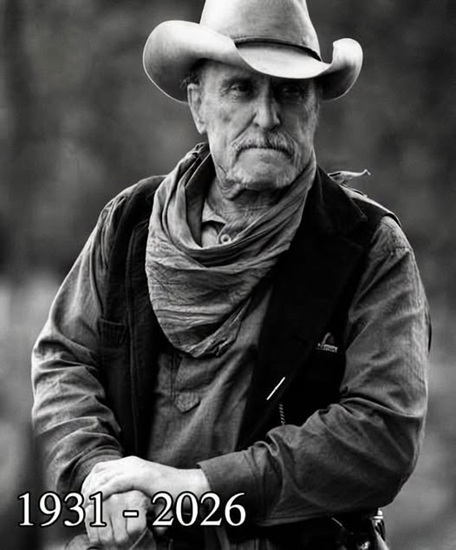
Robert Duvall, the Academy Award-winning actor whose quiet intensity and extraordinary range helped shape some of the most memorable films in American cinema, died on February 15, 2026. He was 95 years old. A representative for Duvall confirmed that he died peacefully at his home in Middleburg, Virginia, with his wife, Luciana Duvall, by his side. His wife also announced his death publicly, saying that he had died surrounded by love and comfort. No cause of death was included in the initial public announcement.
His passing brought to a close a screen career that lasted for more than six decades and included work in film, television and theater. Duvall’s career placed him inside an extraordinary number of films that became lasting parts of American popular culture. He appeared in To Kill a Mockingbird, The Godfather, The Godfather Part II, Apocalypse Now, Network, The Great Santini, Tender Mercies and many other productions. Later generations also knew him from acclaimed television projects such as Lonesome Dove and Broken Trail.
His performances covered an unusually broad range of personalities, professions and emotional worlds. He played lawyers, military officers, lawmen, cowboys, troubled fathers, preachers and criminals without becoming permanently confined to a single type of character. The Washington Post described a career that included roughly 140 film and television credits and extended across more than five decades. Robert Selden Duvall was born on January 5, 1931, in San Diego, California.
Long before he became associated with Francis Ford Coppola and some of the most celebrated movies of the 1970s, he spent years developing his craft away from Hollywood fame. His professional path included stage work and television appearances before movie audiences became widely familiar with his face. The journey was gradual rather than an overnight rise to stardom. That slow development contributed to the kind of acting reputation he eventually earned, one built more around discipline and believable characterization than celebrity image. By the time major film roles began arriving, Duvall had already accumulated considerable experience performing in front of audiences and cameras.
One of his earliest important film appearances came in the 1962 adaptation of Harper Lee’s To Kill a Mockingbird. Duvall played Arthur “Boo” Radley, the mysterious neighbor whose presence hangs over much of the story even though he spends little time on screen. The role offered an early example of Duvall’s ability to make an impression without relying on large amounts of dialogue. His performance was quiet, physically controlled and emotionally precise. Although Gregory Peck was the film’s central star, Duvall’s brief appearance remained memorable for audiences. The Television Academy identifies Boo Radley as Duvall’s film debut, making the role an important starting point in one of the longest major acting careers of his generation.
During the years that followed, Duvall steadily expanded his work across television, stage and motion pictures. He appeared in numerous television productions and built a reputation as a dependable performer capable of adapting himself to different stories. He was not yet the instantly recognizable figure he would become during the 1970s. Instead, he was developing the professional foundation that eventually allowed directors to trust him with increasingly complex characters. Duvall rarely approached those characters as opportunities for display alone. He was known for studying human behavior and searching for details that could make a role appear lived rather than performed. That approach became increasingly visible as his assignments grew more prominent.
The role that permanently changed Duvall’s standing in Hollywood arrived with Francis Ford Coppola’s The Godfather in 1972. Duvall portrayed Tom Hagen, the adopted son and trusted consigliere of the Corleone family. In a movie filled with towering performances and unforgettable personalities, Tom Hagen operated differently. He was usually controlled when people around him were emotional, careful when others were impulsive and analytical when violence threatened to take over a situation. Duvall made that restraint an essential part of the character. He did not need to dominate every conversation to communicate Tom’s intelligence, loyalty and complicated position within the Corleone family.
Tom Hagen occupied an unusual place inside the family portrayed in The Godfather. He was deeply trusted by Vito Corleone, played by Marlon Brando, and closely connected to Michael Corleone, played by Al Pacino, yet he was also different from the Corleones by birth. Duvall conveyed those overlapping loyalties without turning them into obvious exposition. Small changes in expression or tone often communicated what Tom understood but did not say. That subtlety was particularly effective in a story where characters frequently concealed their real intentions. The performance helped establish Duvall internationally as a major supporting actor. It also became one of the roles most closely associated with him for the rest of his life.
Duvall returned as Tom Hagen in The Godfather Part II, released in 1974. The sequel expanded the Corleone story while giving Hagen new responsibilities as Michael’s increasingly isolated leadership changed the family. Once again, Duvall’s controlled style provided a contrast to the rising tension surrounding the character. Tom could remain outwardly composed even when the relationships around him were beginning to fracture. Duvall never needed to transform the lawyer into an exaggerated figure to make him important. The effectiveness of the performance came partly from the suggestion that Tom was constantly observing and calculating. Across the first two Godfather films, Duvall helped create a character whose quietness became one of his defining strengths.
His collaboration with Francis Ford Coppola continued during one of the most ambitious American films of the decade. In Apocalypse Now, released in 1979, Duvall appeared as Lieutenant Colonel Bill Kilgore. The role could hardly have been more different from Tom Hagen. Hagen was measured, cautious and understated, while Kilgore was aggressive, charismatic, theatrical and almost surreal in his confidence. Duvall’s ability to move convincingly between those extremes demonstrated why directors considered him such a versatile performer. The character became one of the most recognizable military figures in movie history and remains closely associated with Duvall’s career.
Kilgore’s scenes also demonstrated that Duvall’s preference for believable acting did not prevent him from playing larger personalities. What mattered was finding a recognizable human foundation beneath the character’s extremes. In Apocalypse Now, he combined authority, recklessness, humor and menace in a performance that became immediately distinctive. The role earned him further acclaim and reinforced the fact that he could transform his physical and emotional energy according to the demands of a story. Viewers who knew him primarily as Tom Hagen suddenly encountered a completely different screen presence. That contrast became one of the clearest examples of his range.
The same year brought another important performance in The Great Santini. Duvall played Lieutenant Colonel Wilbur “Bull” Meechum, a Marine aviator whose commanding personality extends into his family life. The character is powerful, proud and frequently difficult, but Duvall resisted reducing him to a simple stereotype. His performance revealed contradictions beneath the man’s authority and allowed viewers to see both his strength and the damage created by his behavior. The role required Duvall to move between intimidation, pride, vulnerability and emotional limitation. That complexity helped make The Great Santini another important milestone in his career.
Duvall’s work was often strongest when a character could not be neatly divided into hero or villain. He repeatedly portrayed men whose flaws existed alongside qualities that could still inspire sympathy or recognition. His performances invited audiences to observe a character rather than simply receive instructions about how they should feel. That ability became particularly valuable in stories centered on family conflict, authority and personal failure. He could make an unsympathetic action believable without asking viewers to excuse it. He could also reveal vulnerability without making the character suddenly sentimental. Those carefully balanced contradictions became one of the most recognizable qualities of his acting.
A few years later, Duvall delivered the performance that brought him his Academy Award. In the 1983 film Tender Mercies, he played Mac Sledge, a once-successful country singer trying to rebuild a life damaged by alcoholism and personal loss. The character is a long distance from the commanding military men and organized-crime figures Duvall had previously played. Much of the performance depends on stillness, hesitation and emotional restraint. Duvall allowed Mac’s history to emerge gradually rather than explaining everything through dramatic speeches. The result became one of the most acclaimed performances of his career.
At the 56th Academy Awards on April 9, 1984, Duvall won the Oscar for Best Actor in a Leading Role for Tender Mercies. The Academy’s official record lists him ahead of fellow nominees Michael Caine, Tom Conti, Tom Courtenay and Albert Finney. The film itself received five Oscar nominations and won two awards, including Horton Foote’s victory for original screenplay. Duvall’s Oscar represented formal recognition of qualities audiences and filmmakers had observed for years. He had transformed a quiet character into the emotional center of a film without relying on conventional displays of dramatic intensity. The performance remains one of the clearest examples of his ability to communicate complicated emotions through understatement.
Winning the Academy Award did not narrow the kinds of roles Duvall was willing to accept. His career continued across major studio productions, smaller dramas, television projects and Westerns. He had already demonstrated that he could support other stars without disappearing beside them and could lead a film without changing his basic approach to acting. Fame never seemed to require him to play the same character repeatedly. Instead, his later career continued the pattern of moving between personalities whose worlds could be dramatically different. That flexibility helped him remain active through enormous changes in Hollywood.
One of the most beloved performances of Duvall’s later career came through television rather than theatrical film. In the 1989 miniseries Lonesome Dove, he portrayed former Texas Ranger Augustus “Gus” McCrae opposite Tommy Lee Jones as Woodrow Call. The adaptation of Larry McMurtry’s novel became a major television event. Duvall’s Gus was humorous, talkative, romantic, stubborn and experienced, offering yet another striking contrast with the quieter characters he had previously played. The Television Academy later noted that Duvall considered Gus McCrae his favorite role.
Lonesome Dove received 18 Emmy nominations and won six awards, according to Television Academy records. Duvall himself received a nomination for Outstanding Lead Actor in a Miniseries or Special for his portrayal of Gus. Tommy Lee Jones was nominated in the same category for playing Woodrow Call. Although neither actor won that particular award, their performances became deeply associated with the miniseries. Duvall’s affection for Western stories and characters would remain evident throughout his career. Gus McCrae became, for many viewers, every bit as important to Duvall’s legacy as Tom Hagen or Kilgore.
Duvall also moved behind the camera during his career. He worked as a director, producer and writer in addition to acting. One of his most personal projects was The Apostle, released in the 1990s, in which he played a Pentecostal preacher attempting to rebuild his life after a personal crisis. Duvall also wrote and directed the film. His lead performance earned another Academy Award nomination, with the Academy listing him among the Best Actor nominees at the 1998 ceremony. The project reflected his interest in creating complicated characters whose behavior could not be explained through a simple moral label.
The achievement of The Apostle also demonstrated that Duvall’s understanding of character extended beyond interpreting scripts written by other people. He had spent decades observing the ways people spoke, moved, argued and expressed belief. In projects where he had greater creative control, those observations could become part of the entire film rather than only his own performance. He consistently expressed interest in regional cultures, professions and communities that could give characters a specific way of behaving. That attention to detail contributed to the sense that his characters had lives beyond the boundaries of the screenplay.
Duvall’s television work remained significant as he grew older. In 2006, he starred as Prentice “Print” Ritter in the Western miniseries Broken Trail. The production reunited him with the kind of Western setting that had already produced one of his most celebrated performances in Lonesome Dove. This time, the role brought him an Emmy victory. In 2007, Duvall won Outstanding Lead Actor in a Miniseries or a Movie for Broken Trail. The Television Academy also lists him as an executive producer on the project, which won Outstanding Miniseries.
Television Academy records credit Duvall with five Emmy nominations and two Emmy wins. Those achievements complement the film awards that are more frequently mentioned when discussing his career. His success across both television and cinema reflected a willingness to follow interesting characters rather than treat one medium as inherently more prestigious than another. Lonesome Dove became a television landmark, while Broken Trail demonstrated decades later that the Western still provided material capable of drawing out some of Duvall’s strongest work. His career therefore crossed not only generations but different forms of screen storytelling.
Another important feature of Duvall’s career was his longevity. Actors who become prominent during one period of filmmaking do not always remain relevant after styles, audiences and studio priorities change. Duvall worked through several major eras of Hollywood. He was present during the transition from the classical studio period into the more director-driven cinema associated with the late 1960s and 1970s. He remained active throughout the blockbuster era of the 1980s and 1990s. He continued appearing in films during the twenty-first century as digital production, streaming and changing audience habits transformed the industry again.
That longevity was possible partly because Duvall never depended entirely on youthful celebrity or a specific leading-man image. His career could evolve naturally as he aged because character acting made age another source of possibility rather than simply an obstacle. A younger Duvall could play Boo Radley or Tom Hagen. A middle-aged Duvall could become Mac Sledge or Gus McCrae. An older Duvall could portray fathers, ranchers, judges, mentors and other figures carrying decades of history. His changing appearance became part of the characters rather than something his performances needed to conceal.
Duvall was especially respected for his interest in observation. The Washington Post noted his immersive preparation and his tendency to study real people when developing characters. Such preparation did not necessarily produce visibly elaborate performances. Often the result was exactly the opposite. Duvall seemed comfortable removing anything that felt unnecessary and trusting small behavioral details to carry a scene. That philosophy helped create the impression that audiences were watching people rather than actors demonstrating technique.
His characters frequently seemed to possess histories that existed before a movie began. That effect is difficult to produce because a screenplay provides only a limited amount of time for viewers to understand a person. Duvall often used posture, rhythm of speech, pauses and reactions to suggest information never explicitly stated. A lawyer such as Tom Hagen carried himself differently from a soldier such as Kilgore. Mac Sledge in Tender Mercies moved through the world differently from Gus McCrae in Lonesome Dove. Duvall did not merely change clothing and dialogue. He looked for the internal logic that made each man behave differently.
This approach also explains why silence could be so effective in his work. Some performers create attention through constant movement or vocal intensity. Duvall could remain physically still and allow a viewer to wonder what the character was considering. A carefully timed glance might contain skepticism, irritation or affection without requiring dialogue. When he did raise his voice, the contrast could make the moment stronger because it was not his only acting tool. Directors could place him beside equally powerful performers and trust him to maintain his presence without fighting for attention.
His work with major directors became another defining element of his filmography. Francis Ford Coppola gave him several of his most enduring roles, including Tom Hagen and Kilgore. But Duvall’s reputation did not depend on a single filmmaker. Across his long career, he adapted to directors with different visual styles and dramatic priorities. He could serve an ensemble film, carry a small drama or become the unforgettable supporting character audiences discussed afterward. The consistency across such different projects suggested that his craft was highly developed but flexible.
The respect Duvall received from other actors remained visible after his death. Following the announcement in February 2026, tributes came from across the entertainment industry. Francis Ford Coppola, who had worked with Duvall on several important films, publicly described his death as a painful loss and praised him as a great actor. The reaction reflected a professional relationship that had helped create some of the best-known performances of Duvall’s career. Tributes emphasized not only his recognizable roles but the seriousness with which he approached acting itself.
His wife, Luciana, offered a more personal perspective in announcing his death. Her statement distinguished between the public figure known to audiences around the world and the husband she knew privately. She referred to him as an Academy Award-winning actor, director and storyteller but emphasized what he meant within their marriage. She also remembered his devotion to his characters and his interest in people and conversation. The announcement portrayed an artist whose curiosity about human beings extended beyond a movie set.
Duvall and Luciana spent years in Virginia, where horses and rural life were an important part of their world. Local reporting after his death remembered him not only as an internationally famous actor but also for interests that had little to do with Hollywood. Middleburg Life described him as a horseman, conservation supporter and supporter of the local volunteer fire department. Such details provide another dimension to the public image built around The Godfather and Apocalypse Now. They show how a career of extraordinary visibility could coexist with a life rooted far from the center of the movie industry.
Those local associations should not be confused with political or civic advocacy by a publisher telling residents what to believe. They are simply documented parts of Duvall’s life and the way a Virginia publication remembered him after his death. His obituary is primarily a story about an actor, filmmaker and the body of work he left behind. The lasting public significance of that story comes through cinema rather than any contemporary political argument. It is possible to describe his connection to Virginia while remaining factual and avoiding claims to speak on behalf of people who live there.
Duvall’s career also contained substantial stage experience, something sometimes overlooked because of the enormous success of his films. Playbill noted that he appeared on Broadway in Wait Until Dark in 1966 and later in David Mamet’s American Buffalo. His theater work formed another part of the discipline behind his screen performances. Stage acting demands consistency across repeated performances while still making each moment feel immediate. Those skills could translate naturally into the focused concentration for which Duvall became known on screen.
By the time he became internationally famous, Duvall had therefore developed his craft through several different environments. Film audiences might have first encountered him as Boo Radley or Tom Hagen, but those performances were not created in isolation. Years of theater and television work preceded them. The apparent naturalness of his acting was supported by professional experience rather than a lack of technique. His performances often seemed effortless precisely because the preparation remained hidden from the audience.
That distinction is important when considering why Duvall became so respected among other performers. Technical ability in acting does not always appear as something flashy. Sometimes the most difficult achievement is making technique invisible. Duvall could create a character detailed enough to feel specific while avoiding the sense that every choice had been calculated to attract attention. He allowed scenes to breathe. He listened to other actors. And he seemed willing to surrender personal vanity when a character required vulnerability, unpleasantness or age.
His Oscar history provides a measurable indication of how consistently his work was recognized. Duvall ultimately received seven Academy Award nominations during his career, with his victory for Tender Mercies remaining his sole competitive Oscar win. The nominations stretched across different decades and different types of roles. Such a record demonstrated that his standing in the industry was not built around one exceptional year. Recognition followed him through multiple phases of a career that continually reinvented itself.
Yet reducing Duvall’s legacy to awards would miss much of what made his career important. Awards belong to specific seasons and competitions, while film performances can continue reaching audiences for generations. Someone watching The Godfather for the first time today can encounter Tom Hagen without needing to know anything about the awards surrounding the production. A viewer discovering Tender Mercies can respond to Mac Sledge without knowing Duvall won an Oscar. That ability of performances to survive their original cultural moment is one of cinema’s most enduring qualities.
The same is true of Lonesome Dove. Younger audiences continue finding the miniseries long after its original television broadcast. Gus McCrae remains funny, frustrating, wise and emotionally compelling regardless of the decade in which someone first encounters him. Duvall reportedly regarded that character as his favorite role, which is notable given the extraordinary number of celebrated films on his résumé. The affection makes sense because Gus allowed him to combine humor, physicality, friendship, romance and melancholy within a single character.
His career also challenges the idea that a “character actor” must always occupy the margins of a story. Duvall could be a supporting performer and still fundamentally shape a film. Tom Hagen did not have to be Michael Corleone to become essential to The Godfather. Kilgore did not have to dominate Apocalypse Now from beginning to end for his appearance to become unforgettable. At other times, Duvall moved directly into the center of the story, as he did in Tender Mercies, The Apostle and numerous other projects. His career showed how fluid the boundary between character actor and leading actor can become when a performer possesses sufficient range.
There was also a distinctly American dimension to many of his most recognizable roles. Duvall repeatedly explored soldiers, cowboys, lawmen, preachers, fathers and men living in communities shaped by regional traditions. His characters often embodied complicated versions of authority and masculinity rather than idealized ones. Some were honorable. Others were deeply flawed. Many contained both admirable and troubling qualities simultaneously. Through them, Duvall participated in decades of stories examining American families, institutions, landscapes and personal identities.
That does not mean every role should be interpreted as a statement about the country or its politics. Duvall’s achievement was primarily dramatic. He created individual human beings rather than political symbols. Viewers could interpret those characters in many ways depending on the film and their own experience. The important factual point is that his career repeatedly crossed genres and settings associated with American storytelling. That breadth helped make him one of the most recognizable actors of his generation without making his performances feel repetitive.
His military characters alone illustrate that difference. Lieutenant Colonel Kilgore in Apocalypse Now is nothing like Bull Meechum in The Great Santini, even though both are military officers played by the same actor during roughly the same period. Kilgore’s confidence has an almost mythic quality, while Meechum’s authority becomes entangled with family relationships and personal insecurity. Duvall understood that profession alone could not define a character. He searched instead for temperament, habits and contradictions that separated one individual from another.
The same principle applied to his Western characters. Gus McCrae in Lonesome Dove and Print Ritter in Broken Trail belonged to a recognizable genre, but Duvall did not simply repeat a stock cowboy persona. Each character carried a different age, history and relationship to the surrounding world. His Emmy-winning work in Broken Trail came almost two decades after Lonesome Dove, allowing audiences to see how he could return to familiar territory without duplicating an earlier success.
Duvall’s relationship with Westerns was especially significant because the genre itself changed during his lifetime. Westerns once occupied a central position in American film and television before becoming less dominant in later decades. Duvall continued finding meaningful work within the genre after its commercial peak. His enthusiasm for Western storytelling was apparent when he accepted his Emmy for Broken Trail. The continued success of projects such as Lonesome Dove and Broken Trail demonstrated that audiences still responded when familiar genre elements were combined with strong writing and character development.
A similar continuity can be found in Duvall’s ability to work alongside different generations of actors. His early film career placed him in projects with performers who had become stars during an earlier Hollywood era. The 1970s connected him with the generation of Al Pacino, Gene Hackman and other actors who became central to New Hollywood. Later decades brought collaborations with performers young enough to have grown up watching Duvall’s earlier work. He never became simply a ceremonial presence representing the past. He continued acting as part of the dramatic machinery of the films themselves.
That distinction helped preserve the respect surrounding him in later life. Some legendary performers become more famous for what they once accomplished than for the work they continue doing. Duvall retained the ability to make an individual performance matter. His age became part of the emotional vocabulary available to him. Lines on his face, changes in movement and the accumulated weight of experience could enrich older characters rather than limit them. A career built on observation naturally had room for those changes.
When news of his death arrived in February 2026, many reports understandably returned immediately to The Godfather and Apocalypse Now. Those are among the most famous films in his body of work and among the best-known American films of their era. But remembering only Tom Hagen and Kilgore would capture only a fraction of what Duvall accomplished. Tender Mercies showed his capacity for intimate drama. Lonesome Dove demonstrated his strength in television and Western storytelling. The Apostle revealed his ambition as a filmmaker as well as an actor.
Even his awards tell a story of unusual breadth. The Academy recognized him repeatedly across the course of his film career. The Television Academy nominated him for roles including Gus McCrae and awarded him for Broken Trail. His work received admiration in both supporting and leading contexts. That range makes it difficult to identify one definitive Robert Duvall performance because different viewers often choose completely different roles. For one generation he may always be Tom Hagen, while for another he is Gus McCrae or Mac Sledge.
Perhaps the clearest common thread is authenticity. Duvall’s performances rarely seemed designed merely to demonstrate that Robert Duvall was acting. He sought a way into each individual’s behavior. Sometimes that produced restraint. Sometimes it produced volatility. Sometimes it produced comedy, sadness or authority. But the goal remained similar: the character needed to feel like a person rather than a collection of theatrical effects.
That philosophy helps explain why some of his performances remain powerful even when viewed without knowledge of their historical context. Acting styles can become dated as audience expectations change. Highly exaggerated techniques that once seemed natural may appear artificial decades later. Duvall’s emphasis on observation and behavioral detail often helped his work resist that process. Tom Hagen’s silence still feels calculated. Mac Sledge’s weariness still feels personal. Gus McCrae’s humor still emerges from character rather than from an attempt to signal that a joke is coming.
His death at 95 therefore represented the loss of more than a familiar movie face. It marked the passing of an actor whose working life connected very different periods in the history of American film. When Duvall began appearing professionally, television itself was still developing into the cultural force it would become. By the end of his career, audiences could encounter decades of his performances instantly through digital platforms. The technology surrounding acting changed dramatically. The fundamental qualities he valued in performance remained remarkably consistent.
According to the official announcement from his representative, Duvall died peacefully on the evening of Sunday, February 15, 2026, at his home in Middleburg, Virginia. Luciana Duvall was beside him. Her public statement emphasized both the scale of his professional achievements and the personal loss experienced by those closest to him. The announcement did not disclose a specific medical cause of death. Responsible accounts therefore should not speculate about one.
The absence of such details does not diminish the extensive record available for describing his life and career. His birth, major performances, awards and professional achievements are documented across decades of public records and reputable reporting. The Academy of Motion Picture Arts and Sciences confirms his Best Actor victory for Tender Mercies. The Television Academy records his Emmy history and his acclaimed work in Lonesome Dove and Broken Trail. Major news organizations confirmed the date, age and circumstances announced by his family and representative. Those sources provide more than enough factual material to understand why his death generated such widespread attention.
Duvall also left behind the unusual advantage that every great screen actor possesses: his most important work remains available after his death. Audiences do not have to rely entirely on memories or descriptions of what he could do. They can watch Boo Radley emerge quietly in To Kill a Mockingbird. They can observe Tom Hagen calculating his way through the Corleone family. They can see Kilgore command the screen in Apocalypse Now. They can watch Mac Sledge attempt to rebuild his life in Tender Mercies.
They can also spend hours with Gus McCrae in Lonesome Dove, one of the characters Duvall himself treasured most. They can see the authority and emotional damage of Bull Meechum in The Great Santini. They can watch his later Western work in Broken Trail. Each performance offers a different answer to the question of what made Robert Duvall such an admired actor. There is no need to rely on a single famous scene to understand his range. His filmography itself provides the evidence.
For students of acting, that work can also function as a lesson in restraint. Duvall demonstrated that screen acting does not always reward the largest gesture. A camera can notice the smallest change in a face. Silence can become part of dialogue. Listening can be as important as speaking. A character can reveal history through behavior instead of explanation.
Those principles sound simple, but applying them convincingly requires precision. Duvall spent decades refining that precision. Fellow performers and directors repeatedly trusted him with characters whose complexity depended on what remained unspoken. The audience might not always notice the technical decisions behind a scene. Ideally, Duvall seemed to prefer that they did not. The person on the screen mattered more than the display of craft behind him.
That is one reason the phrase “character actor” fits Duvall while also seeming insufficient. He certainly possessed the ability to transform himself into distinctive supporting figures. But he was equally capable of becoming the emotional center of a story. He could disappear inside an ensemble or hold an entire film together. His career was never limited by the size of a role. What mattered was whether the character gave him something human to investigate.
His career also demonstrates how longevity can deepen an actor’s legacy. If Duvall had stopped working after the 1970s, The Godfather, The Godfather Part II, Network, The Great Santini and Apocalypse Now would already have constituted a remarkable body of work. Instead, Tender Mercies, Lonesome Dove, The Apostle, Broken Trail and many other performances were still ahead. Each later chapter complicated the image established by the earlier one. The result was not merely a long filmography but a career containing several distinct eras of major work.
That longevity allowed different generations to form different relationships with him. Someone who entered a theater in 1972 might always associate Duvall first with Tom Hagen. A television viewer in 1989 might think immediately of Gus McCrae. Another audience could discover him through a later film and only afterward explore the classics that had established his reputation. Duvall did not belong exclusively to one generation of moviegoers. His work kept finding new ones.
In the days after his death, tributes naturally emphasized the scale of what he had accomplished. Yet the language used by people who worked with him often returned to something more fundamental than awards or fame: acting itself. Francis Ford Coppola remembered a great actor with whom he had created several extraordinary characters. Luciana Duvall remembered a husband deeply committed to the truth of the people he portrayed. Those responses fit a career built less around celebrity spectacle than around the repeated process of trying to understand another human being.
Robert Duvall’s life also contained interests extending beyond film. Horses became an important part of his later years, particularly in Virginia. He was known for his interest in Argentine culture and tango, connections strengthened through his marriage to Luciana Pedraza. His rural life contrasted sharply with the Hollywood environments associated with his profession. Yet perhaps that distance also suited an actor whose creative instincts depended so heavily on watching people and experiencing worlds beyond film sets.
His Virginia years did not erase Hollywood, just as Hollywood did not completely define his private life. Duvall continued to be recognized as one of America’s most distinguished actors even while living far from the center of the entertainment industry. His home became part of a life that balanced professional history with horses, community relationships and personal interests. When he died, reports from national media and publications close to his Virginia community naturally reflected those different perspectives.
There is a temptation after the death of a celebrated performer to describe every role as a masterpiece or every film as historically important. Duvall’s career does not require that kind of exaggeration. Like any actor who worked for many decades, he appeared in projects that received different levels of critical and commercial attention. His reputation rests on the remarkable number of performances that genuinely endured. The strongest tribute is therefore an accurate one rather than an inflated one.
The documented achievements are substantial enough on their own. He won the Academy Award for Best Actor for Tender Mercies. He accumulated seven Oscar nominations over his career. He received five Emmy nominations and two Emmy wins according to Television Academy records. He portrayed characters in several films commonly regarded as landmarks of American cinema. And he remained professionally respected for decades after first becoming famous.
His work also offers a reminder that memorable acting does not depend exclusively on playing sympathetic people. Some of Duvall’s best characters could be frightening, domineering, morally compromised or emotionally difficult. Others were wounded, humorous, generous or searching for redemption. Duvall approached them with curiosity rather than reducing them to labels. The objective was not necessarily to make viewers approve of them. It was to make viewers believe they existed.
That approach created unusually durable performances. Cinema constantly changes, but believable human behavior remains recognizable. Audiences may know that The Godfather belongs to another era, yet Tom Hagen’s careful observation of a dangerous room still makes immediate sense. They may know that Tender Mercies was released in 1983, yet Mac Sledge’s struggle to rebuild his life can still communicate across decades. Great acting survives partly because human reactions do.
Robert Duvall died with one of the most distinguished résumés in American screen acting behind him. His career began before many of his eventual admirers were born and continued long enough for multiple generations of actors to cite him as an example. He experienced the transformation of Hollywood while maintaining an approach centered on character rather than fashion. That consistency gave his career a coherence despite the extraordinary variety of roles he played.
For people who knew him personally, however, the public filmography represents only one dimension of the loss. Luciana Duvall’s announcement made that distinction clear. To audiences, he was the Oscar-winning performer associated with unforgettable movies. To family and friends, he was a husband, companion and individual whose life existed beyond the roles preserved on film. Both truths can exist simultaneously.
There will inevitably be continued discussion about which Robert Duvall performance was his greatest. Some will choose Tom Hagen because The Godfather remains such an influential film. Others will choose Kilgore because the character became instantly iconic. Many acting enthusiasts will point to the subtle emotional work of Tender Mercies. Western fans may insist that nothing surpassed Gus McCrae in Lonesome Dove.
The fact that so many credible answers exist may be the clearest evidence of Duvall’s range. Few actors leave behind several performances that different audiences can reasonably regard as career-defining. Duvall left considerably more than one. His greatest characters did not resemble each other enough to feel like variations of the same persona. They belonged to different worlds, spoke differently, moved differently and carried different kinds of emotional weight.
That variety was achieved without sacrificing the quality most closely associated with him: credibility. Duvall could appear in an enormously stylized film and still ground his character in specific behavior. He could play a quiet man without allowing quietness to become emptiness. He could play a loud man without turning volume into the entire performance. His best work always suggested thought occurring beneath the visible action.
When future viewers encounter Robert Duvall for the first time, many will probably not begin with an obituary. They will encounter a scene. Perhaps Tom Hagen will calmly deliver difficult information. Perhaps Kilgore will appear amid the chaos of Apocalypse Now. Perhaps Mac Sledge will say very little while revealing enormous emotional history. Perhaps Gus McCrae will make them laugh before reminding them of the sadness beneath his humor.
That is the unusual permanence offered by film. Actors age, retire and eventually die, while recorded performances continue without changing. Duvall at 31 remains Boo Radley whenever To Kill a Mockingbird begins again. The Duvall of the early 1970s remains Tom Hagen. His Oscar-winning Mac Sledge remains preserved exactly as audiences encountered him more than four decades ago.
Yet the meaning of those performances can continue changing because new viewers bring their own experiences to them. A person who saw The Godfather when it opened in 1972 watches from a different perspective than someone discovering it decades later. The performance remains the same, but the audience changes. That is how a film career can cross generations in a way few other professions permit.
Duvall’s influence therefore survives on two levels. There is the direct legacy of the movies and television productions themselves. Then there is the influence his acting methods had on performers who studied his restraint, preparation and attention to behavior. Those younger actors may create characters completely unlike his while still carrying forward lessons visible in his work. Artistic influence often operates in exactly that indirect manner.
His death also arrives at a moment when many foundational figures from twentieth-century American cinema have passed away. Duvall belonged to a generation that worked through major changes in filmmaking, from classical studio traditions to the creative upheaval associated with New Hollywood and beyond. His career connected those periods without becoming trapped inside any one of them. That historical position alone would make his work worthy of continued study.
But history is only part of the reason audiences remember actors. Ultimately, a performance has to work when the film begins. Duvall’s best performances still do. They create tension, sympathy, discomfort, humor or curiosity without requiring audiences to admire the actor’s reputation first. Someone with no knowledge of his awards can still understand immediately why Tom Hagen belongs in the Corleone family’s inner circle or why Gus McCrae feels like a man who has accumulated a lifetime of stories.
That durability is perhaps a more meaningful measure of artistic success than any temporary level of celebrity. Duvall was famous, certainly, but fame changed across different periods of his career. The films did not depend on continuous publicity to survive. Once the performances were recorded, they could continue finding audiences. His reputation became rooted not merely in recognition but in repeated rediscovery.
Robert Duvall’s death on February 15, 2026, closes the possibility of new performances, but it does not close the conversation surrounding his work. Film scholars will continue examining the New Hollywood period in which he played several essential roles. Actors will continue studying his technique. Western enthusiasts will continue returning to Lonesome Dove. Movie audiences will continue discovering The Godfather, Apocalypse Now and Tender Mercies.
The scale of his career makes any single description incomplete. He was an Academy Award winner, an Emmy winner, an actor, filmmaker and producer. He was Boo Radley, Tom Hagen, Bill Kilgore, Bull Meechum, Mac Sledge, Gus McCrae, Print Ritter and dozens of other characters. He worked on theater stages, television sets and major film productions. And he remained associated with serious craftsmanship long after he had already achieved the kind of fame that might have allowed another performer to rely on reputation alone.
The story of Robert Duvall is therefore not simply the story of an actor who appeared in famous movies. It is the story of a performer who repeatedly found ways to make himself essential inside very different kinds of stories. Sometimes he stood in the center of the frame. Sometimes he appeared for far less time than the leading actors. But when the character mattered, Duvall understood how to make that presence count.
His death was peaceful, according to his family and representative, and came at his Virginia home with Luciana beside him. He was 95. Those are the facts surrounding the final chapter that have been publicly confirmed. There is no need to add speculation or dramatic claims beyond what his family chose to share. The extraordinary part of the story lies in the documented career that came before it.
Across more than six decades, Robert Duvall helped create characters that became inseparable from some of American cinema’s most celebrated films and television productions. His work could be restrained or explosive, humorous or painful, supporting or central. What remained consistent was the effort to make the person on screen credible. That commitment brought him an Academy Award, Emmy recognition, repeated nominations and the respect of generations of colleagues.
It also left something more permanent than an awards record. The performances remain available to be watched rather than merely remembered. Tom Hagen still sits quietly among the Corleones, processing everything happening around him. Mac Sledge still searches for a way forward in Tender Mercies. Gus McCrae still rides across the landscapes of Lonesome Dove. Kilgore still commands the screen with a completely different kind of energy.
For an actor whose greatest strength was making fictional people appear real, that may be the most fitting legacy. Robert Duvall is no longer here to create another character, but decades of characters remain. They carry the precision, observation and restraint that made his work distinctive. They continue introducing him to audiences who were not alive when many of those performances were first released.
Robert Duvall died at 95 after a career that crossed generations, genres and major changes in American entertainment. He leaves behind one Academy Award for Tender Mercies, seven Academy Award nominations overall, significant Emmy recognition and a filmography containing some of the best-known productions of the past several decades. More importantly, he leaves behind evidence of his craft in every scene audiences can still watch.
For longtime admirers, his death brings sadness and reflection. For younger audiences, his filmography remains an invitation to discover why his reputation endured for so long. The quiet attorney in The Godfather, the unforgettable officer in Apocalypse Now, the damaged singer in Tender Mercies and the spirited Texas Ranger in Lonesome Dove demonstrate only part of what he could do. Together, however, they reveal the extraordinary range of an actor who spent a lifetime studying how people behave.
Robert Duvall’s career did not require exaggeration to become legendary. The documented record is remarkable enough: decades of work, major performances across cinema and television, an Oscar, Emmys and continued respect from filmmakers and audiences. His death marks the end of his life, but it does not end the presence he created on screen. As long as those films and television productions continue to be watched, new viewers will encounter the quality that generations before them recognized.
He could make authority feel natural without forcing it. He could make vulnerability visible without explaining it. He could turn a supporting role into one of a film’s most remembered characters and a leading role into an intimate study of another person’s life. That combination made Robert Duvall difficult to categorize and even harder to replace.
After more than six decades of performances, the final judgment belongs not to a headline but to the work itself. From Boo Radley to Tom Hagen, from Mac Sledge to Gus McCrae, Robert Duvall created an extraordinary collection of characters. They survive him now, preserved in films and television productions that continue to reach audiences around the world.
Robert Duvall died peacefully on February 15, 2026, at the age of 95. His career had already secured a lasting place in American cinema long before that final day. What remains is an unusually rich record of a performer who understood that great acting does not always demand attention loudly. Sometimes it earns attention through truth, precision and the ability to make audiences forget that they are watching an actor at all.
