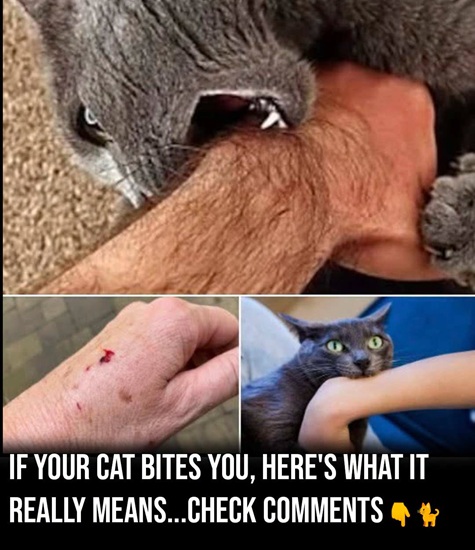
Anyone who has lived with a cat knows that feline behavior can sometimes be wonderfully confusing. A cat may spend one moment curled peacefully beside you and the next suddenly give your hand a quick nip. That bite may be gentle, playful, defensive, or connected with discomfort, depending on what was happening just before it occurred. Cats use their bodies to communicate, and biting is only one part of that communication system. Understanding the situation, the cat’s body language, and the intensity of the bite can help people respond more appropriately.
A bite does not automatically mean that a cat is angry or aggressive, but it should never be ignored when it is strong, unexpected, or breaks the skin. Cats have inherited many behaviors from their wild ancestors, including stalking, chasing, grabbing, scratching, and biting. Even a well-fed house cat may suddenly chase a moving shoelace or pounce on a toy because those actions resemble hunting behavior. Play therefore often involves movements that would be useful when capturing prey.
For kittens especially, biting can be a normal part of exploring and learning. Problems develop when cats learn that human hands and feet are acceptable targets for that play. Best Friends Animal Society recommends redirecting play toward toys rather than encouraging kittens to wrestle directly with hands or feet. A playful bite is usually different from a serious defensive attack. During play, the cat may stalk, pounce, grab, kick with the back legs, or briefly bite before immediately returning to playful behavior.

The cat’s body is often active rather than rigid, and the interaction may continue with toys or running around the room. A cat that is genuinely frightened or defensive may instead flatten its ears, hiss, growl, raise its fur, crouch, or attempt to escape. These signals help provide context. The bite itself is only one clue, so paying attention to everything happening around it gives a much clearer picture of what the cat is trying to communicate.
Some cats also give very gentle nibbles while receiving attention from people they trust. Owners often refer to these as “love bites,” although that phrase should not be interpreted too literally. A soft nibble can occur during a pleasant social interaction, but it can also mean that the cat is beginning to reach its limit. A cat may still be purring and enjoying attention while simultaneously becoming overstimulated. The important point is that the bite can represent a transition rather than pure affection. Watching what happens immediately afterward is usually more useful than assigning one emotional meaning to every gentle nip.
Petting-related overstimulation is common in some cats. A cat may enjoy being stroked for several seconds or minutes and then suddenly become uncomfortable with continued touch. Best Friends Animal Society notes that cats can bite after being petted for a period of time or after being touched in a particular location. Signs such as tail twitching, whiskers moving forward, skin twitching along the back, turning the head toward the hand, or increased body tension can indicate that the cat has had enough. Ending the interaction before the bite happens can prevent conflict and teach the person to recognize the cat’s limits.
This kind of reaction is sometimes called petting-induced aggression, although the behavior does not necessarily mean the cat is generally aggressive. Some cats simply tolerate physical contact for shorter periods than others. One cat may happily sit on a lap for an hour, while another prefers only a few seconds of scratching around the cheeks. Respecting those individual preferences is important. Forcing continued contact because a cat “should” enjoy being petted can create unnecessary stress. Allowing the cat to walk away often makes future interactions more positive.

Cats can also become overstimulated during intense play. A cat chasing a feather wand may become increasingly excited, and that excitement can spill over into grabbing or biting whatever is nearby. Best Friends recommends interactive toys such as wand toys because they create distance between the cat’s teeth and a person’s hands. This allows the animal to chase, pounce, and bite an appropriate target while still enjoying social play.
Kittens are particularly likely to engage in rough play because they are still learning how strongly they can bite. In a litter, young cats learn boundaries by wrestling with siblings and responding when another kitten reacts to a painful bite. A kitten raised without enough appropriate social play may not learn those limits as effectively. Humans can help by redirecting biting toward toys and ending play when teeth are used on skin. Best Friends specifically advises against using hands and feet as toys because kittens may continue that behavior into adulthood.
It can be tempting to laugh when a tiny kitten attacks fingers because the behavior appears harmless. The problem is that the same habit can become painful once the animal is fully grown. Adult cats have stronger jaws and sharper teeth than young kittens. A behavior that once felt like a light nip can eventually cause puncture wounds. Establishing good play habits early is therefore easier than trying to change a long-established pattern later.
Redirecting play does not mean preventing natural hunting behavior. Cats benefit from opportunities to stalk, chase, pounce, and “capture” toys. Wand toys, toy mice, balls, and food puzzles can provide appropriate outlets for those instincts. Best Friends notes that enrichment helps reduce boredom and gives cats appropriate ways to express predatory behavior.
Another common reason for biting is fear. A frightened cat may bite when it believes escape is impossible or when someone approaches too quickly. This is a defensive behavior rather than an attempt to dominate a person. Cats may become frightened by unfamiliar people, loud noises, veterinary examinations, sudden movements, or being physically restrained. In such situations, biting can be one of the final ways the animal tries to create distance.
Fearful cats often provide warning signs before biting. Their pupils may become large, ears may flatten, body posture may lower, or the tail may tuck close to the body. Hissing, growling, or swatting may occur first. Ignoring these warnings and continuing to approach can increase the chance of a bite. Giving the cat an escape route and allowing time to calm down is usually safer than forcing interaction.
Stress can produce similar behavior even when the cat is not facing immediate danger. Changes in the household, unfamiliar animals, moving to a new home, visitors, construction noise, or conflict with another pet can increase anxiety. A stressed cat may become less tolerant of handling and may bite more quickly than usual. Addressing the source of stress can sometimes reduce the behavior.
Cats can also redirect frustration. For example, a cat may see another cat outside through a window and become highly aroused. If a person attempts to touch the cat at that moment, the cat may suddenly bite or scratch the person even though the outside animal triggered the reaction. Best Friends describes this type of behavior as redirected aggression and recommends identifying and managing the original trigger.
This is another reason not to assume that every bite is about the person who receives it. The cat may already be reacting strongly to something else in the environment. Observing what happened immediately before the incident can help explain otherwise confusing behavior. A cat that suddenly becomes aggressive after spotting another animal may need time alone to settle before being touched again.
Pain is another important possibility when a cat suddenly starts biting. Cats often hide discomfort, so behavioral changes may be one of the first signs owners notice. A normally tolerant cat that suddenly bites when touched near the back, abdomen, mouth, or legs may be experiencing pain. Best Friends recommends veterinary evaluation when aggression or biting changes unexpectedly because medical problems can cause pain or irritability.
Dental disease is one example. A cat with painful teeth or gums may resist having its face touched. Arthritis may make handling uncomfortable, especially around the hips or spine. Skin problems can make petting painful. Injuries, urinary problems, or other illnesses can also change behavior.
Because cats cannot explain where something hurts, sudden behavior changes deserve attention. A bite that appears “out of character” should not automatically be treated as a training problem. Veterinary evaluation can help rule out medical causes before behavioral strategies are attempted. This is particularly important in older cats, which are more likely to develop conditions such as arthritis or dental disease.
Territorial behavior can also be involved in some biting incidents. Cats may defend food, resting areas, hiding spaces, toys, or access to important resources. However, describing this simply as a cat trying to “dominate” a human can be misleading. Modern behavior guidance generally focuses more on fear, resource guarding, stress, and communication than on broad dominance explanations.
A cat that guards a favorite hiding place may be communicating that it does not want to be disturbed. Reaching into that space can provoke a defensive response. Providing multiple resting areas, litter boxes, food locations, and vertical spaces can reduce competition in multi-cat homes. Giving cats more control over their environment often reduces conflict.
Some cats also bite because they have learned that biting gets a response. If a cat nips a person and immediately receives food, attention, or play, the behavior may become reinforced. This does not mean the cat is consciously manipulating someone in a human sense. It simply means the cat has learned that a particular action produces a predictable outcome.
For example, a cat may begin nipping ankles shortly before mealtime if that behavior repeatedly causes the person to prepare food. The best response is usually to establish a predictable feeding routine and avoid immediately rewarding unwanted biting. Providing scheduled meals or food puzzles can help redirect attention.
Cats may also use gentle mouth contact during social grooming. Cats that are closely bonded sometimes lick and nibble one another while grooming. A similar behavior can occasionally be directed toward humans. Again, the context matters. Soft mouth contact while relaxed is very different from a hard bite accompanied by growling or tense body language.
Purring should not be treated as proof that a cat is completely comfortable. Cats often purr when relaxed, but purring can also occur when they are stressed, frightened, or unwell. Looking at the entire body posture is more reliable than focusing on one sound.
The tail can provide useful information. Slow, relaxed movement may accompany calm behavior, while rapid tail flicking or thumping can indicate rising irritation in some cats. A tail puffed dramatically can indicate fear or intense arousal. Individual cats vary, so owners often become better at interpreting these signals over time.
Ear position can also be helpful. Forward or neutral ears generally suggest a relaxed or interested cat. Ears turned sideways or flattened backward can indicate discomfort, fear, or aggression. When these signs appear during petting, stopping before a bite occurs is often the best choice.
The eyes also communicate information. Enlarged pupils can appear during fear, excitement, or play. Narrowed eyes may occur when a cat is relaxed, but context again matters. No single physical sign has only one meaning.
Because feline body language is subtle, people sometimes miss early warnings. A person may describe a bite as “completely random” when the cat had already shown tail twitching, muscle tension, or head turning. Learning these smaller signals can make interactions safer and more enjoyable.
Punishment is generally not an effective response to biting. Yelling, hitting, spraying water, or physically restraining a cat can increase fear and damage trust. A frightened cat may become more likely to bite in the future if it learns that people respond unpredictably or aggressively.
Instead, behavioral approaches usually focus on preventing triggers, rewarding calm behavior, and redirecting unwanted play. For kittens, this means offering appropriate toys. For overstimulated cats, it means shorter petting sessions. For fearful cats, it may mean allowing greater distance.
Interactive play can be especially useful for energetic cats. A daily routine involving wand toys can provide exercise and mental stimulation. The toy can imitate prey by moving away from the cat, hiding, pausing, and then moving again. Best Friends specifically advises against repeatedly pushing a toy toward a cat’s face because that can feel threatening rather than engaging.
Food puzzles can provide another form of enrichment. Instead of receiving every meal in a bowl, cats can work to retrieve part of their food from puzzle toys. This encourages problem solving and mimics aspects of natural foraging behavior. Enrichment can reduce boredom and may help prevent some unwanted behaviors.
Environmental enrichment also includes vertical spaces. Cat trees, shelves, and window perches allow cats to observe their surroundings from safe elevated positions. Hiding areas provide privacy when the animal wants to rest. Scratchers provide appropriate outlets for scratching behavior.
A well-designed environment can reduce stress because the cat has more choices. Behavioral problems often become worse when animals feel trapped or unable to escape unwanted interaction. Allowing choice is therefore an important part of cat welfare.
Multi-cat households may require additional planning. Cats can compete for food, litter boxes, sleeping areas, and attention even when fights are not obvious. Providing multiple resources in separate locations can reduce tension. Some behavior experts recommend having more than one litter box and distributing resources rather than placing everything in one location.
Children should also be taught how to recognize when a cat wants space. Young children may hug, chase, or restrain cats without realizing that the animal is becoming frightened. Supervising interactions protects both the child and the cat.
A cat should always have the option to leave. Holding an animal in place while it struggles can quickly turn a calm interaction into a defensive bite. Teaching children to let the cat approach rather than chasing it is usually safer.
Visitors may need similar guidance. A shy cat should not be forced to meet new people. Allowing the animal to hide can reduce stress and may encourage it to come out later when the environment feels safer.
Veterinary visits are another common source of fear-related biting. Cats may become stressed by the carrier, car ride, unfamiliar smells, or physical examination. Training cats to view the carrier as a normal resting place rather than something that appears only before veterinary visits can help reduce anxiety.
Leaving the carrier open at home with bedding or treats inside can make it more familiar. Reward-based handling practice can also help cats become more comfortable with gentle touching of paws, ears, and other body areas.
If a cat repeatedly bites during handling despite careful training, discussing the problem with a veterinarian or qualified feline behavior professional can be useful. Some cats need individualized behavior plans.
The human side of cat bites also deserves careful attention because even a small puncture can become infected. Cat teeth are narrow and sharp, allowing them to penetrate deeply while leaving relatively small marks on the surface. This can carry bacteria into deeper tissues where cleaning is more difficult.
A superficial-looking puncture should therefore not always be dismissed. Mayo Clinic recommends washing minor animal bites thoroughly with soap and water and covering them with a clean bandage. Medical evaluation may be needed depending on the depth, location, and circumstances of the bite.
The original advice to simply wash a bite, apply antiseptic, and cover it is useful as basic first aid, but deeper cat bites often deserve more caution. Mayo Clinic advises prompt medical care for deep punctures, severe wounds, heavy bleeding, or bites showing signs of infection.
Signs of infection can include increasing redness, swelling, warmth, worsening pain, drainage, or pus. Fever or feeling generally unwell can also occur if infection becomes more serious. These symptoms should not be ignored.
Bites to the hands can be particularly concerning because important tendons, joints, and other structures lie close beneath the skin. A deep puncture near a joint can introduce bacteria into areas where infection may become difficult to treat. Medical professionals may therefore recommend evaluation even when the external wound looks small.
People with weakened immune systems, diabetes, circulation problems, or other conditions affecting healing may have a higher risk of complications. They should generally seek professional advice sooner after a bite.
Tetanus vaccination status should also be considered. Mayo Clinic notes that a healthcare professional may recommend a tetanus booster when a wound is deep or dirty and the person has not received an appropriate recent booster.
Rabies is another consideration, although risk depends heavily on the location, the animal, and vaccination status. A bite from a healthy, vaccinated household cat may present a very different risk from a bite from an unknown stray animal. Anyone uncertain about rabies exposure should contact a healthcare professional or local public-health authority promptly.
Rabies decisions should not be delayed while waiting for symptoms. Once rabies symptoms develop, the infection is extremely dangerous. Post-exposure treatment is preventive and must be considered before illness develops.
Owners should keep their cats’ vaccinations current according to veterinary recommendations. This protects the animal and can simplify decision-making if a bite ever occurs.
When a cat bite breaks the skin, the first step is generally to wash the area thoroughly with soap and running water. Visible debris should be removed gently. A clean dressing can then protect the wound.
If bleeding is significant, gentle pressure with a clean cloth or bandage can help control it. Severe bleeding, deep wounds, crushed tissue, or bites involving the face or other sensitive areas should receive prompt medical attention.
It is important not to seal a deep puncture with household glue or other improvised methods. Deep animal bites may need professional cleaning and medical assessment.
Antibiotics are sometimes prescribed for cat bites because of the risk of bacterial infection. Whether they are needed depends on the wound and the person’s medical situation. This decision should be made by a healthcare professional.
Cat bites can sometimes infect rapidly. A wound that becomes increasingly painful or swollen over several hours deserves attention rather than waiting several days to see what happens.
The risk of infection does not mean people should fear their cats. Most human-cat interactions never result in serious bites. Understanding body language and appropriate play can greatly reduce the chance of injury.
Many biting incidents are preventable. If a cat regularly bites after three minutes of petting, stop after one or two minutes. If the cat attacks moving feet, schedule more interactive play and avoid encouraging chase games with human body parts.
Predictability often helps cats feel secure. Regular feeding times, stable routines, and consistent handling can reduce stress. Sudden changes can sometimes trigger behavioral problems.
Every cat is different. One cat may love belly rubs, while another becomes defensive the instant its abdomen is touched. Assuming that all cats should tolerate the same handling can lead to misunderstandings.
The belly is especially sensitive because it protects vital organs. A cat rolling onto its back does not always mean it wants its stomach rubbed. Sometimes the posture indicates relaxation or trust rather than an invitation to touch.
Similarly, exposing the belly during play can allow the cat to use all four paws and teeth. Reaching toward the stomach can quickly produce scratching or biting.
Areas around the cheeks and head are often better tolerated by many cats, although individual preferences vary. Short, gentle petting sessions allow the owner to learn what the cat enjoys.
A useful approach is to allow the cat to initiate interaction. Hold a hand still and allow the animal to sniff or rub against it. If the cat moves closer, brief petting may be welcome. If it turns away, respect the decision.
Consent is not a uniquely human concept in practical animal handling. Giving an animal control over whether interaction continues can reduce stress and create more positive relationships.
Cats also communicate when they want play rather than petting. A cat crouching, wiggling its hindquarters, or watching moving hands intensely may be preparing to pounce. Offering a toy at that moment can prevent hands from becoming targets.
Regular play sessions can be brief. Even several short sessions each day may help an energetic indoor cat release energy. The appropriate amount varies with age and health.
Kittens generally need more play than elderly cats. Senior cats may still enjoy toys but may prefer slower movements or shorter sessions.
Cats with medical conditions may require modified activity. A veterinarian can advise on safe play for animals with arthritis, heart problems, or other limitations.
Behavior changes should always be interpreted in context. A previously playful cat that suddenly hides and bites may be sick. A newly adopted cat that bites during the first week may simply be frightened and adjusting.
New environments can be overwhelming. Giving a recently adopted cat a quiet room with food, water, litter, hiding places, and gradual introductions can help it settle.
Some cats require days to adjust; others need weeks or longer. Patience can prevent defensive behavior.
People should also avoid forcing interaction because they want to “prove” that the cat is friendly. Trust grows through repeated safe experiences.
Treats can help create positive associations with people. Tossing a treat near a shy cat allows it to approach without being touched.
Clicker training and reward-based training can also provide mental stimulation. Best Friends notes that cats can learn cues and tricks using positive reinforcement.
Training can help strengthen communication between cats and humans. A cat can learn to enter a carrier, touch a target, or move to a mat on cue.
These skills can make veterinary care and daily routines easier.
Behavior professionals can be particularly helpful when biting is frequent or severe. A qualified feline behaviorist can evaluate the home environment and identify triggers that may not be obvious.
Veterinarians should be involved first when the behavior appears suddenly because pain or illness needs to be ruled out.
This combination of medical and behavioral evaluation often provides the clearest picture.
It is also useful to avoid labeling a cat as “mean.” Biting is behavior, not a personality diagnosis. The same cat may be affectionate in one situation and defensive in another.
Understanding the reason for the behavior gives owners something practical to address.
A cat biting during rough play needs different help from one biting because of arthritis.
A frightened rescue cat needs a different approach from a kitten attacking ankles.
A hungry cat that has learned to nip before meals needs a different strategy again.
Context is everything.
Some people become worried when a cat gently mouths their hand without applying pressure. If the animal is relaxed and the contact remains gentle, it may simply be exploratory or social.
Still, people should avoid encouraging stronger biting by turning the hand into a toy.
Redirecting to an appropriate object preserves the interaction without teaching unwanted habits.
Cats can also use their mouths while grooming people. A cat may lick hair or skin and then lightly nibble. This resembles grooming behavior seen between cats.
Again, the bite should remain gentle. If pressure increases or the cat’s body becomes tense, ending the interaction is sensible.
Some cats become irritated when petting creates static electricity or touches sensitive fur repeatedly. Small environmental factors can influence tolerance.
Seasonal changes, shedding, and skin conditions may also affect sensitivity.
A cat that suddenly reacts when touched in one specific area should be examined if the behavior persists.
Owners should record patterns when biting becomes a problem. Noting the time, location, what happened before the bite, and the cat’s body language can reveal triggers.
A simple log can sometimes show that bites occur mostly before meals, during evening play, or after long petting sessions.
This information is also useful to veterinarians and behavior professionals.
Videos can help too, but people should never provoke a cat intentionally just to record the behavior.
Safety comes first.
The ultimate goal is not to eliminate every natural feline behavior. Cats will always use their teeth during play, hunting, grooming, and defense.
The goal is to teach them how to live safely with humans while respecting their instincts.
Human behavior also has to adapt.
We cannot expect cats to understand every social rule automatically.
They learn through experience.
Consistent, gentle boundaries usually work better than punishment.
Providing appropriate outlets makes those boundaries easier to follow.
A cat with plenty of toys, scratching areas, hiding places, and climbing spaces has more choices than one living in a bare environment.
Choice reduces frustration.
Play reduces boredom.
Predictability reduces stress.
Respecting warning signs reduces bites.
Veterinary care identifies pain.
These principles together can improve both safety and the relationship.
Cat bites should therefore be understood from two perspectives.
First, they are a form of feline communication and behavior.
Second, if they break human skin, they can become a medical issue.
Ignoring either side can create problems.
Understanding the cat but ignoring a puncture wound is unsafe.
Treating every bite only as a medical issue while never addressing the cause means the behavior may continue.
Both parts matter.
For mild behavioral biting, observe the circumstances and redirect appropriately.
For sudden or unusual aggression, consider a veterinary examination.
For repeated serious biting, consult an experienced behavior professional.
For a bite that penetrates the skin, clean it promptly and assess whether medical care is needed.
Seek professional help for deep punctures, worsening pain, swelling, drainage, severe bleeding, or uncertainty about tetanus or rabies risk.
Above all, remember that a bite does not have one universal meaning.
It might mean “let’s play.”
It might mean “I’ve had enough.”
It might mean “I’m frightened.”
It might mean “that hurts.”
It might be part of grooming.
It might reflect excitement.
Or it might simply be a learned behavior that has worked before.
The cat’s body language and the situation surrounding the bite usually provide the best clues.
People who learn those signals often find that their relationship with their cat becomes easier to understand.
Cats may never become completely predictable.
That is part of their charm.
But their behavior is rarely as mysterious as it first appears.
A tail twitch, flattened ears, tense muscles, or a sudden head turn can tell you that the interaction should stop.
A relaxed body, gentle purring, and soft rubbing may show that the cat still wants contact.
Watching and respecting those signals is one of the most effective ways to prevent bites.
And if a bite does happen, treating the wound appropriately protects the human side of the relationship too.
Living successfully with cats is ultimately about communication.
They communicate differently from people, but they communicate constantly.
Learning their language can turn a surprising nip from a confusing event into useful information about what your cat needs.
