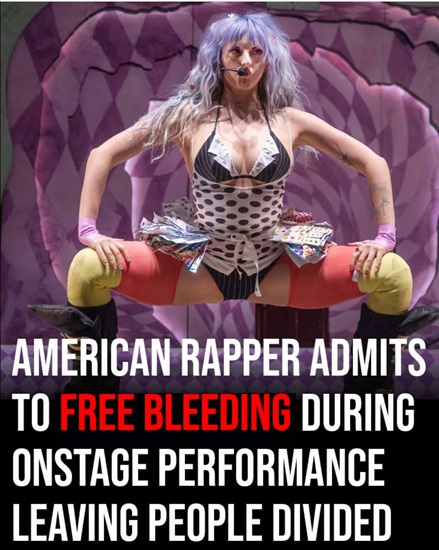
Ashnikko became the center of a lively online discussion after making an unusually candid comment about menstruation during a performance at Sziget Festival in Budapest. The American musician, whose real name is Ashton Nicole Casey, was performing at the 2026 edition of the festival when she told the audience that she felt her period was about to begin. She then joked that if she ended up “free bleeding” while performing, the crowd should respond with support rather than alarm.
The moment was delivered playfully onstage, but videos of it later generated a much broader conversation online. Sziget Festival took place in Budapest from August 11 through August 15, 2026, with Ashnikko among the performers listed for the event. The festival featured dozens of international artists and hundreds of programs across several days, placing Ashnikko’s comments within one of Europe’s major summer music events.
Once clips of her remarks began circulating after the festival, the discussion quickly moved beyond the people who had actually attended the performance. During the show, Ashnikko told the crowd that she felt as though she was about to start her period. She said that if she began free bleeding onstage, she wanted “respect and love” from the audience. She also encouraged fans to send hearts toward her. The musician then repeated a playful line about “free bleeding in Budapest,” incorporating the spontaneous comment into the energy of the performance.
The people attending the show appeared to respond positively to the moment, according to coverage of the performance. Online reaction, however, was much more divided. Some viewers found Ashnikko’s openness refreshing and saw nothing particularly controversial about mentioning menstruation publicly. Others questioned why someone would want to discuss free bleeding during a concert at all.
That difference in reaction turned a brief onstage comment into a larger conversation about periods, public comfort, hygiene and the continuing stigma surrounding menstruation. It also demonstrated how quickly a casual remark from a performer can take on a life of its own once a short video begins circulating on social platforms.
To understand the debate, it helps to define what free bleeding actually means.
Cleveland Clinic describes free bleeding as allowing menstrual blood to flow without using products such as tampons, pads or menstrual cups to collect it. Some people who free bleed simply allow the blood to reach their regular underwear or clothing, while others wear specially designed absorbent period underwear.
Healthline uses a similar definition, explaining that free bleeding generally means menstruating without traditional products that absorb or collect menstrual flow. The term can include people who wear period-proof clothing as well as those who choose not to use any absorbent menstrual product at all.
There is therefore no single universal method.
One person might free bleed only during lighter days.
Another might use period underwear.
Someone else might choose to avoid conventional menstrual products throughout an entire cycle.
The reasons can also vary considerably.
Some people choose free bleeding because they find pads uncomfortable.
Others dislike inserting tampons or menstrual cups.
Some may have skin irritation or vaginal dryness associated with certain products.
Cleveland Clinic notes that comfort is one of several reasons people may decide to free bleed.
Cost can be another factor.
Menstrual products are recurring expenses, and not everyone can easily afford them.
For some people, free bleeding is an intentional personal choice.
For others, going without conventional period products can be connected to financial circumstances rather than preference.
That distinction matters.
The practice has also become connected with conversations about menstrual stigma.
In many cultures and social settings, menstruation has historically been treated as something that should remain hidden.
Some people who intentionally free bleed describe their decision as a way of challenging the idea that menstruation is embarrassing or shameful.
That cultural element helps explain why Ashnikko’s comments generated such passionate responses.
For supporters, her willingness to speak openly about her period during a major music festival could be interpreted as a rejection of embarrassment around a normal bodily function.
For critics, the issue was less about discussing menstruation and more about the possibility of visible blood in a shared public environment.
Those are not necessarily the same argument.
Someone can support open discussion of menstruation while still preferring that bodily fluids be contained in crowded public settings.
Likewise, someone who supports free bleeding personally may not believe everyone should practice it.
Online discussions often collapse those distinctions.
The reactions reported after Ashnikko’s performance illustrate that problem.
Some people asked how anyone could feel comfortable free bleeding.
Others responded much more harshly.
Supporters, meanwhile, argued that menstruation is natural and that Ashnikko had simply been warning the audience not to be surprised if blood became visible.
One response cited in coverage claimed that free bleeding was healthier than using a pad.
That statement should not be treated as established medical fact.
There is no broad medical conclusion that free bleeding is inherently healthier than properly using menstrual pads.
Different menstrual-management methods have different advantages and disadvantages, and personal health needs vary.
Cleveland Clinic does identify potential reasons someone might prefer free bleeding, including avoiding irritation from pads or vaginal dryness from tampons. It also notes that avoiding internal products removes the specific risk of toxic shock syndrome associated with tampon use. But that does not mean every person will be healthier if they stop using period products.
Similarly, another social-media comment characterized menstrual blood as exceptionally “clean.”
That wording is medically misleading if taken literally.
Menstrual blood is not inherently dirty or shameful.
But it is still blood.
Like other human blood, it can potentially carry blood-borne pathogens.
Cleveland Clinic specifically notes this when discussing free bleeding, even while describing the overall activity as relatively low-risk when good hygiene is maintained.
That context allows the conversation to remain both respectful and medically accurate.
Periods are a normal biological process.
Menstrual blood should not be treated as evidence that someone is dirty.
At the same time, normal bodily fluids can still require practical hygiene considerations.
Both points can be true.
Cleveland Clinic says free bleeding can generally be practiced safely if someone maintains appropriate personal hygiene and changes clothing when needed. Leaving menstrual blood against the skin for long periods can create moisture and bacterial buildup, potentially causing odor or mild irritation.
That means free bleeding is not simply a question of whether someone is comfortable seeing blood.
There are also practical issues involving clothing, cleaning and shared spaces.
Those considerations become more complicated at a music festival.
A festival stage is not a private home.
Performers are surrounded by crew members, dancers, equipment and other people working in close proximity.
That does not mean Ashnikko actually bled visibly during the performance.
The verified reporting describes her saying that she felt her period was about to start and that she might free bleed.
Coverage did not establish that she ultimately experienced visible menstrual bleeding onstage.
That distinction is important.
The viral conversation was triggered primarily by what she said might happen.
It should not be rewritten as proof that she definitely bled publicly during the show.
Ashnikko’s comment was also delivered humorously.
After warning the audience, she turned the subject into a spontaneous musical line and repeated “Free bleeding in Budapest.”
That performance style is consistent with her reputation for theatrical and unconventional stage presentation.
Still, how audiences interpret humor can vary.
What feels playful and liberating to one person may feel unnecessarily personal to another.
Social media tends to magnify those differences.
Short clips often remove the broader context of a live performance.
A person scrolling through a few seconds of video may encounter the comment without seeing how the crowd reacted or how it fit into the rest of the show.
That can make reactions more intense.
People may respond to the concept rather than the actual event.
The concept of visible menstruation can still provoke strong feelings because social attitudes toward periods are complicated.
For generations, advertising for menstrual products often avoided showing actual red blood.
Language around periods was frequently indirect.
People used euphemisms rather than saying “menstruation” openly.
Those patterns have gradually changed.
Modern discussions about menstrual health are often more direct.
Period products are marketed more openly.
Athletes, celebrities and other public figures increasingly discuss menstruation as part of ordinary health.
Nevertheless, discomfort remains.
Ashnikko’s announcement placed that discomfort in an environment where people did not expect it.
Concert audiences are accustomed to performers talking about relationships, politics, sex, personal experiences or mental health.
A performer announcing that her period might begin in the middle of a song remains less common.
That unexpectedness partly explains the attention.
It is also worth noting that menstruation itself is not automatically a medical problem.
For many people, it is a regular part of the reproductive cycle.
However, menstrual experiences differ considerably.
Some people have light periods.
Others experience heavy bleeding.
Some have significant cramping.
Others experience relatively little discomfort.
Those differences mean there is no single menstrual-management method that will suit everyone.
One person may prefer tampons.
Another may prefer pads.
Another might use menstrual cups.
Someone else may use period underwear.
Some may combine several methods depending on the day.
And some may choose free bleeding.
Medical advice should therefore avoid implying that one option is universally superior.
The most appropriate method depends on comfort, health, access and personal preference.
There are also situations where changes in bleeding deserve medical attention.
Cleveland Clinic advises speaking with a healthcare provider when menstrual bleeding becomes unusually heavy, unusually prolonged or significantly different from a person’s normal pattern.
Unexpected bleeding between normal periods can also have several possible causes and should sometimes be medically evaluated.
Those medical issues are separate from Ashnikko’s comments.
There is no verified reporting suggesting that she was describing abnormal bleeding or a health emergency.
She said she felt her regular period was about to begin.
The online conversation should therefore not be turned into speculation about her medical condition.
Her comments concerned anticipated menstruation and how she would react if it started while she was performing.
That alone was enough to start the debate.
Some fans interpreted her approach as confidence.
They appreciated that she did not appear embarrassed by the possibility.
Supporters argued that people should not panic simply because menstrual blood might become visible.
Others felt that bodily fluids should remain private regardless of whether menstruation itself is natural.
Neither viewpoint represents every person who saw the clip.
Calling the reaction universally supportive would be inaccurate.
Calling it universal outrage would also be inaccurate.
The response was divided.
That is the most defensible description based on the reporting.
There is another aspect of free bleeding that sometimes appears in these discussions: environmental waste.
Disposable pads and tampons generate waste.
Someone who uses no disposable menstrual products obviously produces less product waste during that period.
Reusable menstrual cups, reusable pads and period underwear also offer alternatives for people concerned about waste.
Free bleeding is therefore one possible approach among several.
It is not the only environmentally conscious option.
Cost is similarly complicated.
Using no menstrual products can reduce recurring expenses.
But absorbent period underwear, if used, requires an initial purchase.
Reusable products also have upfront costs.
Financial circumstances vary dramatically.
For people experiencing period poverty, lack of access to menstrual products may not be a voluntary statement at all.
Healthline notes that some people free bleed because they choose to challenge social norms, while others may do so because they cannot afford traditional products.
That distinction is easy to lose when free bleeding is discussed simply as an online trend.
For some people, it is political.
For some, practical.
For some, comfortable.
For some, financially necessary.
And many people have no interest in it at all.
Ashnikko’s festival comment did not attempt to provide a medical explanation of the practice.
She was talking to an audience during a performance.
The broader health debate appeared afterward as people online began arguing about what free bleeding means and whether it is appropriate.
That difference matters.
Ashnikko should not be presented as having instructed fans to adopt the practice.
The available reports show her talking about what might happen to her personally onstage.
She did not tell the audience that they should stop using menstrual products.
She also did not make a documented medical claim that free bleeding was healthier.
Some of those claims came from commenters reacting to the viral video.
Separating the performer’s words from viewers’ comments prevents misinformation.
It also makes the discussion more useful.
The central event was straightforward.
Ashnikko was performing at Sziget.
She felt her period might begin.
She told the audience.
She jokingly said that if she free bled, she wanted their support.
The clip circulated.
People disagreed.
Everything beyond that requires context.
The festival itself was a major international event.
Sziget’s official information lists its 2026 dates as August 11 through August 15.
Ashnikko appeared among an international lineup that also included acts such as Florence + The Machine, Twenty One Pilots, Zara Larsson, Lewis Capaldi, Bring Me The Horizon and others.
Against that large festival backdrop, Ashnikko’s comment was initially just one moment in a much longer performance.
Online sharing transformed it into the defining story from her appearance.
That is a common pattern in celebrity coverage.
A performance may last an hour.
One 20-second moment becomes the clip millions see.
People then discuss the clip more than the music.
This does not make the conversation meaningless.
But it does make accuracy especially important.
A headline can easily exaggerate.
Saying Ashnikko “free bled onstage” would go beyond the verified reporting.
Saying she “said she might free bleed because she felt her period was about to begin” accurately reflects what was reported.
Likewise, saying the crowd “was horrified” would be unsupported.
Coverage described the live response as generally positive, while the divided reaction emerged primarily online.
That contrast is interesting.
People physically present at a performance experience the artist’s tone, body language and surrounding atmosphere.
Online viewers may encounter the same words without those signals.
A joke that feels harmless in the room can look provocative when isolated in a short captioned clip.
This is not unique to Ashnikko.
It is part of how social media changes entertainment coverage.
The discussion also reveals how periods remain culturally sensitive despite being ordinary biology.
People are usually comfortable acknowledging that menstruation happens.
They may become far less comfortable when it is discussed visually or publicly.
Ashnikko’s comments challenged that boundary directly.
Whether someone sees that as refreshing or unnecessary is subjective.
What is not subjective is that menstruation is a normal biological process for many people.
Free bleeding is a real practice.
And there are medically responsible ways to discuss it without describing menstrual blood as either shameful or uniquely harmless.
Balanced health information avoids both extremes.
Menstrual blood is not evidence of poor hygiene.
But blood exposure should still be handled sensibly.
A person can support reducing menstrual stigma while also acknowledging sanitation.
Those positions do not contradict each other.
This nuance was mostly absent from the strongest social-media comments.
That is common during viral debates.
People tend to express clear approval or disapproval.
Medical reality is usually less dramatic.
Free bleeding can be a personal option.
It is not a requirement.
Traditional period products can also be used safely when instructions are followed.
People can select whatever method works best for them.
Tampons should be changed according to manufacturer and health guidance because leaving them in too long can increase the risk of toxic shock syndrome.
Pads need to be changed for comfort and hygiene.
Menstrual cups require proper cleaning.
Period underwear requires washing.
Free bleeding requires attention to clothing and skin hygiene.
Every approach involves practical considerations.
There is no reason to turn those choices into a moral competition.
Ashnikko’s comment nevertheless touched something larger than product preference.
It dealt with how comfortable people are acknowledging bodily functions publicly.
Artists often intentionally test those boundaries.
Ashnikko has built much of her public image around unusual visuals, candid lyrics and provocative performance choices.
A direct conversation with an audience about menstruation therefore did not occur in a completely unexpected artistic context.
Even so, the exact remark surprised people.
That surprise is what created the viral moment.
The incident can also be understood without labeling either side of the debate irrational.
Someone may feel uncomfortable seeing blood.
That reaction can exist without believing periods are shameful.
Another person may believe visible menstrual blood should not automatically cause embarrassment.
That belief can exist without demanding that everyone free bleed.
Internet arguments tend to eliminate those middle positions.
Responsible coverage should restore them.
The most useful question is not whether everyone should approve of Ashnikko’s joke.
It is what actually happened and what health information is accurate.
She made the comment.
The audience appeared receptive.
Online users disagreed.
Free bleeding means menstruating without conventional products collecting the flow.
It can be practiced in different ways.
Good hygiene matters.
Claims that it is universally healthier than pads are unsupported.
Claims that menstrual blood is somehow uniquely clean are also misleading.
Those facts leave plenty of room for personal opinions about the performance.
Some fans will admire her openness.
Some people will still find the comment uncomfortable.
Others may simply view it as a harmless joke during a concert.
That range of reaction is normal.
What should be avoided is turning discomfort into medical misinformation.
The same applies to supportive comments.
Defending menstruation from stigma does not require making exaggerated health claims.
Accurate normalization is stronger than exaggeration.
Periods are normal.
They can sometimes be messy.
People use different methods to manage them.
There should be no shame in discussing them.
At the same time, health and hygiene recommendations remain relevant.
Ashnikko’s Budapest moment became notable because all those subjects unexpectedly collided during a music festival.
A few sentences spoken between songs became a discussion about body autonomy, menstrual products, public expectations and social stigma.
Whether that conversation lasts is difficult to know.
Viral debates often fade quickly.
But the underlying subject is unlikely to disappear.
Conversations about menstrual health have become more open over time.
People discuss period poverty.
They discuss environmental waste.
They discuss product safety.
They discuss pain that was once routinely dismissed.
They also debate where personal choices intersect with shared public spaces.
Ashnikko’s comments touched several of those topics without trying to present a formal argument about any of them.
She was joking with fans.
The internet did the rest.
That context is probably the most accurate way to understand the episode.
It was neither a medical campaign nor a documented public-health problem.
It was a spontaneous comment from a performer anticipating that her period might start during her show.
The subsequent reaction revealed how divided people remain about visible menstruation and free bleeding.
And perhaps that is why the story attracted so much attention.
Had Ashnikko quietly left the stage and managed her period privately, nobody outside the venue would have known.
By discussing it openly, she made something usually hidden impossible to ignore.
Some viewers appreciated that.
Others disliked it.
But both responses demonstrated the same underlying reality: menstruation can still provoke unusually strong reactions despite being a routine part of life for billions of people.
The factual conclusion is simpler than the debate surrounding it.
Ashnikko performed at Sziget Festival in Budapest in August 2026.
During her set, she said she felt her period was about to start and joked that she might free bleed onstage.
She asked the crowd for support if that happened.
Videos circulated online afterward.
The comments became divisive.
There is no need to embellish the event beyond those facts.
The interesting part is what happened next.
People used one brief concert moment to debate comfort, hygiene, stigma and personal choice.
Some defended the performer.
Some criticized her.
Others used the moment to learn what free bleeding actually means.
That last response may ultimately be the most constructive.
Understanding the term makes it possible to discuss the practice without either sensationalizing it or treating it as something shameful.
Free bleeding is simply one method some people use to manage menstruation.
It has potential practical advantages for certain individuals and practical disadvantages for others.
It is not inherently a statement everyone has to embrace.
And it is not automatically dangerous when practiced with appropriate hygiene.
The decision remains personal.
Ashnikko’s decision to talk about the possibility publicly was personal too.
Fans are free to find the moment funny, empowering, awkward or unnecessary.
What matters for accurate reporting is keeping those opinions separate from what actually occurred and from what medical evidence supports.
In that sense, the viral Budapest clip offers a useful reminder about online debates.
Strong reactions travel faster than nuance.
A performer says something provocative.
A short clip spreads.
People choose sides.
Health claims enter the conversation.
Within hours, a personal joke can look like a much larger controversy.
Looking carefully at the evidence produces a calmer picture.
A musician anticipated her period during a live performance.
She openly joked about it.
Some people applauded that openness.
Others found the idea uncomfortable.
Medical sources indicate that free bleeding is a legitimate menstrual-management choice and can generally be safe with good hygiene, but they do not establish that it is universally healthier than conventional menstrual products.
That is the story without unnecessary exaggeration.
And it is arguably more interesting that way.
A brief moment at one of Europe’s biggest festivals became an unexpected test of how comfortable modern audiences really are with talking openly about menstruation.
The answer, judging from the reactions, is that people are still far from unanimous.
