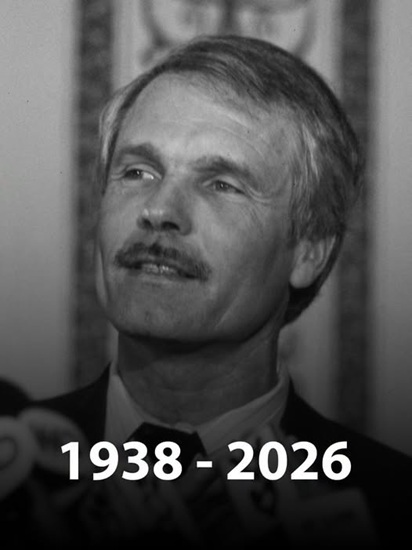
Ted Turner, the pioneering media entrepreneur whose ideas helped transform television news, cable broadcasting, professional sports and philanthropy, died on May 6, 2026, at the age of 87. Turner Enterprises announced that he died peacefully while surrounded by members of his family. His death brought renewed attention to a career that stretched across more than six decades and included some of the most influential developments in modern television. Turner was best known as the founder of CNN, the network that introduced continuous television news on a scale that had never previously existed.
But CNN represented only one chapter of an unusually wide-ranging career. Robert Edward Turner III was born in Cincinnati, Ohio, on November 19, 1938, and spent much of his childhood in the American South. His family eventually settled in Georgia, a state that would become closely associated with his professional life. Turner grew up in a family involved in the outdoor advertising industry, with his father operating a billboard business. The younger Turner did not begin life with an established television empire waiting for him.
His earliest professional experience instead came from learning the advertising business his family had built. That business would eventually provide the foundation for ambitions far larger than billboards. Turner attended Brown University but did not graduate, and his path into business developed through the family company. After his father died in 1963, Turner took control of the business while still a relatively young man. He expanded its operations and demonstrated the aggressive approach to competition that would later characterize his broadcasting career.
Turner did not appear satisfied with managing an established advertising operation indefinitely. He began searching for opportunities in radio and television at a time when broadcasting was undergoing significant technological change.
His move into television came in 1970, when he acquired a struggling UHF television station in Atlanta. The station had limited reach and faced significant competition from better-established broadcasters. Turner filled its schedule with inexpensive programming, including older movies, syndicated television programs and sports. Rather than viewing the station’s limited local audience as a permanent restriction, he began thinking about ways technology could expand its reach. That decision ultimately helped turn a modest Atlanta station into a national broadcasting operation.
The breakthrough came through satellite distribution. In the 1970s, Turner’s Atlanta station began transmitting its signal to cable systems across the United States, becoming one of the earliest nationally distributed television “superstations.” What had once been a local station could suddenly appear on television screens hundreds or thousands of miles away. The concept demonstrated that cable and satellite technology could weaken the traditional geographic boundaries of local television. Turner recognized the opportunity before cable television had become a dominant part of American media.
The station eventually became closely associated with the Turner Broadcasting System, or TBS. Its programming combined movies, entertainment and sports, creating a broad schedule designed to attract viewers across the country. Turner understood that national distribution meant he needed programs that audiences would seek out regardless of where they lived. Sports became particularly important because live games gave viewers a reason to return regularly. The strategy helped establish TBS as a significant cable brand and provided Turner with experience operating television on a national scale.
His involvement with professional baseball became closely connected to that strategy. Turner purchased the Atlanta Braves in the 1970s and placed the team’s games prominently on his television station. As the TBS signal expanded nationwide, Braves games became available to viewers far beyond Georgia. That unusual level of exposure eventually helped transform the Braves from a regional franchise into a team with supporters across much of the United States. The relationship between team ownership and television distribution showed Turner’s ability to connect separate businesses into one larger strategy.
Turner also became known for being a highly visible sports owner. He did not behave like a distant executive who appeared only at formal events. He attended games, interacted with players and frequently attracted media attention himself. During one unusual episode, he briefly attempted to manage the Braves during a difficult stretch of the team’s season. The move reinforced his reputation for ignoring traditional boundaries when he believed direct involvement was necessary.
Turner’s connection to sports extended well beyond baseball. He was also associated with ownership of the Atlanta Hawks basketball franchise and later had interests connected with other professional sports properties. Sports programming remained an important element of his television strategy because it delivered live audiences and encouraged cable companies to carry his channels. Long before sports media rights became the enormous global business they are today, Turner understood their value as television content.
His competitive instincts were equally visible away from the television industry. Turner became an accomplished sailor and competed at the highest levels of international yacht racing. In 1977, he captained Courageous to victory in the America’s Cup, one of sailing’s most prestigious competitions. The achievement brought him international recognition that was separate from his growing reputation as a broadcaster. His success on the water reinforced an image of a man who approached both sports and business with intense competitiveness.
Yet the project that would define Turner’s place in media history had not yet begun.
During the 1970s, television news in the United States was still dominated by major broadcast networks. News programs generally appeared during designated periods, especially in the evening. If a major event occurred outside those periods, broadcasters could interrupt regular programming, but there was no major television network devoted exclusively to news twenty-four hours a day. Turner believed the limitations of that system created an opportunity.
He later explained that part of his inspiration came from his own frustration with scheduled television newscasts. If someone arrived home after the evening news had ended, that viewer often had to wait until a later broadcast for another television summary of the day’s events. Turner imagined a channel that would make news available whenever someone wanted to watch it. The idea sounded questionable to many people in an industry accustomed to a completely different economic and programming model.
Creating such a network would require enormous financial investment. It would need anchors, reporters, producers, camera crews, technical facilities and news bureaus operating continuously. Instead of producing a few hours of news each day, Turner’s company would have to fill an entire television schedule with journalism. Critics questioned whether enough people would watch continuous news to make the business sustainable. Turner decided to proceed anyway.
On June 1, 1980, Cable News Network began broadcasting. CNN was built around the idea of delivering news twenty-four hours a day, seven days a week. The launch represented one of the boldest experiments in the young cable television industry. Viewers could now turn on a television at almost any hour and find news coverage rather than waiting for a scheduled evening program.
CNN’s early years were difficult. The network operated with far fewer resources than the established American broadcast networks and initially attracted skepticism from parts of the television industry. Critics even mocked the operation with nicknames suggesting that the young cable service could not compete seriously with older institutions. Turner nevertheless continued investing in the network. He expanded its reporting capabilities and remained committed to the idea that a permanent news service would eventually find an audience.
The fundamental innovation was not simply that CNN produced more news programming. Turner had changed the relationship between television and time. Under the older model, viewers adjusted their schedules around the news. Under CNN’s model, the news service remained available and viewers could enter the coverage whenever they chose. That seemingly simple shift became one of the foundations of modern television journalism.
The importance of continuous coverage became clearer whenever a major event unfolded unexpectedly. A twenty-four-hour network did not need to cancel an entertainment program before beginning sustained reporting because the network was already dedicated to news. Journalists could remain on the air while information developed. Interviews could occur immediately. Correspondents could provide updates as circumstances changed.
The model also created new expectations among audiences. Viewers increasingly wanted to see important events as they occurred rather than learn about them hours later. Television technology and satellite communications made live reporting from distant locations increasingly practical. CNN positioned itself to take advantage of those changes. The network gradually expanded both its domestic presence and international reporting operations.
Major stories during the 1980s helped establish the usefulness of Turner’s concept. Continuous coverage meant CNN could remain with a developing event far longer than traditional broadcasters ordinarily could. The network’s growing number of bureaus also allowed it to report from locations around the world. Over time, CNN stopped looking like an unusual cable experiment and increasingly appeared to be a permanent part of the television landscape.
The network’s reputation grew significantly during major international events. By the time of the Persian Gulf War in 1991, CNN’s ability to provide extensive live coverage had become one of its defining advantages. Millions of viewers watched developments unfold through television rather than waiting for later summaries. The network’s Gulf War coverage became an important moment in CNN’s transformation into an internationally recognized news organization.
Turner’s original assumption had proved influential: audiences did want access to news beyond fixed broadcast schedules.
CNN’s success also encouraged competitors. Other companies eventually launched their own twenty-four-hour news services, both in the United States and internationally. What had once seemed unusual gradually became a standard category of television. By the beginning of the twenty-first century, continuous television news was firmly established around the world.
The influence extended beyond cable television. The expectation that news should be immediately available later became central to digital journalism, websites, smartphones and social media. Turner could not have predicted every technology that followed CNN’s launch, but the basic expectation created by continuous news became even more powerful in the internet era. Modern audiences often expect significant events to be covered almost instantly.
CNN was not Turner’s only major cable venture.
His broadcasting company expanded into entertainment programming through additional networks. TNT launched as another important Turner property, offering movies, television programs and eventually significant sports coverage. Cartoon Network followed, using Turner’s access to a large library of animated programming. Turner Classic Movies created a dedicated television home for classic films and developed a distinctive reputation among movie enthusiasts.
These channels reflected a broader insight about cable television. Turner understood that the medium could support networks organized around specific types of programming rather than requiring every channel to serve every possible audience. News could have its own network. Cartoons could have one. Classic films could have another.
That model eventually became one of cable television’s defining characteristics.
Turner’s expansion into film libraries was partly connected with his acquisition of MGM/UA in the 1980s. The transaction was complicated and created major financial pressure, and Turner later sold significant portions of the company. However, he retained valuable rights associated with an extensive library of films and television content. Those assets later became strategically important for his cable channels.
The MGM transaction illustrated both sides of Turner’s approach to business. He was willing to make enormous bets when he saw strategic value, but those bets sometimes produced substantial financial difficulties. Turner did not build his empire through a sequence of effortless successes. Several ventures created debt, controversy or pressure that required further restructuring.
His ambitions occasionally reached directly toward the traditional broadcasting establishment. In 1985, Turner attempted a takeover of CBS, one of America’s major television networks. The attempt did not succeed, but the fact that a cable entrepreneur would challenge such an established broadcaster demonstrated how rapidly the media balance was changing. Turner was no longer merely running an unconventional station in Atlanta.
He was competing with some of the most powerful institutions in American television.
Turner’s media empire eventually included a collection of brands that touched news, entertainment, movies, cartoons and sports. Turner Broadcasting had become far larger than the business from which his career began. The company helped prove that cable television could create nationally and internationally recognized media brands. By the 1990s, the once-disruptive cable industry had become an essential part of the television business.
In October 1996, Turner Broadcasting merged with Time Warner. The transaction, valued at roughly $7.5 billion, created one of the largest media combinations of its era. Turner became an important executive and shareholder within the combined organization. The merger brought CNN, TBS, TNT and other Turner properties together with Time Warner’s extensive media assets.
For Turner, the transaction represented both triumph and the beginning of a more complicated period.
He had spent decades building a company largely around his own personality, instincts and willingness to take risks. After the merger, that company existed inside a much larger corporate structure. Turner remained influential, but he no longer possessed the same degree of independent control he had enjoyed while building Turner Broadcasting.
The situation changed again when America Online and Time Warner announced their enormous merger at the beginning of the new century. The deal was initially celebrated as a combination of traditional media and the rapidly growing internet economy. Instead, the merger became one of the most famous disappointments in corporate history. The collapse in AOL’s share value and other difficulties damaged the value of Turner’s holdings significantly.
Turner gradually lost influence within the company that now controlled the media properties he had created. He eventually left Time Warner’s board in 2006. By that stage, CNN and the other Turner networks had lives far beyond their founder. His direct corporate authority had diminished, but the institutions created under his leadership continued operating.
His business career alone would have secured Turner a significant place in media history.
But during the second half of his life, philanthropy became increasingly important.
One of the defining moments came in September 1997, when Turner publicly announced an extraordinary commitment of up to $1 billion to support the United Nations and UN-related causes. At the time, it was described as the largest philanthropic commitment ever made by an individual. The decision surprised both the business and philanthropic worlds because of its enormous scale.
The United Nations Foundation was established in 1998 as the vehicle for Turner’s commitment. It developed partnerships designed to support UN priorities in areas including global health, peace and security, women and children, and environmental issues. Turner remained closely associated with the organization for the rest of his life. After his death, the UN Foundation described him as its founder and chairman and highlighted the lasting influence of the 1997 pledge.
Turner’s gift also influenced conversations about philanthropy among extremely wealthy individuals. The size of the pledge demonstrated that private fortunes could be deployed on a scale traditionally associated with governments or major institutions. Other prominent philanthropists later made similarly large commitments in areas such as health, education and poverty reduction.
His philanthropic interests were not limited to the United Nations.
Turner had a longstanding interest in reducing the risks associated with nuclear weapons and other weapons of mass destruction. In 2001, he joined former U.S. Senator Sam Nunn in launching the Nuclear Threat Initiative. The organization was created to work on reducing nuclear, biological and other major security threats.
Turner committed substantial personal resources to the organization. His involvement reflected concerns he had expressed for years about nuclear proliferation and the potential consequences of catastrophic conflict. Unlike his broadcasting ventures, these efforts were not intended primarily to generate commercial returns. They became part of his attempt to use his wealth and public profile for causes he considered globally important.
Environmental conservation was another major part of his later life.
Turner accumulated vast land holdings across the United States and became one of the country’s largest private landowners. Portions of those properties were managed with conservation and wildlife-restoration goals in mind. His holdings included habitats supporting native species, including large populations of American bison.
The Turner Foundation, established in 1990, supported initiatives related to land conservation, water quality, biodiversity and sustainable energy. The Turner Endangered Species Fund later focused specifically on restoring and protecting imperiled wildlife populations on Turner properties and elsewhere. These initiatives reflected a long-term environmental interest rather than a short-lived philanthropic campaign.
Turner’s environmental interests even entered popular culture.
He was involved in the development of the animated environmental television series “Captain Planet and the Planeteers,” which debuted in 1990. The program aimed to introduce younger audiences to environmental challenges through entertainment. The Captain Planet Foundation later supported youth environmental projects. The initiative represented another example of Turner combining media with causes he considered important.
His interest in international cooperation also appeared through sports.
Turner created the Goodwill Games during the Cold War era following the political tensions and Olympic boycotts that affected international athletics. The first Goodwill Games were held in Moscow in 1986. Turner hoped international sports competition could provide another avenue for communication between countries whose governments were frequently in conflict.
The Games never reached the status of the Olympics, but they reflected Turner’s characteristic preference for large, ambitious projects. Whether he was starting a television network, buying professional teams or creating an international sporting event, his instinct was rarely to begin modestly.
His public personality was similarly difficult to overlook.
Turner became famous for an outspoken, sometimes provocative communication style. Nicknames such as “Captain Outrageous” and “Mouth of the South” reflected his reputation for saying things other corporate executives might have avoided. His remarks occasionally generated controversy and sometimes required apologies or clarification.
That behavior made Turner a complicated public figure.
Admirers saw confidence, creativity and unusual courage in his willingness to challenge established institutions. Critics sometimes saw arrogance, impulsiveness or unnecessary provocation. Both characteristics could appear simultaneously, and they contributed to the public image he carried throughout much of his career.
Turner frequently treated business as competition.
He wanted to win.
That attitude helped him survive the early years of CNN, when many observers expected the network to fail. It also contributed to some of the risky acquisitions and confrontations that created financial problems. His career demonstrated that the same personality traits that produce extraordinary success can also create extraordinary difficulties.
His personal life received substantial public attention as well.
Turner married three times and had five children. His third marriage, to actress and activist Jane Fonda, began in 1991 and ended in divorce in 2001. Because both were internationally recognized public figures, their relationship regularly attracted media interest.
Fonda and Turner came from very different backgrounds and had their own strong public identities. Their decade-long marriage became one of the most closely watched celebrity relationships of the 1990s. After their divorce, each continued with separate careers and public activities.
Turner’s family history also included painful experiences.
His father died by suicide in 1963, leaving the young Turner responsible for taking control of the family business. Turner later spoke publicly about depression and other personal struggles. Those experiences formed a darker background to the confident public personality associated with his business career.
In his later years, health became another major challenge.
In 2018, Turner publicly disclosed that he had been diagnosed with Lewy body dementia. The condition is a progressive neurological disorder that can affect cognition, movement and other functions. Turner spoke about the diagnosis rather than keeping it entirely private.
As his health declined, his public appearances became less frequent.
By that point, however, the institutions he had created had already influenced several generations of viewers and media professionals. CNN had been operating for decades. TBS, TNT and other Turner brands were familiar parts of American television. His philanthropic organizations had established their own histories.
The media environment itself had also changed dramatically.
Cable television, which had once seemed secondary to traditional broadcasting, became a dominant force before eventually facing disruption from internet video and streaming services. Television news expanded from three major evening broadcasts into a crowded ecosystem of cable channels, websites, livestreams, apps and social platforms.
Some of those later developments created problems Turner could not have anticipated when CNN began.
The twenty-four-hour news cycle increased the speed of journalism, but it also created pressure to fill enormous amounts of airtime. Competition for viewers intensified. Commentary and opinion became increasingly prominent across television news. Digital platforms eventually pushed the demand for immediacy even further.
Turner’s innovation therefore produced both opportunities and consequences.
Continuous coverage made it possible for audiences to follow wars, elections, natural disasters, political changes and historic events as they unfolded. Journalists could remain live for hours rather than compress developments into short evening broadcasts. International events became immediately accessible to viewers thousands of miles away.
At the same time, the demand for constant updates fundamentally changed the pace of journalism.
Those larger debates about modern news do not alter the historical significance of CNN’s launch.
Before June 1, 1980, a national twenty-four-hour television news network was largely an untested idea. After CNN proved that the model could survive, competitors appeared around the world. The concept became so common that later generations could easily forget how unusual it had initially seemed.
Turner was willing to invest before that certainty existed.
His influence on sports television was similarly lasting.
Broadcasting Braves games nationally through a superstation helped demonstrate how television distribution could expand the identity of a sports franchise beyond its home market. Fans who had never visited Atlanta could regularly watch the team. That exposure helped create the Braves’ reputation as a nationally followed baseball club.
Modern sports media operates on an enormously larger financial scale, but Turner’s strategy anticipated an important principle: control of compelling live content could make a television platform more valuable.
He understood the connection between distribution and programming.
Owning a television channel was useful.
Owning programming people wanted to watch made the channel substantially more powerful.
That idea ran throughout many of his business decisions.
Films supported his entertainment channels.
Sports supported his superstation.
News supported CNN.
Animation supported Cartoon Network.
Each part could strengthen the broader media system Turner was assembling.
His career also demonstrated how quickly supposedly permanent media structures can change.
When Turner entered television, three major broadcast networks controlled much of American television culture. Cable initially occupied a much smaller place. Turner built businesses around a technology many traditional broadcasters had underestimated.
Later, the same cable channels Turner helped establish faced competition from digital media and streaming.
The lesson was not that one medium would remain dominant forever.
Turner’s career instead showed how an entrepreneur could recognize an emerging distribution technology and build new institutions around it.
He was not alone in developing cable television.
Nor did he personally invent every technology involved.
But his ability to combine satellite distribution, programming, sports rights, news and recognizable brands made him one of the industry’s most important figures.
His philanthropy followed a similarly expansive philosophy.
The $1 billion UN commitment did not represent a small charitable donation attached to an already famous business career. It represented a major portion of his wealth and created an institution designed to continue supporting international causes. The United Nations Foundation later reported that Turner’s original gift helped generate substantially more support through partnerships and additional contributions.
After his death, UN Foundation leaders described him as a humanitarian whose generosity had helped establish a new era of large-scale global philanthropy. That assessment came from an organization Turner himself founded, but the basic facts behind it are well documented. His 1997 pledge was unprecedented in scale at the time.
Turner’s conservation work likewise remained visible through his properties and foundations.
He owned enormous areas of land and used portions of them for wildlife management and habitat restoration. His interest in bison became particularly well known, and his properties supported one of the world’s significant privately managed bison populations.
Conservation was not separate from Turner’s business personality.
He frequently pursued environmental goals on the same unusually large scale that had defined his television ventures.
The years following his departure from Time Warner gave him more time to focus on those interests.
Although he no longer controlled CNN, he remained forever associated with its creation. Interviews with Turner frequently returned to the network and the circumstances surrounding its launch. He sometimes expressed opinions about how television news had changed, but his historical contribution did not depend on the later editorial direction of the company.
He had created the original platform.
Thousands of journalists and executives subsequently shaped what it became.
CNN itself marked Turner’s death on May 6, 2026, remembering the founder who had transformed the possibilities of television news. Current and former journalists discussed the skepticism the network faced in its early years and Turner’s determination to continue funding it.
Tributes also came from outside CNN.
Media executives, journalists, sports organizations and international institutions recognized different aspects of his career. Some remembered him primarily as a broadcaster. Others emphasized professional sports, sailing, conservation or philanthropy.
The range of reactions reflected the unusual breadth of Turner’s public life.
The Atlanta Braves remembered the owner who helped turn the club into a nationally known franchise.
The United Nations Foundation remembered the philanthropist whose unprecedented gift helped establish the organization.
Journalists remembered the entrepreneur who insisted that a news channel could remain on the air every hour of every day.
Conservation organizations remembered his efforts to protect land and wildlife.
Few media executives have accumulated such a varied set of legacies.
Turner was not a conventional corporate leader.
He could be impulsive.
He could make statements that attracted criticism.
He made investments that failed and transactions that cost him heavily.
His public behavior sometimes overshadowed his business accomplishments.
But judging his historical importance does not require pretending that every decision was successful.
Some of his greatest achievements came precisely because he accepted risks other executives considered unreasonable.
CNN was one of those risks.
The superstation strategy was another.
His major philanthropic commitments represented a different type of gamble: the belief that private wealth could be used to mobilize resources on international problems.
Even his sports activities often involved unconventional thinking.
This combination made Turner’s career difficult to categorize.
He was a broadcaster, but broadcasting was only part of his story.
He was a sports owner and champion sailor, but those achievements did not define him completely.
He was a billionaire businessman who eventually devoted enormous resources to philanthropy and conservation.
He was also a public figure whose personality generated both admiration and controversy.
The television industry that existed when Turner began working bears little resemblance to the media environment that existed when he died.
When he purchased his early Atlanta television station, viewers had relatively few channels.
When he launched CNN, the concept of receiving television news at any hour was revolutionary.
By the time of his death, people carried devices capable of streaming live news from almost anywhere in the world.
Information traveled constantly.
Breaking events could reach millions of people within seconds.
Turner did not create the internet or the smartphone era.
But his belief that audiences would value immediate, continuous access to information anticipated an important part of the culture that followed.
CNN demonstrated that news did not need to wait for a scheduled program.
That idea became increasingly important with every new communications technology.
His entertainment businesses had a similar impact.
TNT, Cartoon Network and Turner Classic Movies demonstrated how specialized cable networks could establish powerful identities.
Turner Classic Movies in particular became known for preserving and presenting classic cinema to new generations of viewers.
Cartoon Network became a major entertainment brand.
TNT grew into a significant destination for entertainment and sports.
These channels outlived the corporate structure under which Turner originally created them.
Ownership changed.
Companies merged.
Business strategies evolved.
But the brands remained evidence of the media ecosystem Turner helped construct.
His professional life was therefore defined not only by individual programs or television channels but by a broader approach to media.
Turner believed distribution technology could create new audiences.
He believed audiences would respond to specialized content.
He believed live sports could build national television brands.
And most famously, he believed news should never have to close for the night.
The last idea became inseparable from his name.
CNN’s launch on June 1, 1980, remains the moment most often cited when describing Turner’s influence.
It was an entrepreneurial gamble that changed television journalism.
The network struggled initially.
It survived.
It expanded internationally.
And competitors eventually copied the basic model.
That sequence transformed a risky experiment into an industry standard.
Turner’s later accomplishments expanded his legacy beyond media.
His billion-dollar commitment helped create the United Nations Foundation.
His work with Sam Nunn helped establish the Nuclear Threat Initiative.
His land holdings became connected with major conservation projects.
His foundations supported environmental work.
His sports interests reached baseball, basketball, sailing and international athletic competition.
At the time of Turner’s death, those achievements represented almost seven decades of public activity.
He had lived through the rise of television, cable, satellite broadcasting, the internet and streaming.
He had watched companies he created become pieces of corporations far larger than the original Turner Broadcasting System.
He had also watched the twenty-four-hour news format spread around the world.
Turner Enterprises said he died peacefully on May 6, 2026, surrounded by his family. He was 87.
His death did not end the debates surrounding the media environment he helped create.
The modern news business continues to struggle with questions involving speed, accuracy, competition, polarization and changing audience habits.
Cable television itself now faces pressure from streaming and digital platforms.
Yet those contemporary debates do not erase the magnitude of Turner’s original innovation.
He looked at television news when it operated mainly on a schedule and imagined a permanent service.
He looked at a local television station and imagined national distribution.
He looked at sports teams and saw television programming with national potential.
He looked at a personal fortune and eventually imagined philanthropy on a billion-dollar scale.
Many of those ideas initially appeared excessively ambitious.
Several succeeded beyond what critics expected.
Others failed or created serious problems.
Together, they produced one of the most unusual careers in modern American business.
Ted Turner’s life included wealth, competition, risk, success, failure, controversy, sports, philanthropy and environmental activism.
But one achievement remained at the center of nearly every assessment of his career after his death.
He changed how television delivers news.
Before CNN, scheduled news broadcasts were the norm.
After CNN, the possibility of continuous live news became part of everyday media.
The network he founded continued broadcasting long after he ceased controlling it.
Its competitors adopted the model.
International broadcasters adapted it.
Digital technology pushed the concept even further.
Turner had imagined that viewers would want news available whenever they were ready to watch.
That assumption became reality.
The pioneering broadcaster who made the gamble is now gone.
The world of continuous news he helped build remains.
