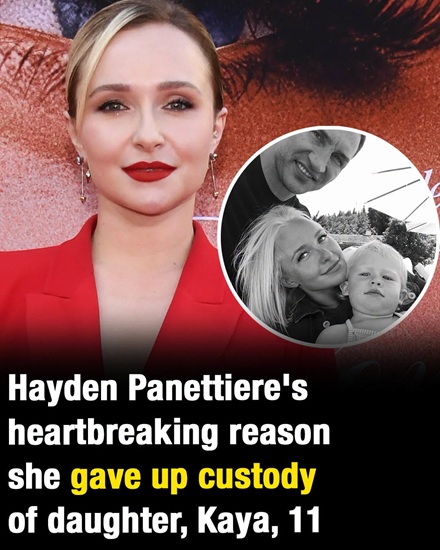
Hayden Panettiere, the actress known for Heroes, Nashville, Remember the Titans and the Scream franchise, died at the age of 36 on August 16, 2026. Her death was confirmed by her representative and family, bringing an unexpectedly early end to a career that had lasted for most of her life. Panettiere’s father, Alan “Skip” Panettiere, described his daughter as an extraordinary presence who brought love and happiness to the people around her and to millions who watched her perform.
She is survived by her parents and her 11-year-old daughter, Kaya Evdokia Klitschko. For many people who followed Panettiere’s career, her relationship with Kaya became one of the most emotional parts of her later public story. Kaya was born in December 2014 to Panettiere and her former fiancé, Ukrainian former heavyweight boxing champion Wladimir Klitschko. Years later, Panettiere spoke openly about the circumstances that eventually led her to sign over full custody of Kaya to Klitschko in 2018.
She repeatedly made clear that the decision was not the result of indifference toward her daughter. Instead, she described it as one of the most painful choices she ever made. The decision came after a period in which Panettiere was struggling with postpartum depression, alcoholism and other substance-use problems. Those difficulties developed following Kaya’s birth and eventually affected several areas of Panettiere’s personal and professional life. In interviews and later in her 2026 memoir, This Is Me: A Reckoning, Panettiere explained that she reached a point where she believed she was not capable of giving her daughter the stability she deserved on a daily basis.
Panettiere strongly objected to the suggestion that she had simply abandoned her daughter. During a May 2026 appearance on Jay Shetty’s On Purpose podcast, she addressed the criticism directly. She explained that people who assumed she had casually walked away from motherhood did not understand what was happening in her life at the time. For Panettiere, allowing Kaya to live with her father was a decision connected to her own health struggles and her belief that her daughter needed a stable environment.
Her comments made clear that the emotional consequences remained with her years later. Panettiere described being separated from Kaya’s everyday life as profoundly painful. She wrote in her memoir about grieving the fact that she was not the mother she had imagined herself becoming, while also emphasizing how deeply she loved her daughter. She described Kaya as the greatest gift of her life and said she remained grateful for the privilege of being her mother even though they did not live under the same roof.
The story of how Panettiere reached that point began long before the custody decision. She had grown up in entertainment herself, beginning professional work when she was extremely young. Panettiere later recalled being taken to auditions as a baby and appearing in dozens of commercials before she was old enough to attend elementary school. That early start eventually led to television roles, including appearances on One Life to Live and Guiding Light.

As Panettiere grew older, her career continued to expand. She voiced Dot in Pixar’s A Bug’s Life and appeared alongside Denzel Washington in the 2000 sports drama Remember the Titans. The film introduced her to a much larger audience and became one of the most recognizable projects from the early stage of her career. By adolescence, Panettiere already had years of experience working in television and film.
Her international breakthrough arrived in 2006 when she was cast as Claire Bennet on NBC’s Heroes. Claire was a high-school cheerleader who discovered that she possessed extraordinary regenerative abilities. The character became one of the series’ central figures, and Panettiere rapidly became one of television’s most recognizable young actresses. The show ran from 2006 to 2010 and brought her worldwide attention.
A few years later, Panettiere began another defining role. In 2012, she was cast as Juliette Barnes in the television drama Nashville. The character was a successful but emotionally complicated country singer dealing with fame, relationships, career pressure and personal difficulties. Panettiere remained part of the series throughout its six-season run and received two Golden Globe nominations for her performance.
During the same period, however, Panettiere’s private life became increasingly difficult. She and Klitschko welcomed Kaya in December 2014. Following the birth, Panettiere experienced postpartum depression, something she later discussed publicly at a time when the subject was still frequently misunderstood. She sought treatment and became one of several high-profile women speaking openly about how serious postpartum mental-health struggles can become.

Panettiere later revealed that her difficulties extended beyond postpartum depression. Alcohol increasingly became a problem, and she also experienced addiction involving other substances. She described feeling emotionally overwhelmed and increasingly unable to manage certain areas of her life. Those problems did not disappear simply because she was professionally successful or financially comfortable.
Her personal difficulties also unfolded while she continued working on Nashville. Panettiere later spoke about the uncomfortable similarities between aspects of Juliette Barnes’ fictional life and her own experiences. The overlap sometimes made the work emotionally complicated because storylines involving motherhood, addiction and instability could resemble things she was dealing with away from the cameras.
Eventually, Panettiere reached a point where her relationship with Klitschko and the arrangements surrounding Kaya changed significantly. Panettiere and Klitschko ended their romantic relationship, but they continued sharing a connection through their daughter. In 2018, Panettiere signed over full custody of Kaya to Klitschko.
That moment became one of the central subjects of Panettiere’s memoir years later. She explained that she believed she was making a decision based on what would provide Kaya with the greatest stability. Panettiere was dealing with addiction and serious emotional difficulties, while Klitschko could provide a structured home environment for their daughter.
From the outside, the custody arrangement sometimes generated harsh judgments. Panettiere later described how painful it was to see people accuse her of abandoning Kaya. She said those descriptions ignored both the circumstances and the emotional toll the decision had taken on her.
She repeatedly emphasized that relinquishing custody was not the same as relinquishing love. Panettiere remained involved in Kaya’s life and maintained communication with her daughter. By 2026, reporting described Panettiere and Klitschko as maintaining a workable co-parenting relationship despite the unusual geographic circumstances.
Kaya primarily lived with her father in Europe. That meant Panettiere had to experience motherhood across significant geographic distance. In her memoir, she reflected on how difficult it was to participate in her daughter’s life remotely and how much she wished circumstances had been different.
At the same time, Panettiere expressed gratitude that Kaya had stability. Her comments consistently returned to the idea that a parent sometimes has to distinguish between what they personally want and what they believe is healthiest for their child. For Panettiere, the separation was painful precisely because she loved Kaya deeply.
She also wanted to protect her daughter’s privacy. Having grown up in the entertainment industry herself, Panettiere understood what constant public attention could do to a child. She said Kaya had not chosen to be born into celebrity and deserved opportunities to live privately and make choices that Panettiere herself had not been able to make while growing up.
That desire reflected Panettiere’s own complicated childhood. In This Is Me: A Reckoning, she described entering professional entertainment before she could fully understand the consequences of fame. By the time she was five years old, she said she had already appeared in approximately 50 commercials.
Panettiere later discussed how being a child performer affected her relationship with work, identity and independence. The industry gave her opportunities that eventually made her internationally famous, but she also felt that many important decisions were made around her rather than by her.
That background influenced how she thought about Kaya. Panettiere wanted her daughter to have more control over her own identity and future. She did not want Kaya’s childhood to become a public product simply because her parents were famous.
Her comments about motherhood therefore went beyond custody. They were also about breaking patterns she believed had shaped her own childhood. Panettiere understood how quickly public curiosity could turn a child’s private life into entertainment, and she wanted to limit that exposure for Kaya.
The custody decision also occurred during a period when Panettiere’s addiction was becoming increasingly serious. She later described relying heavily on alcohol to manage emotional pain, anxiety and insomnia. Her condition eventually became serious enough that treatment and rehabilitation were necessary.
Panettiere did not present recovery as an easy process. She described multiple difficult periods and acknowledged that progress was often followed by setbacks. Her comments reflected the reality that addiction recovery can involve sustained treatment and long-term changes rather than a single moment of transformation.
At one point, Panettiere said a doctor warned her that continuing to drink could result in severe medical consequences. That warning became part of a larger turning point in her recovery. She eventually entered treatment again and began focusing more seriously on rebuilding her health and life.
Kaya remained central to that motivation. Panettiere said that if she could not initially make necessary changes entirely for herself, she could make them because she wanted to remain connected to her daughter and become healthier.
Over the years, Panettiere became increasingly willing to discuss addiction publicly. She acknowledged choices she regretted rather than attempting to portray herself as someone to whom difficult things had simply happened without personal responsibility.
That willingness to speak openly became a defining characteristic of her final years. She discussed addiction, postpartum depression, relationships, abuse, motherhood, grief and recovery in increasingly direct terms.
The loss of her younger brother, Jansen Panettiere, added another devastating chapter. Jansen died in February 2023 at only 28 years old. His family later said his death resulted from an enlarged heart combined with complications involving the aortic valve.
Hayden described losing Jansen as an extraordinary emotional blow. He was her only sibling, and she said the loss made her feel as though part of herself had disappeared. Her grief affected her emotionally and physically and remained present during the years that followed.
Despite those challenges, Panettiere continued trying to rebuild different parts of her life. She returned to acting as Kirby Reed in Scream VI in 2023, reprising a role she had originally played in Scream 4 more than a decade earlier.
Her return was welcomed by fans and represented a significant professional comeback after a period in which she had stepped away from major acting roles. Panettiere later continued working on other film projects while also preparing her memoir.
This Is Me: A Reckoning was published in May 2026. The book became one of the most detailed accounts Panettiere ever provided of what her life had been like behind the public image audiences had known for decades.
Motherhood was one of the memoir’s most emotional subjects. Panettiere did not attempt to hide her regret about missing large portions of Kaya’s everyday life. At the same time, she maintained that the decision made in 2018 had been connected to her inability at that moment to provide the stability her daughter deserved.
That distinction was extremely important to her. Panettiere did not want the custody arrangement reduced to a headline suggesting that a celebrity mother had simply walked away from her child.
During her May 2026 conversation with Jay Shetty, Panettiere again confronted the subject directly. The discussion became emotional as she described how painful the decision remained and how difficult it was knowing some members of the public misunderstood what had happened.
She emphasized that Kaya had been at the center of the decision rather than pushed aside by it. In Panettiere’s telling, recognizing that she could not provide the best environment at that moment was itself part of trying to protect her daughter.
That perspective does not erase the pain Panettiere experienced. She openly said she grieved the type of motherhood she had imagined. Missing ordinary daily moments with Kaya remained one of her deepest regrets.
Nevertheless, Panettiere continued to describe Kaya with enormous affection. She spoke proudly about her daughter’s personality and interests and expressed gratitude for their relationship.
By May 2026, Panettiere said she and Klitschko were on good terms as co-parents. Their romantic relationship had ended years earlier, but both remained connected through Kaya.
Klitschko himself had an unusual public life. A former world heavyweight champion, he became one of the most successful boxers of his generation. After Russia’s full-scale invasion of Ukraine, the Klitschko family also became closely associated with Ukraine’s defense and public life.
For Kaya, however, Panettiere consistently expressed the hope that neither parent’s public identity would dictate her future. She wanted her daughter to decide for herself how much of her life would be visible to outsiders.
That concern makes Panettiere’s later comments especially significant. She had spent virtually her entire childhood working in public. Kaya, she believed, deserved something different.
Panettiere’s death at 36 now gives those statements an additional emotional weight. Her daughter has lost her mother only months after Panettiere published her most extensive account of motherhood and their relationship.
Still, it is important not to frame Panettiere’s relationship with Kaya exclusively around separation. The public record also shows a mother who remained emotionally attached to her daughter, spoke about her frequently and described her as the most important gift in her life.
The phrase “gave up custody” can therefore be misleading without context. Legally, Panettiere relinquished full custody to Klitschko in 2018. Emotionally, she described the decision as something she did during a period when she believed she was unable to provide the stable environment Kaya needed.
Her circumstances included postpartum depression, alcoholism and addiction. Those struggles were serious enough that Panettiere eventually sought extensive treatment.
She later described her recovery as requiring honesty about both what had happened to her and choices she herself had made. She did not ask audiences to see her as perfect.
Instead, she increasingly presented herself as someone still trying to understand her own life. That honesty became one of the themes of her memoir.
The story of Panettiere and Kaya also highlights how incomplete celebrity narratives can become when complicated family decisions are compressed into headlines. A phrase such as “gave up custody” leaves out years of addiction, treatment, concern for a child’s stability and emotional consequences.
Panettiere spent years trying to fill in those missing details. She wanted people to understand that living separately from Kaya had never meant that she stopped caring about her.
Her later comments also reflected a broader understanding of motherhood. She acknowledged that loving a child does not always mean being able to provide everything that child needs at every moment.
Sometimes, she suggested, caring for a child can involve accepting painful realities about one’s own circumstances. Whether outsiders agree with every decision she made, Panettiere believed Kaya’s welfare had to remain more important than protecting her own public image.
This was one reason accusations that she had “abandoned” Kaya affected her so deeply. Panettiere knew what she had sacrificed emotionally and felt those descriptions erased the painful reasoning behind the decision.
By speaking openly, she attempted to reclaim that story. Instead of allowing rumors or tabloid interpretations to define what happened, she described it herself through interviews and her memoir.
Her decision to publish those experiences came after decades of being known primarily through fictional characters. Audiences knew Claire Bennet and Juliette Barnes long before they understood much about Hayden Panettiere’s private struggles.
The memoir changed that balance. It presented childhood fame, addiction, motherhood, trauma, grief and recovery as parts of one complicated life.
For Panettiere, Kaya remained one of the most important threads running through that life. Even when the two lived in different countries, Panettiere repeatedly spoke about wanting her daughter to have a healthy and private childhood.
The actress also expressed hope that she could continue becoming more present as Kaya grew older. Her comments did not suggest that she believed motherhood had ended when custody changed.
Instead, she described the relationship as evolving under circumstances neither mother nor daughter had originally imagined.
Panettiere’s death means that relationship has now been cut short in a way she could not have anticipated. Kaya was only 11 when her mother died.
That fact is one of the most painful elements of Panettiere’s death. The actress had spent years rebuilding her health and discussing her desire to remain connected to her daughter, while Kaya now faces growing up without her mother.
It is also another reason to discuss the custody history carefully. Reducing it to a claim that Panettiere simply “gave away” her daughter does not match how she herself described what happened.
The more accurate account is that Panettiere relinquished full custody to Klitschko during a period marked by postpartum depression and addiction and later described the decision as deeply painful but connected to her desire to protect Kaya’s stability.
Years afterward, she continued grieving the daily moments she had lost while also expressing gratitude that Kaya was safe, loved and able to live outside much of the public attention surrounding her mother.
Panettiere’s story therefore contains no simple version of motherhood. It includes love, separation, regret, responsibility, addiction, recovery and an attempt to make choices under extremely difficult circumstances.
Her life had been public since infancy, but one of her final wishes for her daughter was almost the opposite. She wanted Kaya to have the ability to decide for herself how public her own life would become.
That wish may ultimately be one of the most meaningful parts of Panettiere’s legacy as a mother. She knew from personal experience what it meant to grow up before an audience and wanted her child to have choices she felt she had never fully received.
Hayden Panettiere will be remembered for a career that began in childhood and included some of television and film’s most recognizable roles. But her final years also allowed audiences to understand the woman behind those performances more clearly.
She spoke candidly about the mistakes she made, the difficulties she endured and the people she loved most. Among all those subjects, Kaya remained central.
Panettiere’s custody decision was one of the most painful parts of her story, but it was not a story about a mother who stopped loving her daughter. According to Panettiere’s own account, it was the decision of a woman struggling seriously with her health who believed her child needed a level of stability she could not provide at that moment.
She spent subsequent years trying to recover, rebuild and remain part of Kaya’s life. Whatever judgments outsiders made, Panettiere consistently described the separation as heartbreaking rather than convenient.
Now, following her death at 36, that context matters more than ever. Hayden Panettiere leaves behind not only decades of performances but also an 11-year-old daughter she repeatedly described as the greatest gift of her life.
Her story with Kaya was complicated, imperfect and deeply emotional. But according to Panettiere’s own words, the motivation behind her most difficult decision was not a desire to escape motherhood. It was her belief that her daughter deserved stability, privacy and the opportunity to grow up with choices that Hayden herself felt she never had.
