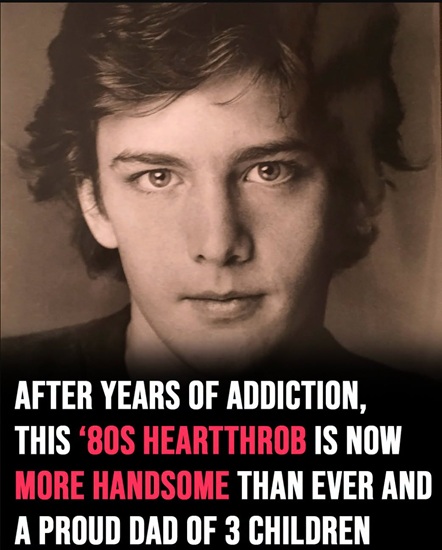
During the 1980s, Andrew McCarthy became one of the most recognizable young faces in American cinema. With dark hair, an understated smile, and a reserved screen presence, he stood apart from some of the louder personalities associated with young Hollywood. Movies such as St. Elmo’s Fire, Pretty in Pink, Mannequin, and Weekend at Bernie’s helped make him particularly familiar to teenage audiences. For many viewers who grew up during that period, his films eventually became inseparable from memories of adolescence itself.
Yet McCarthy has repeatedly explained that becoming famous did not make him feel naturally comfortable or secure. Behind the successful movie career, he was dealing with anxiety, uncertainty, alcohol misuse, and a complicated relationship with celebrity. Andrew Thomas McCarthy was born on November 29, 1962, in Westfield, New Jersey. He grew up as one of four brothers in a family without direct connections to Hollywood or the entertainment industry.
His mother worked for a newspaper, while his father worked in investments and stocks. The environment in which McCarthy was raised therefore offered little preparation for the unusual attention he would eventually receive as a movie actor. He has said that when success arrived, he did not know people who were famous in the way he suddenly became famous. Rather than naturally enjoying attention, McCarthy has described himself as someone who often recoiled from it.
Long before movie premieres and magazine photographs, McCarthy has described himself as feeling somewhat isolated during his school years. He later recalled experiencing loneliness and a sense that he did not completely belong in the environment around him. Acting provided one possible way of expressing feelings that were otherwise difficult for him to articulate. After high school, he went to New York University to study acting. His time there did not follow the conventional path toward graduation, however, and he eventually left after failing to participate consistently in his studies. What initially appeared to be a serious setback was followed almost immediately by an extraordinary opportunity.

McCarthy responded to an open casting call for the 1983 film Class. Hundreds of young actors reportedly appeared for the opportunity, and McCarthy had little reason to assume that he would be selected. Instead, he won the role of Jonathan Ogner in a movie starring Jacqueline Bisset and Rob Lowe. The story involved a prep-school student who unknowingly becomes romantically involved with the mother of his roommate. For an inexperienced actor who had only recently been struggling with acting school, it represented an astonishing change in circumstances. McCarthy later joked about the surreal transition from being a student to performing intimate scenes opposite the internationally famous Bisset.
Class did not immediately make McCarthy one of Hollywood’s biggest stars, but it established that he could carry an important film role. More work followed, and his quiet acting style gradually became one of his defining characteristics. Unlike performers who projected obvious confidence, McCarthy often seemed uncertain, introspective, or emotionally exposed on screen. Those qualities proved especially effective in coming-of-age films. Audiences could see vulnerability in characters who might otherwise have been written simply as handsome romantic leads. That quality eventually became central to the way viewers remembered him.
A major turning point arrived in 1985 with St. Elmo’s Fire. McCarthy appeared alongside Emilio Estevez, Rob Lowe, Demi Moore, Judd Nelson, Ally Sheedy, Mare Winningham, and other young performers. The movie followed recent college graduates struggling with adulthood, relationships, careers, and identity. Reviews were often unfavorable, but commercial success and the young cast turned the film into a defining artifact of 1980s popular culture. McCarthy played Kevin Dolenz, a journalist whose emotional reserve concealed complicated feelings for a friend. The role suited the understated qualities audiences had already begun associating with him.

The movie also connected McCarthy with one of the most persistent labels of his career: the “Brat Pack.” The phrase became widely associated with a group of young Hollywood actors after a 1985 New York magazine article by journalist David Blum. Rather than being a formal group that regularly met or worked together under that name, the “Brat Pack” was largely a media construction. McCarthy has repeatedly said that the label felt dismissive and damaging at the time. He believed it reduced a collection of individual actors to a caricature involving youth, privilege, celebrity, and supposed arrogance. Nearly four decades later, he would return directly to that complicated history in his documentary Brats.
McCarthy’s status as a romantic lead grew considerably the following year. In 1986, he appeared opposite Molly Ringwald in Pretty in Pink, directed by Howard Deutch and written by John Hughes. McCarthy played Blane McDonough, the wealthy student who develops a relationship with Ringwald’s working-class character, Andie Walsh. The movie explored adolescence, social divisions, friendships, insecurity, and the pressure to fit within a particular group. McCarthy’s restrained performance complemented Ringwald’s more expressive central character. For many viewers, Blane became one of the roles most closely connected with McCarthy’s youthful image.
The affection audiences developed for his character concealed a very different experience behind the camera. McCarthy later disclosed that he was drinking heavily during this period. In a 2004 interview with ABC’s 20/20, he recalled that viewers interpreted his performance in Pretty in Pink as sensitive and gentle while he was frequently suffering from hangovers during production. His account illustrates the considerable gap that can exist between what audiences see on screen and what an actor is experiencing privately. A polished performance does not necessarily reveal the physical or emotional condition of the person giving it. McCarthy would need years before he fully confronted what alcohol was doing to his life.
He has also explained what alcohol initially seemed to provide psychologically. McCarthy was naturally anxious and uncomfortable with attention, while drinking temporarily made him feel more confident. He described alcohol as giving him a kind of borrowed courage that made him feel powerful, attractive, and in control. Those effects were precisely part of the danger because they provided temporary relief rather than addressing the insecurity underneath. As his tolerance and dependence developed, the substance that once appeared to offer confidence increasingly controlled his behavior. His later reflections describe this period without suggesting that fame itself was the sole cause of his drinking.

That distinction is important when discussing his addiction accurately. McCarthy has specifically rejected the simple explanation that he drank because becoming famous overwhelmed him. His difficulties with alcohol were part of a deeper and longer personal pattern. Success may have provided an environment in which drinking was readily available, but McCarthy does not describe celebrity as the single cause. In later interviews, he looked back on the experience as something he eventually became unable to manage. By the early 1990s, he could no longer convincingly deny that he needed help.
His career continued developing while these private difficulties were intensifying. In 1987, McCarthy starred opposite Kim Cattrall in the romantic comedy Mannequin. The film was not universally admired by critics, but it became another recognizable title from the decade. McCarthy played Jonathan Switcher, an artist whose department-store mannequin mysteriously comes to life. The movie’s mixture of fantasy, romance, and broad comedy differed substantially from the adolescent tension of Pretty in Pink. It further demonstrated his commercial appeal across several varieties of mainstream entertainment.
That same year, he appeared in Less Than Zero, an adaptation of Bret Easton Ellis’s novel. The film presented a much darker picture of affluent young people in Los Angeles. McCarthy played Clay alongside Jami Gertz and Robert Downey Jr. The subject matter included addiction and destructive behavior, themes that were particularly striking given McCarthy’s own private struggles. There is no reason to treat his fictional role as a direct representation of his personal life, but the contrast between his successful professional career and increasing dependence on alcohol became sharper as the decade continued.
Another major commercial success came with Weekend at Bernie’s in 1989. McCarthy played Larry Wilson opposite Jonathan Silverman’s Richard Parker in a black comedy built around an absurd premise. After discovering that their employer Bernie Lomax has died, the two characters attempt to convince other people that he is still alive. The movie became a familiar comedy of its period and eventually received a sequel. By then, McCarthy had accumulated a series of films that ensured his place in 1980s popular culture. His professional visibility, however, offered no automatic solution to what was happening away from the camera.
McCarthy has described attempting to stop drinking around the period of Weekend at Bernie’s. For a time, he withdrew socially and tried to maintain sobriety on his own. Being naturally comfortable with solitude made that isolation possible for him. He has said that he has always been relatively comfortable spending time alone and believes people sometimes create problems by desperately trying to avoid solitude. But his first attempt to stop drinking was not the final turning point. He eventually resumed drinking and entered another deeply difficult phase.
While working on Jours tranquilles à Clichy, released in 1990, alcohol returned to his life. McCarthy has recalled being offered a beer by another actor and experiencing a physical reaction as he prepared to drink. The period that followed was one he would later characterize as painful and largely lost to addiction. His drinking increasingly produced consequences he could no longer ignore. The glamorous image associated with a successful young actor had little connection to his private condition. Eventually, his situation became serious enough that continuing without professional help was no longer realistic.
McCarthy has also spoken candidly about using cocaine during parts of the 1980s. He has said that when drugs were available, he sometimes participated, although cocaine primarily intensified his drinking. He has also explained that he generally avoided using it while actively working on set because he already felt anxious enough without a stimulant increasing that feeling. These admissions come from McCarthy’s own retrospective account of his life rather than speculation about his behavior. They are relevant because he has chosen to discuss them publicly while explaining his recovery. His story does not present substance use as glamorous or harmless; it describes consequences that eventually forced him to seek treatment.
The decisive change came in 1992. McCarthy was 29 when he sought professional assistance and underwent treatment for his alcohol problem. He has said that by then he could no longer pretend that the situation was manageable. Instead of continuing to rely on willpower alone, he accepted that he needed help. He subsequently stopped drinking and has publicly described himself as sober since that period. This date is important because simplified retellings sometimes incorrectly imply that his permanent sobriety began with his earlier attempt to quit in 1989.
Recovery did not erase his past or instantly solve every difficulty in his life. It did, however, create the conditions for McCarthy to develop interests and relationships that had been overshadowed by addiction. He gradually became less attached to the Hollywood social environment that had surrounded his early fame. The identity of “teen heartthrob” became less relevant as he entered his thirties and forties. Instead of trying to recreate his youthful celebrity, McCarthy began developing a career with several distinct creative directions. Acting remained one of them, but it was no longer the only way he told stories.
Directing became an especially important second career. McCarthy eventually directed episodes of numerous television series, including Gossip Girl, White Collar, Orange Is the New Black, The Blacklist, Good Girls, and The Sinner. His work behind the camera allowed him to use decades of experience on sets from a different position. Rather than being responsible for only one character, he had to understand the structure and rhythm of an entire episode. The transition demonstrated that his relationship with filmmaking extended beyond performing. He became an established television director rather than merely an actor occasionally trying another job.
His work on Orange Is the New Black became particularly notable. McCarthy directed multiple episodes of the acclaimed Netflix series during its run. The show was dramatically removed from the romantic comedies that had established him three decades earlier. Its ensemble storytelling, darker subject matter, comedy, and social themes required a very different directing sensibility. For viewers who knew McCarthy only from Pretty in Pink, discovering his name behind episodes of contemporary television could be surprising. For McCarthy himself, however, directing became a natural extension of storytelling.
Writing provided another major transformation. During travels abroad, McCarthy began recording experiences and observations in notebooks. He later explained that when he first wrote down a travel experience, he felt a creative recognition similar to what he had experienced when discovering acting. He began pursuing travel writing seriously during the 2000s. Rather than using his celebrity merely to obtain travel opportunities, he worked to develop the reporting and storytelling skills needed to publish in respected outlets. Travel eventually became one of the most important elements of his adult creative identity.
McCarthy wrote for publications including National Geographic Traveler, The New York Times, The Atlantic, and Travel+Leisure. He became an editor-at-large for National Geographic Traveler and received professional recognition for his travel journalism. These achievements gave McCarthy credibility in a profession very different from acting. They demonstrated that travel writing had become a serious vocation rather than simply a celebrity hobby. By that stage of his life, he had already begun showing that the career people associated with him in the 1980s was only one chapter of a much larger story.
McCarthy has explained that he does not consider acting and travel writing as unrelated as outsiders might assume. To him, both are methods of storytelling. Acting uses dialogue, character, pacing, and emotional behavior to communicate a story, while travel writing uses many of those same elements while placing the writer directly into unfamiliar surroundings. McCarthy has said that traveling makes him more alert and more present in the world. That vulnerability, he believes, can create opportunities for meaningful encounters and self-discovery.
His 2012 book The Longest Way Home: One Man’s Quest for the Courage to Settle Down combined travel with personal reflection. Instead of offering a conventional celebrity memoir, the book considered relationships, independence, commitment, and the reasons he repeatedly felt compelled to leave familiar surroundings. Travel became a way of examining the tension between his enjoyment of solitude and his need for intimate relationships. McCarthy traveled through several destinations while considering questions about home and commitment. His literary career subsequently expanded beyond straightforward travel journalism.
In 2017, McCarthy published the young-adult novel Just Fly Away. The book centers on a teenage girl whose understanding of her family changes when she learns that she has a half-brother. Its publication demonstrated that McCarthy wanted to experiment with fictional storytelling as well as memoir and travel journalism. The novel became another stage in an increasingly varied creative career. By this point, describing him only as an actor from Pretty in Pink captured just one part of his professional life. He had become an actor, director, journalist, travel writer, author, and filmmaker.
McCarthy returned more explicitly to the 1980s with his 2021 memoir Brat: An ’80s Story. The book examines the period when success came suddenly and he found himself surrounded by celebrities, parties, hotels, and opportunities he had never anticipated. It also addresses his drinking, insecurity, relationships, and complicated feelings about the “Brat Pack” label. Rather than presenting the decade purely through affectionate nostalgia, McCarthy examined how uncomfortable he had often been while living through it. That perspective makes his recollections considerably different from a simple celebration of 1980s Hollywood. The famous photographs represented only a fraction of what the young actor was experiencing.
One lighter memory from the memoir involved Courteney Cox before she became internationally famous through Friends. McCarthy recalled noticing her at a party and attempting to start a conversation. According to his humorous version of events, Cox showed little interest in him. The story provides a small reminder that celebrity circles frequently contained young performers whose future fame was impossible to predict. It also shows McCarthy’s willingness to describe awkward moments rather than presenting his younger self as someone who effortlessly impressed everyone around him. His memories of the period combine privilege, insecurity, humor, and discomfort.
His complicated relationship with the “Brat Pack” eventually became the subject of an entire documentary. In 2024, McCarthy directed Brats, examining how the label affected him and other actors connected with it. He reconnected on camera with performers including Emilio Estevez, Rob Lowe, Ally Sheedy, and Demi Moore. The documentary also explored the original journalism that created the term and why different actors reacted to it in different ways. McCarthy had spent many years resenting the label, believing that it limited the way Hollywood viewed him. Returning to it decades later provided an opportunity to examine rather than simply avoid that history.
The documentary also complicated the common assumption that the “Brat Pack” was a close and organized group. McCarthy has emphasized that the actors did not exist as a formal club in the way popular culture later imagined. They appeared in overlapping films, moved within the same industry, and became symbols of a particular generation, but the label itself helped create the impression of a unified group after the fact. Some actors reportedly began avoiding one another professionally because they feared reinforcing the stereotype. Ironically, a term that suggested constant companionship may have contributed to greater distance between them.
McCarthy has also become increasingly interested in how audiences remember those movies compared with how he remembers making them. For viewers, a film such as Pretty in Pink may be connected with a first date, a high-school friendship, a difficult breakup, or a particular year of adolescence. Those emotional associations can become stronger with time. McCarthy, however, experienced the movie as a job performed at a particular stage of his life. He has said that he appreciates what the films mean to viewers even though he does not personally experience intense nostalgia for his own past. The difference allows both perspectives to exist without one invalidating the other.
His personal life also developed far beyond his youthful screen persona. On October 9, 1999, McCarthy married Carol Schneider, with whom he had previously been romantically involved years earlier. McCarthy later described reconnecting after hearing from someone that Schneider appeared happy with another partner. That information unexpectedly bothered him, and he contacted her again. They eventually married and welcomed their son Sam in 2002. McCarthy and Schneider later divorced in 2005.
Sam McCarthy eventually followed his father into acting. He became known to television audiences through roles including Charlie Harding in Netflix’s Dead to Me. The father and son also shared an experience far removed from a Hollywood set when they walked approximately 500 miles along Spain’s Camino de Santiago. McCarthy subsequently wrote about the journey in his 2023 memoir Walking with Sam. The trip gave father and son long stretches of time together while Sam was approaching adulthood. It also combined two important parts of McCarthy’s life: family relationships and transformative travel.
McCarthy married Irish writer and director Dolores Rice in August 2011. They have two children together, Willow and Rowan. Willow has also pursued acting and theater, while Rowan has remained considerably more private. Together with Sam, they make McCarthy a father of three. His family life represents a very different reality from the solitary young actor who once felt overwhelmed by celebrity. Over the years, fatherhood has become an increasingly important part of the way McCarthy talks about his life.
His relationship with Sam was explored particularly openly through their Camino journey. Walking for weeks together required a kind of sustained interaction that modern schedules often make difficult. There was no film set separating them into professional roles and no quick solution when conversations became uncomfortable. Travel forced them to remain present with one another. For McCarthy, that experience became sufficiently meaningful to form the basis of an entire book.
The career he has built since becoming sober also challenges the idea that an actor’s most famous period must remain the center of his life forever. McCarthy’s biggest mainstream film roles may still be associated with the 1980s, but his subsequent decades have been professionally active. He has directed substantial amounts of television, continued acting, published books, written journalism, and made a feature documentary. His career did not simply end when the era of teenage magazine covers passed. Instead, it gradually shifted toward forms of storytelling that offered him more control and a different relationship with attention.
His physical appearance has naturally changed as well. The young actor remembered from Pretty in Pink was in his twenties. McCarthy was born in November 1962, which means he is 63 as of August 2026. Comparing photographs taken four decades apart can show how dramatically time changes anyone’s appearance, but aging itself is not an extraordinary revelation. The more significant transformation is arguably the range of experiences accumulated between those photographs. The person in recent images has lived through addiction, recovery, marriage, divorce, parenthood, travel, directing, writing, and decades of professional change.
McCarthy has never appeared especially eager to turn aging into a dramatic celebrity narrative. He has often seemed more interested in understanding why audiences remain emotionally attached to the version of him captured in the 1980s. For many people, seeing him today means seeing the passage of their own lives reflected back at them. The actor on the screen has aged, but so have the viewers who once watched him as teenagers. That makes reunions and retrospective discussions emotional in ways that have little to do with appearance alone. The movies can function as markers of personal history.
In discussions about the enduring significance of the Brat Pack era, McCarthy has suggested that his generation of films represents coming of age for many viewers. People were often watching those characters while experiencing their own adolescence and young adulthood. When those audiences see the actors again decades later, they may remember who they themselves were at the time. McCarthy therefore recognizes that public nostalgia belongs partly to the audience rather than to him. That distinction helps explain why he can respect the affection surrounding Pretty in Pink without personally wanting to live in the past.
His recovery from alcohol dependence remains one of the most consequential developments of his adult life. McCarthy’s public discussion of addiction is valuable precisely because he does not describe it as glamorous. Alcohol initially seemed to reduce fear and increase confidence, but eventually the cost became much greater than the temporary relief. His attempts to stop on his own did not immediately succeed. Professional treatment in 1992 became the decisive intervention. More than three decades later, that decision stands as a major dividing point in his adult life.
It is equally important not to reduce McCarthy solely to his history of addiction. Recovery created the opportunity for other parts of his life to expand, but it is only one part of his biography. He became an accomplished travel journalist after most audiences already thought they knew exactly who Andrew McCarthy was. He developed a directing career without abandoning acting entirely. He wrote books ranging from memoir to young-adult fiction. And he eventually confronted a label he had spent decades wishing would disappear.
His story also illustrates how misleading the concept of effortless celebrity can be. A magazine photograph can make fame look natural. A romantic movie can make an actor appear confident and emotionally composed. A red-carpet photograph can suggest that the person smiling for cameras is completely comfortable being watched. McCarthy’s own testimony complicates all of those assumptions. During some of his most famous performances, he was anxious, drinking heavily, and uncertain about the attention surrounding him.
None of this means that every successful moment from his youth should be reinterpreted as secretly tragic. McCarthy enjoyed extraordinary professional opportunities and created films that continue to matter to audiences. He has also recalled humorous, exciting, and memorable experiences from that period. A truthful account can acknowledge both sides at once. Fame provided remarkable opportunities while failing to protect him from personal difficulties. The presence of one reality does not erase the other.
His later career similarly resists a simple transformation story in which everything became perfect after treatment. Human lives rarely follow such neat structures. Sobriety did not eliminate introversion, uncertainty, relationship challenges, or professional setbacks. Instead, it allowed McCarthy to face those parts of life without relying on alcohol. The decades that followed involved continuing development rather than a single miraculous solution. That makes the story more credible and ultimately more interesting.
Travel became particularly important in that process because it required McCarthy to step into unfamiliar environments. He has described himself as becoming more alert and vulnerable when traveling. Rather than attempting to control every situation, he had to observe, respond, and interact with people whose lives were very different from his own. Those encounters became material for journalism and books. Travel also offered distance from Hollywood, an environment with which he maintained an increasingly complicated relationship. It allowed him to develop an identity that did not depend on being recognized.
Directing offered another kind of distance from celebrity. A television director can influence performances, pacing, framing, tone, and storytelling without becoming the image viewers associate with the final product. For someone who once said attention made him recoil, that behind-the-camera role seems especially fitting. McCarthy could remain deeply involved in filmmaking while no longer needing to be the face on the poster. His directing credits accumulated quietly over many years. The result was a substantial second career that existed alongside his more visible history as an actor.
The same could be said of his writing. A travel article asks readers to pay attention primarily to a place, an encounter, or an experience rather than the author’s physical appearance. McCarthy could tell stories without the visual expectations that accompanied his acting career. He approached travel journalism seriously enough to earn recognition from professional writers rather than relying solely on his established name. That achievement appears especially meaningful given how skeptical people can be when celebrities enter unrelated professions. He gradually proved that storytelling on the page was not a temporary experiment.
By the time McCarthy created Brats, he was able to look directly at a cultural phenomenon he once preferred to avoid. The documentary did not pretend that everyone associated with the label remembered it the same way. That disagreement was part of the point. The film examined memory, journalism, celebrity, friendship, resentment, and the strange experience of seeing one’s youth transformed into cultural history. McCarthy was no longer merely the young actor being described by somebody else’s article. He was the filmmaker deciding how to investigate that article’s impact almost 40 years later.
There is a certain symmetry in that development. At the beginning of his career, McCarthy had little control over how magazines and newspapers defined him. He became a “Brat Pack” actor because a journalist’s phrase captured public imagination. Decades later, he could use directing and writing to examine what that label had meant from his own perspective. He did not need to convince every viewer to share his interpretation. Simply participating in the historical record on his own terms represented a significant change.
Today, younger viewers may discover Andrew McCarthy through streaming television, his directing credits, his books, or Brats before encountering his earliest movies. Older audiences may still immediately picture Blane standing opposite Molly Ringwald in Pretty in Pink. Both versions belong to the same career. The difference is that one represents a moment captured when McCarthy was barely into adulthood, while the other reflects more than four decades of life and work. Reducing him to either version alone misses much of the story.
The story is therefore less about how an 1980s heartthrob “looks now” than about what happened after the posters stopped representing his everyday life. McCarthy survived a period of serious alcohol misuse and sought treatment. He built and maintained sobriety. He became a father, traveled extensively, wrote professionally, directed television, published books, and revisited his past through documentary filmmaking. His youthful fame remained part of him without becoming the only part. That distinction may explain why he appears relatively detached from nostalgia even while accepting that fans experience his old movies differently.
For viewers who loved those films, there is nothing wrong with nostalgia. Pretty in Pink, St. Elmo’s Fire, Mannequin, and Weekend at Bernie’s remain connected to a particular era of cinema. They also preserve a young Andrew McCarthy at a moment when his life was changing almost faster than he could process. What audiences could not see was the anxiety and alcohol dependence developing outside the carefully composed frames. What nobody could have seen was the writer, director, father, and sober man he would eventually become. Time supplied those chapters later.
McCarthy’s life also provides a useful reminder that public success and private well-being are not interchangeable. Someone can be professionally successful while struggling personally. Someone can appear confident while experiencing intense uncertainty. And a career that seems to peak early can develop in unexpected ways decades afterward. McCarthy’s transition from young actor to multidisciplinary storyteller demonstrates each of those possibilities. The trajectory is far more substantial than a simple before-and-after photograph.
There is also no need to exaggerate his difficulties in order to make the story compelling. McCarthy has himself described his alcohol dependence, drug experimentation, anxiety, rehabilitation, and recovery. Those firsthand accounts provide enough material without inventing secret behavior or speculating about unverified events. Similarly, his family relationships deserve to be discussed through information he and his relatives have made public rather than assumptions about their private lives. Responsible celebrity writing can still be engaging while respecting those boundaries. Accuracy does not diminish the emotional weight of his story.
As of 2026, Andrew McCarthy’s career covers more than four decades. The shy young actor from New Jersey became a defining face of a generation almost accidentally. He then spent years learning how to live with and eventually beyond that identity. Sobriety gave him an opportunity to rebuild, but creativity gave him multiple new directions in which to grow. Acting introduced him to storytelling; directing, journalism, books, travel, and documentary filmmaking allowed him to continue it. That broader body of work is now as important to understanding him as the photographs that once made him a teenage heartthrob.
For McCarthy himself, the past appears to be something worth examining but not necessarily something worth recreating. He can acknowledge what Pretty in Pink means to someone who watched it at 16 without needing to become Blane again. He can investigate the Brat Pack while rejecting the idea that the label completely defined him. He can discuss addiction without allowing addiction to become his entire identity. And he can remember his younger self without pretending that youth was automatically the best stage of his life.
Perhaps that is what makes Andrew McCarthy’s story endure. The boy on the poster was real, but he was never the complete person. Behind the famous face was someone frightened by attention, uncertain about himself, and increasingly dependent on alcohol. Ahead of him was a recovery he had not yet imagined and careers he could not possibly have predicted. The decades that followed did not erase the 1980s; they placed them in perspective. More than 40 years after his breakthrough, McCarthy’s most interesting story may not be that he once became famous, but everything he learned to build after fame arrived.
