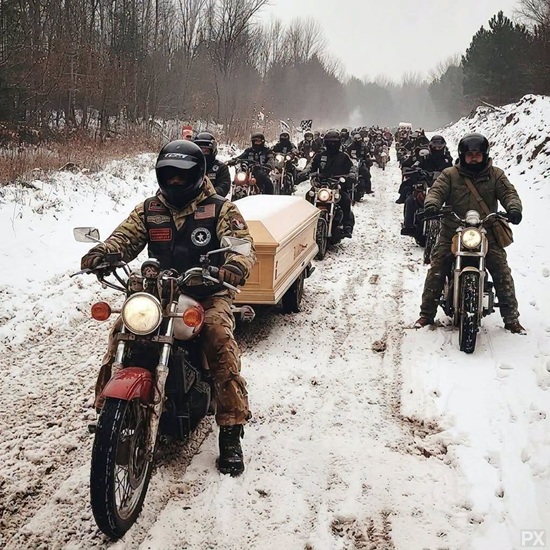
Winter had already settled heavily over the northern plains when Sarah received the news every military parent fears. Her son, Marine Corporal Danny Chen, had died while serving overseas, leaving behind a family that had expected to welcome him home under entirely different circumstances. In this fictional story, Danny had always spoken affectionately about Millfield, Montana, the small community where he had spent much of his childhood. He had told his family that if anything ever happened to him, he wanted to rest near his father.
For Sarah, bringing him home therefore became more than a matter of transportation or ceremony; it represented one final promise between a mother and her son. The military procedures surrounding the return of a fallen service member were careful and respectful, but circumstances outside anyone’s control complicated the journey. A powerful winter weather system had moved across the region, disrupting transportation and making several routes dangerous.
Heavy snowfall reduced visibility, ice covered highways, and changing conditions forced transportation officials to reconsider schedules. Sarah understood that safety mattered, yet understanding the reason for a delay did little to reduce her grief. Every additional day felt unbearably long when all she wanted was to have her son home before Christmas. There was no villain responsible for the situation.
The military personnel involved were attempting to follow procedures while keeping everyone safe, and transportation crews could not control the weather. Sarah knew these things intellectually, but grief does not always respond to practical explanations. Her home seemed unusually quiet as she waited for updates. Christmas decorations that normally brought warmth now reminded her of the person who would never walk through the door again.
Unable to sleep one evening, Sarah wrote about her situation in an online support group for families who had lost loved ones in military service. She was not trying to start a campaign, criticize officials, or attract national attention. She simply described how much it meant to her to bring Danny home. She explained that his final resting place was supposed to be beside his father and that she desperately hoped the weather would not keep him away for weeks.
Other grieving parents understood immediately. Some had experienced the same agonizing wait after losing sons or daughters. Others understood what it meant to receive formal telephone calls and carefully worded explanations while struggling with emotions that could not fit into official language. Messages of sympathy appeared beneath Sarah’s post. Then someone shared it with a veterans’ motorcycle organization.
The organization included former service members from several generations. Some had served decades earlier, while others had recently returned from deployments. Their military experiences were different, as were their ages, professions, political beliefs, and personal histories. What connected them in this fictional account was a shared belief that families of fallen service members should not feel abandoned after receiving devastating news.
One member contacted another. Telephone calls followed, and within hours an idea began developing. If normal transportation remained delayed, perhaps volunteers could help escort Danny on part of his journey home once all necessary military and legal arrangements were completed. It was not something that could happen simply because a group of riders wanted it to happen. Permission, logistics, weather conditions, appropriate vehicles, and safety requirements all had to be considered.
The Montana chapter leader was a 67-year-old veteran known among the riders as Big Jake. Years on motorcycles had weathered his face, while his gray beard made him instantly recognizable at club gatherings. Jake had participated in memorial escorts before, but he understood that winter changed everything. Riding hundreds of miles in ordinary conditions was one challenge. Attempting the same thing through snow, freezing temperatures, and mountain weather was something entirely different.
Jake refused to describe unnecessary risk as courage. Before volunteers were accepted, he made one rule clear: nobody would be expected to ride a motorcycle through conditions that were genuinely unsafe. The purpose was to honor a fallen Marine, not create additional casualties. If sections of the route required riders to move into support vehicles, they would do so. If authorities closed a highway, the convoy would wait or change course.
Planning became as important as emotion. Volunteers began studying weather forecasts and highway reports. They identified fuel stops, possible shelters, hospitals, repair shops, and fire stations along the proposed route. Emergency blankets, food, water, first-aid supplies, batteries, tools, and additional winter clothing were loaded into support vehicles. The motorcycles themselves were inspected carefully.
Some volunteers would ride. Others would drive trucks or support vehicles. A specialized vehicle would carry the casket during appropriate portions of the fictional journey. The organizers also established communication procedures so the convoy would not become separated when visibility deteriorated. Everyone involved understood that completing the trip depended on discipline rather than bravado.
Military officials in the story initially expressed serious reservations. Their concern was understandable. Weather reports showed potentially dangerous conditions across parts of the route, and nobody wanted a compassionate idea to end with injured volunteers. One commander reportedly asked the group to reconsider whether the journey was worth exposing so many people to winter hazards.
Jake listened before responding. He did not accuse the commander of indifference because he understood that the officer was responsible for safety. Instead, Jake explained why the mission mattered to the volunteers. Danny had accepted extraordinary risks while serving his country, he said, and these veterans wanted to do whatever could responsibly be done to help return him to his family.
Behind Jake stood men and women whose service stretched across different periods of American military history. Some had served during Vietnam. Others had served during the Gulf War, Iraq, or Afghanistan. Younger veterans stood alongside people old enough to be their grandparents. They did not pretend their experiences were identical, but each understood something about service and loss.
Eventually, a plan emerged that balanced respect with safety. The convoy would proceed only when authorities considered the roads passable. Motorcycles would be used where conditions permitted, while enclosed vehicles would transport riders through particularly hazardous stretches. The escort would remain flexible enough to stop whenever weather conditions changed.
Sarah was informed that volunteers were attempting to help. At first, she struggled to understand why strangers would make such an effort for someone they had never met. Danny had not been famous. He had not been a celebrity or public figure. To Sarah, he was simply her son—the child whose shoes had once been scattered across the hallway and whose laughter she could still imagine coming from another room.
To the veterans, however, his anonymity was irrelevant. They did not need to know Danny personally to understand what his death represented to his family. Many had attended military funerals before. Some had carried memories of friends who never returned from deployments. Others knew parents who had received folded flags.
The convoy began under a gray winter sky. Engines started one after another, their sound briefly cutting through the cold morning air. Riders wore multiple layers beneath protective clothing, while support crews checked equipment for the final time. Nobody knew precisely how long the trip would take because weather remained unpredictable.
The first miles passed without serious difficulty. Roads were cold but manageable, and visibility remained sufficient. Gradually, however, snow began falling more heavily. Wind pushed it across the highway in long white sheets, obscuring lane markings and forcing everyone to reduce speed.
The convoy responded exactly as planned. Riders increased the distance between vehicles and avoided unnecessary movement. When conditions became too difficult for motorcycles, they stopped at a predetermined location and transferred into support vehicles. The mission was never supposed to be a test of toughness.
That decision proved important. Farther along the route, wind intensified and visibility deteriorated sharply. What had looked like an open highway minutes earlier became a shifting wall of white. Snowplows moved ahead where possible, and highway officials provided updates about changing conditions.
Progress slowed dramatically. Miles that would normally take minutes required far longer. Yet nobody complained about the pace. Arriving safely mattered more than arriving quickly.
Meanwhile, news of the fictional convoy began spreading through communities along the route. A veteran at one fuel station called a friend in the next town. Someone contacted a volunteer fire department. A restaurant owner heard what was happening and prepared containers of hot coffee.
When the convoy reached its first major stop, volunteers were waiting. They had coffee, sandwiches, bottled water, blankets, and hand warmers. Nobody had been asked to provide these things. Residents had simply heard about the journey and decided to contribute.
A mechanic examined several motorcycles while riders warmed themselves indoors. He refused payment for the inspections. A local business provided additional fuel. Firefighters opened their station so volunteers could sit somewhere warm before continuing.
None of these contributions was individually dramatic. Together, however, they made the difficult journey possible. The escort was no longer being supported only by the original motorcycle organization. Ordinary people along the route had become part of it.
At another stop, an older veteran quietly approached the procession. He did not say much. He simply stood beside the vehicle carrying Danny and saluted before walking away.
For some of the riders, moments like that were more emotional than any formal ceremony. Military service had connected people who might otherwise never have met. The salute did not change the tragedy, but it acknowledged it.
Sarah continued receiving updates from Montana. Someone would call and tell her where the convoy had reached, how the roads looked, and whether another delay was expected. She began tracing the route on a map.
Every update brought conflicting emotions. She wanted Danny home immediately, yet she also worried about the people traveling through the storm. She did not want anyone injured because they were trying to help her family.
Jake reassured her that safety remained the priority. If they needed to stop, they would stop. If a road became impassable, they would not challenge it merely to prove something.
That promise mattered to Sarah. The escort was supposed to represent respect for life and service. Recklessness would have contradicted everything the volunteers hoped to accomplish.
As the convoy moved north, the landscape became increasingly covered in snow. Fields disappeared beneath white drifts. Trees bent under accumulated ice, and mountains became barely visible behind clouds.
Temperatures fell after sunset. Roads that had been wet during daylight began freezing. Drivers watched carefully for black ice, one of the most dangerous hazards of winter travel.
The support team adjusted again. Vehicles slowed, and riders who had hoped to return to motorcycles remained inside trucks. Nobody objected. The plan existed to serve the mission, not anyone’s ego.
At one point, the convoy stopped for several hours because conditions ahead had become too dangerous. Volunteers rested inside a fire station while snowplows worked. Some slept in chairs. Others drank coffee and quietly shared stories.
Veterans who had never met before began talking about their years of service. One described returning from Vietnam to a country deeply divided over the war. Another remembered friends lost decades earlier. A younger veteran spoke about Afghanistan.
Different generations discovered familiar emotions in one another’s experiences. The technology, uniforms, and missions had changed, but separation from family and the uncertainty of deployment were themes everyone understood.
Danny’s journey became a bridge between those generations. They were not there to debate wars or politics. They were there because a family was waiting.
When the highway reopened, the convoy resumed its journey. Progress remained slow, but conditions gradually improved.
More communities appeared along the route. At some intersections, only a handful of residents were waiting. At others, dozens gathered despite the cold.
People brought small American flags. Veterans stood at attention. Firefighters parked emergency vehicles nearby while residents watched quietly.
Parents brought children, explaining in simple terms why the procession mattered. The moment was not treated as entertainment. Most people remained silent as the vehicle carrying Danny passed.
No one in the fictional story claimed to speak for an entire town, state, or country. The people who appeared along the route represented themselves. Each had made an individual decision to stand outside for a few minutes and acknowledge a family’s loss.
That distinction mattered. Respect did not require political agreement or a shared worldview. It required only recognition that another family was grieving.
Eventually, the convoy crossed into the final portion of the journey toward Millfield. Word had already reached the town that Danny was approaching.
Residents began gathering along the main road. Businesses lowered flags where appropriate. Veterans put on old service jackets and caps.
The temperature remained bitterly cold. Breath formed clouds in the air, and people stamped their feet to stay warm. Still, they waited.
Sarah stood with relatives near the place where the procession would arrive. She had imagined this moment repeatedly, but imagination had not prepared her for it.
In her mind, Danny remained alive in hundreds of ordinary memories. She remembered him as a boy running through the house, as a teenager preparing for adulthood, and finally as the young Marine who had left home wearing a uniform.
The first escort vehicles appeared in the distance. Then came more.
People along the road grew silent. Hats were removed. Veterans raised their hands in salute.
Sarah watched the procession approach and understood that the strangers accompanying her son had traveled through conditions that repeatedly forced them to stop, adapt, and continue.
They had not defeated the storm. They had respected it. That was precisely why they had reached Millfield safely.
When Danny finally arrived, there was no celebration. Homecoming had an entirely different meaning now.
Sarah placed her hand against the vehicle carrying her son. For several seconds, she said nothing.
No words could make the moment easier. No convoy, regardless of its size, could restore what had been lost.
But Danny was home.
The funeral took place with the dignity appropriate to the family’s wishes in this fictional account. The flag covering the casket was handled according to military tradition, and those gathered remained quiet as the service proceeded.
Danny was laid to rest beside his father, fulfilling the wish around which the entire journey had been organized.
For Sarah, that detail mattered enormously. She could visit both of them in the same peaceful place. The promise had finally been completed.
Afterward, people gradually returned home. The crowds disappeared, roads reopened fully, and everyday life resumed.
For the motorcycle volunteers, however, the mission did not simply end when the funeral concluded.
Several riders remained in contact with Sarah. They called occasionally, especially around difficult anniversaries and holidays.
When memorial events were held, some returned to Millfield. Danny’s name was included in ceremonies remembering service members who had died.
Big Jake continued talking about the escort, but never as a story about how tough the riders had been. He emphasized the opposite lesson.
The journey had succeeded because people knew when to slow down, when to accept help, and when to change their plans.
Courage, he believed, was not ignoring danger. It was remaining committed to a purpose while respecting the value of everyone involved.
The mechanics who checked motorcycles had mattered. The firefighters who provided shelter had mattered. The people who prepared coffee had mattered.
So had the police and transportation workers who helped keep the route safe.
No single person could claim ownership of what happened.
The fictional escort had begun with one grieving mother’s wish to bring her son home. It became possible because many people contributed small pieces of what they could offer.
One person had a motorcycle. Another had a truck. Someone had mechanical skills. Someone else had a warm building.
Others had nothing more than a flag and a few minutes to stand beside the road.
Together, those contributions formed something larger.
The story is therefore not about defeating nature or proving that determination can overcome every obstacle. Sometimes weather really does make travel impossible, and responsible people must wait.
Instead, it is about what can happen when compassion is combined with careful planning.
The riders wanted to honor Danny, but they also had a responsibility to return safely to their own families.
That balance gave their journey meaning.
Sarah would always carry grief that no act of kindness could erase. Losing a child does not become easy because strangers offer support.
What changed was that she no longer had to carry every part of that experience alone.
People who had never met Danny learned his name.
Veterans from different generations remembered him during ceremonies.
Residents who had never met Sarah stood outside in freezing weather because they wanted her family to know that someone cared.
The support continued after the funeral, when there were no cameras and no procession to watch.
That continuation may have been the most meaningful part.
Public ceremonies eventually end. Flowers fade, uniforms are put away, and flags are folded.
Families, however, continue living with absence long afterward.
Remembering that reality is one of the most respectful things a community can do for someone experiencing loss.
In this fictional story, Danny’s final journey therefore became about more than transportation.
It became a story about responsibility, remembrance, cooperation, and the quiet ways strangers can support one another.
The winter storm remained dangerous. The loss remained permanent.
Nothing transformed tragedy into something positive, and nobody pretended otherwise.
But along a frozen road toward a small Montana town, people demonstrated that compassion can still have a physical form.
Sometimes it looks like a veteran standing silently beside a highway.
Sometimes it is a mechanic checking an engine in freezing weather.
Sometimes it is a firefighter unlocking a station at midnight.
Sometimes it is a stranger handing another stranger a cup of hot coffee.
And sometimes it is simply refusing to let a grieving parent feel forgotten.
The escort could not bring Danny back to life.
It could only bring him home.
For Sarah, that was enough to make every careful mile matter.
