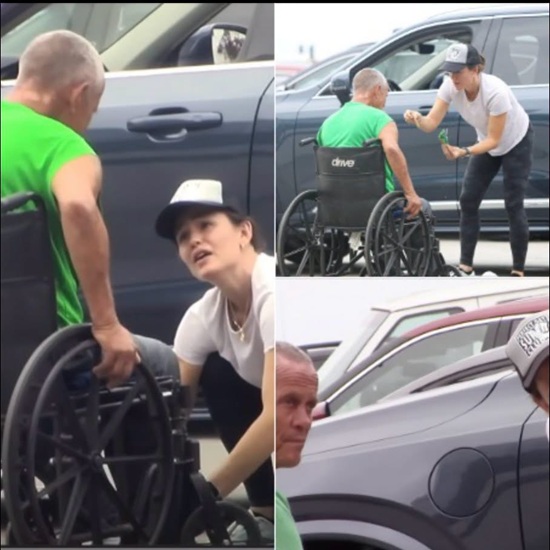
Jennifer Garner has spent decades in the public eye, building a successful career through television and film while also becoming known for charitable work and an unusually approachable public image. In September 2023, however, it was not a movie premiere, television role, or Hollywood event that put her in the headlines. Instead, reports and photographs documented a small encounter in Santa Monica, California, involving Garner, a man experiencing homelessness, and a photographer who happened to be nearby.
What began with Garner offering the man basic supplies eventually turned into an effort to find him a pair of shoes. The episode attracted widespread attention precisely because it appeared to be an ordinary human interaction rather than a carefully staged celebrity appearance. The encounter reportedly happened on a Sunday afternoon in a parking area near Santa Monica Beach. Garner was in her vehicle when she noticed a man using a wheelchair who appeared to need assistance.
According to Page Six’s account of the incident, she lowered her window and began speaking with him rather than immediately leaving the area. She then handed him a bag containing essential items. During their conversation, Garner noticed another important detail: the man was barefoot. Instead of limiting the interaction to handing him the bag, she got out of the vehicle to see whether she could help further. Garner had socks available and crouched beside the man to put them on his feet.
Photographs and reporting from the encounter subsequently circulated online, drawing considerable public attention. Yet she apparently still believed something was missing. Socks provided some protection, but the man needed shoes. Garner therefore removed the sneakers she was wearing and tried to give them to him. It was a spontaneous solution, but there was an obvious practical problem: her shoes were too small for his feet.
That might have ended the attempt, but Garner noticed a photographer nearby and asked whether he could help. According to the published account, she asked what shoe size he wore and whether she could purchase his shoes for the man. Garner explained that the man needed approximately a size 10½. The photographer replied that he wore size 11, making his shoes a much more realistic fit. Instead of selling them to Garner, he reportedly offered the shoes without accepting payment.
The moment therefore became an act of cooperation involving people who ordinarily occupy very different roles in celebrity culture. Garner was the internationally recognizable actress. The photographer was there documenting her movements. The third person was a man experiencing homelessness whose identity was not turned into the center of the entertainment story. When a practical need became obvious, the photographer gave up his shoes and Garner helped get them onto the man’s feet. Reports also said Garner provided him with a blanket from her vehicle.
It is tempting to add dramatic interpretations to a scene like this, but the documented actions are meaningful without exaggeration. There is no need to claim that Garner transformed the man’s circumstances permanently or solved the broader problem of homelessness. A pair of shoes, socks, basic supplies, and a blanket cannot do that. What the encounter demonstrates more modestly is that she noticed an immediate need and tried to address it with the resources available to her at that moment. That distinction keeps the story focused on what was actually reported rather than turning a compassionate interaction into something it was never claimed to be.
The episode also attracted attention because Garner had already developed a long public record of charitable involvement. Her work with Save the Children, in particular, extends far beyond a single celebrity appearance. The organization currently identifies Garner as both an ambassador and a member of its Board of Trustees, with a focus that has included educational opportunity and programs serving children. Save the Children’s profile of Garner says she has traveled to communities in several U.S. states and worked to draw attention to early childhood education and challenges facing children and families.
Garner’s interest in those issues has personal roots. Although she was born in Houston, Texas, she was raised primarily in Charleston, West Virginia. She has explained that she did not personally grow up in poverty but was surrounded by communities where poverty was visible. Speaking to Southern Living about her involvement with Save the Children, she described herself as being only “a generation and a holler removed from rural poverty.” That background helped direct her attention toward children living in rural American communities where access to educational resources, nutritious food, and other opportunities can be limited.
Her relationship with Save the Children began many years before the Santa Monica encounter. The organization’s profile states that she has served as an Artist Ambassador for years and joined its Board of Trustees in 2014. Her activities have included visits to programs, meetings with families and educators, fundraising, and advocacy surrounding early childhood programs. The organization specifically notes her involvement in bringing early childhood education initiatives to her home state of West Virginia.
That work is important context because it shows that the September 2023 encounter did not suddenly establish Garner’s interest in helping vulnerable people. It was consistent with activities she had already pursued for years. At the same time, charitable work by a celebrity should not be turned into evidence that someone is flawless. Public figures, like everyone else, are more complicated than any collection of positive headlines. The most accurate approach is simply to describe Garner’s documented actions without making claims about her private character that cannot independently be established.
Garner has also used her business activities to support programs involving children. She co-founded Once Upon a Farm in 2017 with Cassandra Curtis and former Annie’s executive John Foraker, according to Save the Children’s biography of her. The company focuses on food products aimed at children and families. Garner’s involvement with the business has intersected with her philanthropic work, including initiatives intended to address food insecurity.
In 2022, Southern Living reported on a partnership involving Once Upon a Farm and Save the Children that sought to provide one million meals for children facing food insecurity by the end of 2023. The campaign connected commercial activity with charitable support, including donations tied to particular product purchases. The initiative was another example of Garner using an existing business platform to draw attention to an issue she had already supported through nonprofit work.
Her work with Save the Children has continued well beyond the period covered by the original story. As of 2026, the organization’s official leadership page still lists Jennifer Garner among its Board of Trustees. Save the Children describes her professionally as an actor, philanthropist, entrepreneur, advocate, and co-founder of Once Upon a Farm. This provides an important current correction to older articles that might describe her charitable involvement only in the context of the early 2010s or 2023.
The organization has also continued involving Garner in public campaigns. In 2026, Save the Children promoted a challenge connected with Garner that sought to raise awareness and funding to combat child hunger. The campaign involved a 67-day running challenge culminating in Santa Monica. Regardless of how individual readers view celebrity philanthropy in general, Garner’s continued presence in the organization’s activities demonstrates that her relationship with Save the Children has been sustained rather than limited to one promotional campaign.
Garner’s charitable activities have also intersected with major events affecting children. During the COVID-19 pandemic, she worked with fellow actress Amy Adams on #SAVEWITHSTORIES. Save the Children said the initiative was created in response to school closures and the difficulties they created for children who depended on schools not only for education but also for meals and other resources. Celebrities participated by reading children’s books online while the campaign raised awareness and support.
The Santa Monica encounter was much smaller in scale. There was no national campaign attached to putting socks on someone’s feet. There was no major fundraising target and no corporate partnership required to find a pair of shoes. Perhaps that difference explains why the photographs resonated with so many people. The situation involved an immediate problem that could be understood instantly: someone did not have shoes, another person noticed, and several people tried to help.
The photographer’s participation deserves recognition as well. Celebrity stories naturally placed Garner’s name in the headline, but the final solution depended on another person’s willingness to contribute. When Garner offered to buy his shoes, the photographer reportedly declined payment and simply gave them to the man. His decision changed the situation from one celebrity’s gesture into a brief example of cooperation.
It is also worth avoiding assumptions about the man himself. Published reports described him as experiencing homelessness and using a wheelchair, but responsible retellings should not invent details about his background, health, family, or the circumstances that led him there. Homelessness can result from many different combinations of economic and personal circumstances. Nothing in the documented encounter provides enough information to explain this particular man’s life. Preserving that uncertainty is more respectful and more accurate than creating an emotional backstory simply to make the article more dramatic.
Likewise, it would be inaccurate to suggest that Garner was the only Hollywood celebrity who would have stopped to help. Claims about what “most celebrities” would have done cannot be verified. The significance of the story does not depend on criticizing people who were not there. Garner’s actions can stand on their own: she stopped, spoke with the man, gave him supplies, noticed he lacked shoes, put socks on his feet, tried offering her own shoes, and then sought help when they did not fit.
That practical sequence reveals an interesting quality of the encounter. Garner’s first solution failed. Her shoes were simply the wrong size. Rather than treating the attempt itself as sufficient, she looked around for another possibility. The photographer happened to wear almost exactly the required size. The story therefore became less about performing a symbolic gesture and more about solving a straightforward problem.
At the time of the encounter in September 2023, Garner was 51. She was born on April 17, 1972, so older reports correctly described her as 51 at that time. Articles republished years later sometimes retain that age, which can create confusion. In 2026, Garner is 54. Maintaining the original date of the story is therefore important when presenting it to contemporary readers.
By 2023, Garner had already spent more than two decades as a major Hollywood figure. Television audiences first came to know her particularly well through “Alias,” the ABC spy drama in which she played Sydney Bristow. The series established her as a leading actress and demonstrated that she could handle demanding action sequences alongside dramatic and comedic material. She later built a film career that included romantic comedies, family films, dramas, and action projects.
One of her most enduringly popular movies is “13 Going on 30,” released in 2004. Garner played Jenna Rink, a teenager who suddenly wakes up as her 30-year-old self. The movie became a lasting favorite for many viewers and introduced Garner to audiences beyond those who had followed “Alias.” She also appeared in films such as “Juno,” “Dallas Buyers Club,” “Elektra,” and numerous other productions across different genres.
Her Hollywood career undoubtedly created the financial security and public visibility that made many of her charitable activities possible. But Garner has often tried to maintain a public identity that extends beyond premieres and red carpets. Social-media posts from her kitchen, garden, farm, and family life have contributed to an image that is deliberately less polished than conventional Hollywood publicity.
That public image should still be understood as public-facing material rather than unrestricted access to someone’s private personality. Audiences know Garner through interviews, performances, social-media posts, charitable activities, and encounters reported by journalists. It would therefore be inappropriate to claim that these moments reveal everything about who she is privately. They do, however, provide documented examples of how she has chosen to use her visibility.
Only days before the Santa Monica story appeared, Garner had attracted attention for something completely different involving her father, William John Garner. During a short trip to Charleston, West Virginia, she arranged an early birthday surprise for him. Her father was approaching his 85th birthday, and Garner arranged for him to ride in a 1948 Studebaker Champion, which she described as his childhood car.
Garner shared photographs from the experience and credited David King for helping make the ride possible. It was a nostalgic gift rather than a conventional luxury present. Her father had a personal connection to that particular model of automobile, giving the experience emotional significance to the family. The visit was part of a brief return to Charleston during which Garner also spent time with relatives and people who had been important during her youth.
Sadly, William Garner died the following year at age 85. Jennifer announced his death in April 2024 and shared a tribute reflecting on his life and the family’s memories of him. She expressed gratitude for the additional time her family had with him and thanked medical professionals involved in his care. That later development makes the 2023 Studebaker photographs especially meaningful in retrospect, though at the time they were simply part of an early birthday celebration.
Garner has often spoken about the influence of her upbringing. Although born in Texas, she moved to Charleston with her family when she was young and was raised there with her sisters. Her connection with West Virginia later influenced her charitable focus, especially her interest in children growing up in rural communities. Save the Children says she has visited programs and advocated for investments in early education while drawing on what she observed growing up.
That history helps explain why her work has frequently centered on children rather than simply attaching her name to unrelated charitable causes. Early childhood education, nutrition, and support for families have appeared repeatedly across her nonprofit and business activities. This does not mean that any one celebrity can solve structural problems such as poverty or hunger. Organizations working in these areas depend on educators, community workers, donors, policymakers, families, volunteers, and many others.
Garner’s role is more accurately understood as using her visibility to amplify and financially support some of that work. Save the Children itself describes its mission as helping children in the United States and internationally receive a healthy start, opportunities to learn, and protection from harm. Garner serves as one of a number of public figures who support that mission.
This distinction matters because celebrity-focused stories can easily overstate an individual’s impact. Garner did not create Save the Children, nor is its work dependent on one actress. The organization has operated for more than a century and works through extensive professional and community networks. Garner’s contribution is part of that much larger structure.
The same perspective can be applied to what happened in Santa Monica. Garner did not solve homelessness by giving one person supplies. The photographer did not solve it by donating his shoes. But neither fact makes their actions meaningless. Large social problems and small individual acts exist at different scales, and both can be discussed without confusing one for the other.
For the man receiving assistance that afternoon, dry socks, properly fitting shoes, basic supplies, and a blanket had immediate practical value. Garner recognized those needs and responded to them. When her own shoes did not fit, she asked another person for help. The photographer responded generously as well. That is the factual heart of the story.
It also offers a reminder that compassion does not always require an elaborate plan. Sometimes it begins with paying attention. Garner could see that the man lacked footwear because she spent enough time interacting with him to notice. From there, one action led naturally to another.
The story became widely shared because Jennifer Garner is famous, and that reality should not be ignored. Similar acts of generosity happen every day without photographers present or articles being written about them. Volunteers, nonprofit workers, neighbors, families, and strangers regularly provide food, clothing, transportation, shelter assistance, and other forms of help without public recognition.
Garner’s celebrity simply ensured that this particular moment reached a much larger audience. That visibility can create an opportunity to focus attention not only on the celebrity but on the underlying principle demonstrated by the encounter: noticing another person’s immediate needs and responding respectfully when possible.
Years after the photographs were taken, the episode remains a memorable part of Garner’s public story because of its simplicity. There was no dramatic speech and no need to portray the encounter as something larger than it was. A woman noticed that another person did not have shoes. She tried giving him hers. They did not fit. She asked someone nearby for assistance, and that person helped too.
Against the scale of a Hollywood career, it was a very small event. Yet small events can reveal why compassion resonates so strongly when it appears in unexpected settings. Garner’s established work with Save the Children gives the encounter additional context, but the moment does not require celebrity status to make sense.
It is ultimately a story about practical kindness rather than perfection. Jennifer Garner’s decades-long career includes major films, successful television roles, business ventures, family milestones, and sustained charitable involvement. But on that afternoon in Santa Monica, none of those achievements was particularly relevant to the immediate situation in front of her.
Someone needed basic assistance, and Garner attempted to provide it. When she could not provide everything herself, she asked another person to participate. The photographer chose to help without taking the money she offered. The resulting photographs captured something far removed from a red carpet or movie set.
That may be why the story continues to attract attention. It does not require readers to believe that celebrities are fundamentally different from everyone else, nor does it require anyone to treat Garner as flawless. It simply documents a compassionate interaction that happened to involve a very famous person.
For Garner, it also fits into a broader, verifiable record of involvement with children’s welfare and charitable organizations. Save the Children continues to list her as a trustee, and her work with the organization has stretched across many years and multiple initiatives.
The encounter should therefore be remembered without embellishment. Jennifer Garner saw a man experiencing homelessness in Santa Monica in September 2023, spoke with him, provided essential items, put socks on his bare feet, and attempted to give him her own shoes. When those shoes were too small, a nearby photographer donated a pair
