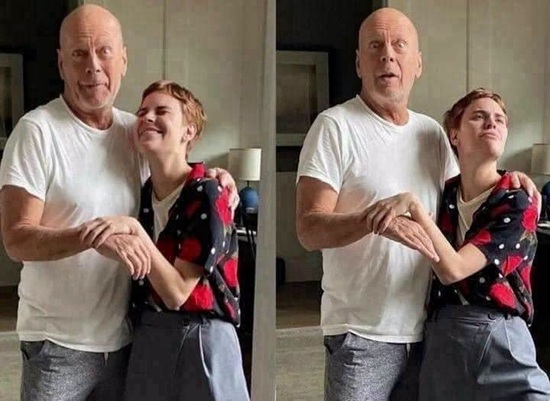
For years, Bruce Willis was known around the world as one of Hollywood’s most recognizable action stars, appearing confident and seemingly unstoppable on screen. Away from the movies, however, his family has been navigating a profoundly different reality. In March 2022, Willis’ relatives announced that he was stepping away from acting after being diagnosed with aphasia, a condition affecting communication. Less than a year later, in February 2023, the family revealed that doctors had reached a more specific diagnosis: frontotemporal dementia, commonly known as FTD.
The announcement changed the public understanding of what Willis and his relatives had been experiencing. According to the family’s statement released through the Association for Frontotemporal Degeneration, Bruce’s condition had progressed beyond the communication difficulties initially associated with his aphasia diagnosis. His relatives described receiving the FTD diagnosis as painful while also saying that having greater clarity brought some relief. They chose to make the diagnosis public partly in the hope that Bruce’s visibility could help increase awareness of a disease that many people still know relatively little about.
Frontotemporal dementia is not simply another name for ordinary age-related memory loss. It refers to a group of disorders caused by degeneration in the frontal and temporal areas of the brain, regions involved in behavior, personality, language and other essential functions. Symptoms can therefore look different from those people commonly associate with Alzheimer’s disease. In Bruce Willis’ case, his family has particularly emphasized communication difficulties, while avoiding turning every aspect of his medical condition into public information.
Bruce’s health journey has inevitably affected those closest to him. His wife, Emma Heming Willis, has spoken publicly about the challenges faced by families caring for someone with FTD and about how desperately caregivers can need reliable information and support. She has also used her platform to discuss caregiver well-being rather than presenting herself as unaffected by the experience. The Willis family has generally approached Bruce’s condition as something they face together, while also acknowledging that dementia changes everyday life in ways that can be emotionally difficult.
Bruce has five daughters: Rumer, Scout and Tallulah from his marriage to Demi Moore, as well as Mabel and Evelyn with Emma Heming Willis. His blended family has frequently expressed affection and support for him publicly. Rather than allowing his diagnosis to become the only thing defining their relationship with him, family members have continued sharing meaningful moments while respecting that his circumstances have changed. Their public comments often combine grief over what is being lost with gratitude for the connection that remains.
Tallulah Willis has been especially open about the complicated emotions surrounding her father’s condition. In a personal essay for Vogue, she wrote about recognizing changes in Bruce before she fully understood what was happening. Looking back, she described how painful it was to realize that some behaviors she had interpreted personally were actually connected to his declining health. Her account provides an important reminder that serious neurological conditions can affect entire families long before everyone understands the reason behind the changes they are observing.
At the same time, Tallulah has publicly discussed significant challenges of her own. She has spoken about struggling with an eating disorder and undergoing mental-health treatment, and she has described receiving several diagnoses during her efforts to better understand herself. These experiences should not be turned into speculation about her current condition. They are relevant because Tallulah herself chose to discuss them, explaining how periods of treatment and recovery affected the way she understood her life and relationships.
In March 2024, Tallulah also publicly revealed that she had been diagnosed with autism as an adult. Responding to a question on social media, she described the diagnosis as something she had learned relatively recently. She later spoke about being diagnosed at age 29 after years in which she felt she had been misunderstood or incorrectly diagnosed. Her decision to discuss autism publicly added another dimension to a family story already receiving significant attention because of her father’s health.
It would be inaccurate, however, to combine Bruce’s dementia and Tallulah’s personal health history into a narrative suggesting that the entire family is somehow collapsing. They are separate health experiences involving different conditions, circumstances and people. Tallulah has spoken honestly about painful periods while also describing love, healing and greater self-understanding. During a public interview about her father, she acknowledged that some days are painful but emphasized that there is also considerable love within the family.
That distinction matters because dramatic headlines can easily flatten complicated experiences into a single story of tragedy. Bruce Willis has a progressive neurological illness, and his relatives have never minimized the seriousness of that reality. Tallulah has her own history involving mental health, eating-disorder recovery and a late autism diagnosis. Yet neither set of circumstances justifies unsupported claims about what might secretly be happening or predictions about someone’s future health. Responsible coverage can acknowledge difficulty without inventing additional crises.
Tallulah’s earlier writings also reveal why her father’s illness has been emotionally complicated for her. She recalled periods when she was dealing intensely with her own health problems while Bruce’s condition was becoming more apparent. In retrospect, she recognized that she had not always been emotionally available to process what was happening to him. Rather than presenting this as a failure, her account showed how several difficult realities can exist simultaneously within one family.
Her relationship with Bruce has remained central to the way she talks about the experience. Tallulah has described preserving memories and paying attention to moments she can still share with him. She has acknowledged the anticipatory grief that can accompany a parent’s progressive illness while also resisting the idea that every interaction must be dominated by sadness. Her descriptions emphasize presence: appreciating the person who is still there rather than allowing fear of the future to erase the present.
Emma Heming Willis has expressed a related perspective from the position of a spouse and caregiver. She has discussed the importance of accepting support and recognizing that caregivers themselves have needs. Her public advocacy has also helped direct attention toward FTD and the experiences of families caring for people with dementia. The family’s willingness to speak publicly has consequently become about more than celebrity news; it has helped introduce many people to a condition they may never previously have encountered.
The Association for Frontotemporal Degeneration noted when the diagnosis was announced that communication problems can be only one feature of FTD. The family likewise explained that there were no treatments at the time capable of stopping the disease. Their statement expressed hope that increased awareness could eventually contribute to research and treatment development. Bruce’s diagnosis therefore became connected to a broader discussion about neurological disease without requiring his private medical life to become public property.
For people following the Willis family from outside, perhaps the most important point is to distinguish confirmed information from speculation. Bruce’s diagnosis of frontotemporal dementia is public and was announced by his family. Tallulah’s autism diagnosis and the health experiences she has chosen to discuss are also public. Claims suggesting additional secret illnesses, dramatic deterioration or hidden family crises require evidence before they should be repeated as fact.
Their story is therefore not simply about one famous actor becoming ill or one daughter confronting her own difficulties. It is about several people attempting to adapt when circumstances they never chose change the shape of family life. Dementia can introduce uncertainty and grief, while personal recovery may follow a complicated path of its own. The Willis family’s public comments show that hardship can exist alongside affection, humor, celebrations and ordinary moments of connection.
Bruce Willis’ condition remains a serious and deeply personal reality for those who love him. Tallulah’s willingness to discuss her own experiences has similarly offered a more nuanced picture than sensational headlines often provide. Their situations should neither be minimized nor exaggerated. What has been publicly documented is already powerful enough: a family adjusting to frontotemporal dementia while individual members continue navigating their own lives and health.
Ultimately, the Willis family’s experience demonstrates why careful language matters when discussing illness. A diagnosis can profoundly affect a person and everyone around them, but it does not erase the rest of their identity. Bruce remains a father, husband and loved family member in addition to being someone living with FTD. Tallulah remains a daughter and an individual with her own experiences rather than merely another chapter in her father’s diagnosis.
The most accurate account is therefore less sensational but more human. Bruce Willis and his family are living with the consequences of a progressive neurological condition, while Tallulah has openly discussed her own journey toward recovery and greater self-understanding. Their public statements reveal pain, uncertainty and grief, but they also repeatedly emphasize love and connection. That combination — rather than unsupported claims that another family member’s life is secretly unraveling — is what the documented story actually shows.
