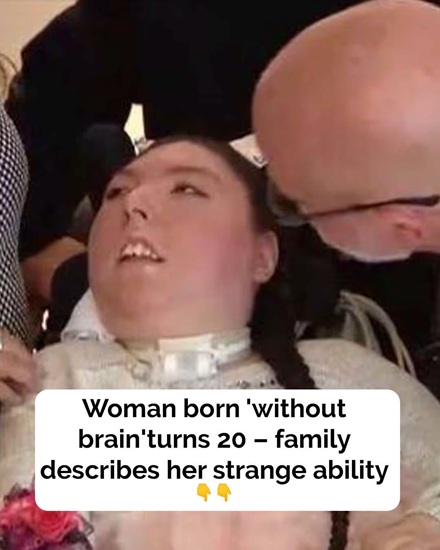
Alex Simpson of Omaha, Nebraska, reached an extraordinary personal milestone when she celebrated her 20th birthday in November 2025. Alex lives with hydranencephaly, a rare and severe congenital neurological condition involving the absence of most of the cerebral hemispheres. Her parents, Shawn and Lorena Simpson, told local television station KETV that doctors diagnosed their daughter when she was approximately two months old and warned them that her life expectancy would likely be very limited.
Two decades later, Alex remains surrounded by a family that describes her as a fighter. Reports sometimes describe Alex as a woman “born without a brain,” but that wording requires important medical context. Hydranencephaly does not literally mean that every part of the brain is absent. Cleveland Clinic explains that the condition involves missing cerebral hemispheres, which normally make up the largest part of the brain. The space where those structures would normally be located is largely occupied by cerebrospinal fluid. Alex’s father has described her as having only a very small amount of cerebellar tissue remaining.
Hydranencephaly is extremely rare. Cleveland Clinic estimates that it occurs in approximately one in 5,000 to one in 10,000 pregnancies. The condition develops during fetal development and profoundly affects the central nervous system. Some babies may initially appear relatively typical after birth, which can mean the condition is not always recognized immediately. Symptoms can become apparent during the first weeks or months of life.
Possible symptoms include difficulties with growth, abnormal muscle tone, rigid arms or legs, breathing problems and significant impairment involving vision and hearing. Hydranencephaly can sometimes be detected during pregnancy through ultrasound, while MRI and other imaging techniques can provide more detailed information. When it is not diagnosed prenatally, medical imaging after birth can help distinguish it from conditions such as hydrocephalus or holoprosencephaly.
The prognosis is generally very serious. Cleveland Clinic states that most affected babies die before birth or before reaching their first birthday. Rarely, however, children with hydranencephaly survive for years with extensive supportive care. This makes Alex’s survival to adulthood highly unusual, although it would be more accurate to describe it as an exceptional outcome rather than claim that she is necessarily the first person in medical history with the condition to reach that age.
According to Alex’s parents, the early prognosis they received was devastating. They told KETV that physicians did not expect their daughter to live beyond approximately four years of age. Families receiving such a diagnosis face tremendous uncertainty because there is currently no cure for hydranencephaly. Medical care instead focuses on managing complications, maintaining comfort and providing whatever supportive treatment an individual patient requires.
Cleveland Clinic notes that supportive care can include nutritional assistance, physical therapy, medications for seizures and respiratory support when needed. Some patients develop hydrocephalus or increasing head size and may require procedures intended to manage cerebrospinal fluid. Treatment varies considerably according to each person’s individual medical circumstances.
For the Simpson family, however, Alex’s story has always involved more than medical terminology and statistics. When KETV revisited the family around her 20th birthday, both Shawn and Lorena attributed her remarkable longevity in part to the love surrounding her. Shawn also spoke about the importance of faith in helping the family cope with the uncertainty they experienced after receiving Alex’s diagnosis.
“Twenty years ago we were scared,” Shawn told KETV while reflecting on those early years. He said faith had helped sustain the family through circumstances they could not predict. Lorena described her daughter simply as “a fighter.” Their comments express the family’s personal interpretation of Alex’s survival rather than a medical explanation for her longevity.
That distinction matters. Love, attentive caregiving and family support can have enormous importance for quality of life, but they should not be presented as medically proven explanations for why someone survives an exceptionally severe neurological disorder. Alex’s unusually long survival remains an individual outcome within a condition whose prognosis is generally poor.
Alex’s parents have also discussed the significant sensory limitations associated with her condition. According to their account, she cannot see or hear in the conventional sense because the relevant brain structures are absent. Nevertheless, her family believes she responds to their presence in ways that are meaningful to them. Shawn told KETV that he notices movements from Alex that he interprets as her searching for him when he approaches and speaks to her.
Her younger brother, SJ, has expressed similar beliefs. He told KETV that he thinks Alex can sense when people around her are experiencing stress or discomfort, even without obvious communication. These observations are personal accounts from her relatives and should be presented as such rather than as scientifically established evidence of exactly what Alex perceives.
SJ has also spoken proudly about having Alex as his sister. According to the family’s 2025 interview, he frequently mentions her when discussing his family and has taken an interest in learning about her disability. For a younger sibling who has grown up with Alex’s medical needs as part of everyday family life, understanding her condition has become personally important.
The family had already attracted media attention years before Alex’s 20th birthday. When she reached ten, her survival was similarly considered remarkable given the prognosis her parents had received. Lorena described the anxiety of Alex’s early childhood and recalled spending nights closely watching her daughter because she feared Alex might stop breathing.
Those memories illustrate the emotional burden families can experience when caring for a child with a life-limiting condition. Prognostic statistics can provide medical information, but they cannot tell parents precisely what will happen to one individual child. Alex’s survival ultimately extended far beyond the expectations her parents say they were initially given.
Her father has also used opportunities to discuss the way people perceive individuals with profound disabilities. He has objected to dehumanizing descriptions of his daughter and argued that disability does not make someone’s life less deserving of dignity, care or opportunities for comfort and enjoyment.
That aspect of Alex’s story is particularly important because people with profound neurological disabilities can sometimes be discussed entirely in terms of what they cannot do. Her medical limitations are significant and should not be minimized, but they do not erase the relationships her family has developed with her or the value they place on her presence.
Responsible reporting also requires avoiding claims that cannot be established from the available evidence. For example, calling Alex’s 20th birthday “medical history” or stating that nobody with hydranencephaly has ever lived as long would require comprehensive medical documentation that the available reporting does not provide. What can confidently be said is that reaching 20 with hydranencephaly is exceptionally unusual given the generally poor prognosis associated with the condition.
Similarly, the phrase “born with no brain” is attention-grabbing but medically imprecise. Alex’s condition involves the absence of most of the cerebral hemispheres rather than the absence of every neurological structure. Her father’s description of a very small amount of cerebellar tissue illustrates just how extensive her condition is without requiring an anatomically inaccurate headline.
Hydranencephaly also should not be confused with hydrocephalus. Hydrocephalus involves an abnormal accumulation of cerebrospinal fluid that places pressure on brain tissue. In hydranencephaly, major portions of the brain itself are absent and replaced by fluid-filled spaces. This distinction is medically important because the conditions have very different underlying features and prognoses.
Researchers still do not fully understand why every case of hydranencephaly occurs. Cleveland Clinic notes that potential causes remain incompletely understood, and prevention is therefore not straightforward. Families should not automatically assume that a parent did something to cause the condition.
For Alex and her family, medical statistics have always existed alongside everyday caregiving. Her parents have spent two decades adapting to circumstances they initially feared might last only a few years. Each birthday has therefore carried particular significance for them.
Her 20th birthday in November 2025 represented another milestone that once appeared extremely unlikely. It does not change the seriousness of hydranencephaly or mean other families should expect the same medical course. Every affected child can have different complications and support requirements, and medical decisions should always be individualized.
Alex’s story is therefore best told without turning her condition into a sensational medical claim. She is a young woman living with an extraordinarily rare and profound neurological disorder who has survived much longer than the prognosis her parents say they received during infancy. Her family continues to describe her with affection, pride and gratitude.
Twenty years after Shawn and Lorena Simpson faced an uncertain future with their infant daughter, they were able to celebrate something they once feared they might never see: Alex entering her twenties. For her family, that milestone represents years of caregiving, uncertainty and shared experiences that cannot be summarized by a diagnosis alone. And while medicine can explain what hydranencephaly is and how serious its prognosis generally remains, Alex’s individual story demonstrates why medical statistics describe populations—not the exact future of every individual patient.
