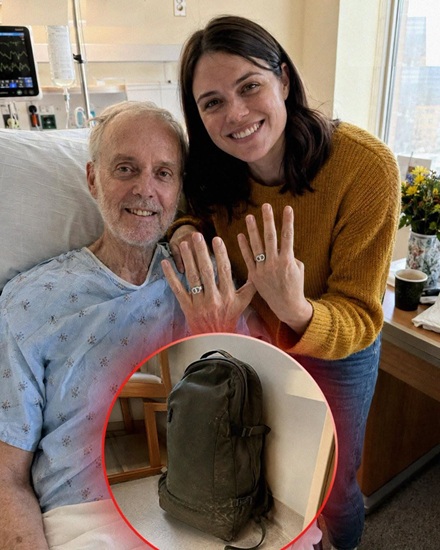
Sarah never expected to become anyone’s wife inside a hospital room. She certainly never imagined that the marriage would last only seven days. Yet that was exactly what happened after she met Thomas, a 72-year-old terminally ill patient whose quiet manner and remarkable attention to other people slowly changed the way she understood grief, loneliness and kindness. Sarah had started volunteering at the hospital after the death of her mother. She was 29 and functioning normally on the outside, but grief had left her emotionally motionless.
She still worked, paid her bills and answered messages from friends, yet much of her life felt suspended. Volunteering gave her somewhere to place the sadness she did not know how to carry. She spent time with patients who had few visitors or relatives who lived far away. She brought water, read aloud, adjusted blankets and sometimes simply sat quietly beside people who were frightened. Hospital staff described her as generous, but Sarah privately knew that helping others also gave her a way to avoid confronting her own loss.
Thomas noticed that before she did. He was often found near the cardiac wing, sitting beside his faded green backpack. Sometimes Sarah encountered him near the vending machines, where he joked that the coffee was terrible but at least honest. Other times he sat quietly in the hospital chapel, watching people come and go without asking questions they were not ready to answer.
What made Thomas unusual was how much he remembered about everyone around him. He knew that one nurse’s grandson was preparing for a driving test. He remembered which song a housekeeper hummed because it had been her mother’s favorite. He knew that the cafeteria worker saved peppermint candies for nervous visitors. None of these details seemed particularly important, but Thomas treated them as if they were.
When Sarah once asked how he remembered so much, Thomas gave a simple answer. He said he did not really try to remember everything. He simply tried to pay attention while people were speaking. Sarah laughed at the time, but later she would realize that those few words explained almost everything about him.
Their friendship developed slowly. Thomas rarely spoke about himself, and Sarah did not pressure him. He asked about her mother but avoided the questions people usually asked after someone died. Instead of asking about the illness or the final days, he asked what her mother’s laugh had sounded like.
Sarah told him it was the kind of laugh someone made while trying unsuccessfully not to laugh. Thomas smiled and told her those were the best kinds of laughs. It was such a small comment that Sarah almost forgot about it. Later, however, it would become part of the mystery he left behind.
Weeks later, Thomas surprised her by asking her to marry him. Sarah initially thought he was joking. They had not known each other very long, there was a large age difference between them, and Thomas was extremely ill. Yet he spoke calmly and explained that he was not asking for money, property or a complicated promise about the future.
He simply did not want to leave the world feeling like an anonymous patient in a hospital file. He wanted to know that someone had willingly chosen to stand beside him at the end. Sarah did not answer immediately, but her heart had already moved before her thoughts had caught up.
Two days later, a hospital chaplain married them in Thomas’s room. Sarah wore a yellow sweater because Thomas said it made the room look less tired. Thomas wore an old cardigan with one missing button. When they realized they had no rings, he removed the pull tab from a soda can and gently slid it onto Sarah’s finger.
It was too large, and Thomas laughed softly. He told her they would simply pretend her finger was shy. Sarah laughed too, and for a few minutes the hospital room no longer felt like a place where someone was dying. It felt like a small room where two people had made a promise.
For the next seven days, Sarah was his wife. She helped him drink tea, signed paperwork when necessary, adjusted his blankets and remained beside him when pain made his breathing shallow. Their marriage was not romantic in the traditional sense. It was something quieter and stranger, built almost entirely from companionship.
Near the end, Thomas opened his eyes one afternoon and told her not to mistake stillness for peace. Sarah asked what he meant. Thomas gave her only a faint smile and said she would understand later. Then he closed his eyes and went back to sleep.
He never woke again.
Less than an hour after Thomas died, his attorney arrived carrying the faded green backpack that had always rested beside him. He placed it in Sarah’s hands and told her that Thomas wanted her to understand the truth about who he had been. Sarah expected legal papers, hidden savings or perhaps information about relatives she had never heard him mention.
Instead, she found envelopes.
Dozens of them filled the backpack. Each carried the name of an ordinary place written carefully across the front: Bus Stop, Grocery Store, Airport, Laundromat, Park Bench, Waiting Room and Hospital Chapel. At the bottom rested a worn notebook with bent corners.
Sarah opened the envelope labeled Bus Stop first. Inside was an old transportation ticket. On the back Thomas had written a few words explaining that a frightened teenager had finally gotten onto a bus after watching several earlier buses leave without him.
Another envelope contained a grocery receipt for soup and bread. Thomas had written that an elderly woman had eventually accepted an offer of food. Inside Park Bench was an old photograph of Thomas sitting next to another man. The note on the back simply said that the man had smiled before Thomas left.
None of it made sense.
Then Sarah opened the envelope marked Waiting Room.
Inside was a hospital visitor sticker dated almost a year earlier. On the back, Thomas had written about a woman who described her mother’s laugh as sounding like someone trying not to laugh. Sarah immediately recognized herself.
That night, she carried the backpack home and placed it on her kitchen table. She walked around it for nearly two hours before finally reaching inside and taking out the notebook.
The first page contained only a few lines. Thomas had written that people often believed loneliness meant having nobody around them. In his experience, however, loneliness was often something different: the feeling that nobody truly noticed you.
The pages that followed were not a diary. Thomas barely mentioned himself. Instead, each page described a small encounter with another person. There was a nervous young father outside a delivery room, an elderly woman standing alone in a grocery aisle, a teenager avoiding the trip home and a veteran sitting quietly in a park.
Thomas never wrote that he saved anyone. He never described dramatic interventions or extraordinary advice. He simply recorded what happened when someone realized another human being had noticed them. A woman laughed. A man called his daughter. Someone finally went inside. Someone else slept.
Sarah slowly understood that Thomas had spent years collecting small moments when people took one step forward.
A few days later, she met his attorney again. She told him she had read the notebook but still did not understand why Thomas had chosen her. The attorney asked Sarah to think carefully about what Thomas had ever demanded from her.
She considered the question.
Thomas had never asked her for money. He had never told her to cancel plans. He had never asked her to promise that she would spend the rest of her life remembering him. Apart from his unusual request for marriage, he had asked almost nothing from her.
The attorney then showed Sarah an old newspaper clipping. In the photograph, a younger Thomas stood outside a community counseling center. The headline explained that a local grief counselor was retiring after four decades of service.
Sarah stared at the photograph.
Thomas had spent much of his professional life helping people cope with loss.
He had simply never told her.
The attorney explained that Thomas believed people sometimes spoke more honestly when they did not feel as though someone was treating or analyzing them. After retiring, he continued paying attention to strangers and collecting ordinary moments, not as cases but as reminders of how often people simply needed to be noticed.
Before Sarah left the office, the attorney gave her one final envelope. Thomas had asked that it be delivered only after his funeral.
Sarah opened it later in a park near her apartment.
Inside was not a confession or explanation.
It was a list.
Botanical Garden. Farmers’ Market. Ice cream on Oakridge Street. Feed the ducks even if they ignore you.
At the bottom, Thomas had written one final sentence: ordinary Tuesdays were where life quietly hid.
Sarah looked around the park. Children were running after pigeons. A man walked an old golden retriever. An elderly couple sat nearby discussing a crossword puzzle. Everything looked painfully ordinary.
Life had continued.
Sarah realized that she had not.
Since her mother’s death, she had been functioning without fully participating in her own life. She had convinced herself that remaining busy meant she was moving forward. Thomas had noticed that she was standing still.
The following Tuesday, Sarah followed his list.
She visited the botanical garden and walked slowly instead of rushing through it. She wandered through a farmers’ market and bought peaches she did not need. Then she drove to the small ice cream shop on Oakridge Street and ordered vanilla.
It was her favorite.
Finally, she stopped beside a lake and attempted to feed the ducks.
The ducks ignored her.
Sarah began laughing.
People nearby looked over, but she did not care. For the first time in months, the laughter felt completely natural rather than something she produced to reassure other people.
Months passed, and Sarah did not suddenly stop grieving. Thomas had never promised that grief could be repaired like something broken. His lesson was far smaller and, for Sarah, far more useful.
He had taught her to notice people.
To listen when they spoke.
To remember the ordinary details.
And to understand that helping someone does not always require a perfect speech, an answer to every problem or the ability to remove their pain.
Sometimes kindness is simply sitting beside someone long enough for them to understand that they have not disappeared from the world.
Sarah kept Thomas’s green backpack.
She also kept the soda-can ring.
But the most important thing he left behind was something she could not put inside a box.
He had shown her that a person’s life is often hidden in the smallest moments: a conversation in a waiting room, soup offered in a grocery store, a stranger sitting beside someone at a bus stop or an ordinary Tuesday spent walking through a garden.
And sometimes, the greatest kindness is not knowing exactly what to say.
Sometimes it is simply noticing another person, listening carefully and staying for a while.
