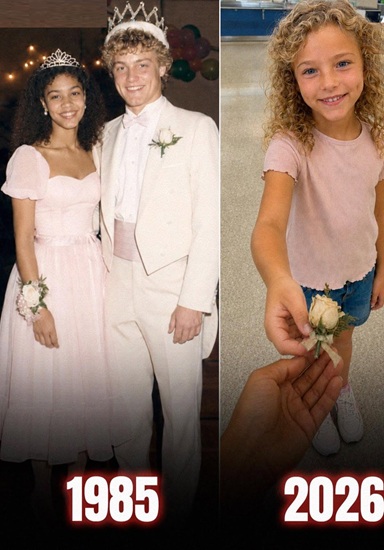
For forty years, every spring brought me back to the same night. I worked in an elementary school cafeteria, and each April the nearby high school filled our building with decorations for prom season. Silver streamers appeared in boxes, strings of tiny lights were carried through the hallways, and teenagers argued about centerpieces while I served lunches to children who had no idea why those decorations sometimes made me unusually quiet. They reminded me of 1985, of my senior prom, and of Michael—the boy who promised he would return in five minutes and then disappeared from my life forever.
Michael and I had started dating during our sophomore year. We were completely different people, yet somehow those differences made us fit together. I planned everything carefully, carried extra books everywhere, and hated being late. Michael could barely make it anywhere on time because he was constantly stopping to help someone. Once, he arrived twenty minutes late for a movie because an older woman had locked her keys inside her car. Another time, he stopped to help a neighbor find a missing dog. Whenever people asked what we saw in each other, Michael always smiled and gave the same answer: “Balance.”
Prom night arrived on a warm spring evening. My mother spent hours helping me prepare, while my father pretended he wasn’t emotional about seeing his daughter dressed for her final high school dance. Michael arrived late, naturally, because he had stopped to help catch someone’s escaped dog while wearing his tuxedo. I tried to look annoyed when I opened the door, but one glance at his embarrassed smile ruined the performance. That was Michael. No matter how frustrated I became, he somehow made me laugh.
The school gym looked completely different that evening. Hundreds of tiny lights reflected against silver decorations while music filled the room. Michael and I danced until our feet hurt, laughed at almost everything, and unexpectedly ended up being named Prom King and Queen. Someone placed plastic crowns on our heads, but Michael’s kept sliding sideways. The photographer repeatedly tried to straighten it, and each attempt only made us laugh harder. Those photographs would eventually become some of the last images I ever had of him.
Near the end of the evening, the band announced the final slow song. Michael found me before anyone else could and wrapped his arms around me. I rested my head against his shoulder while we moved slowly beneath the lights. When the song ended, neither of us immediately stepped away. Then Michael kissed my forehead and told me not to move. He had forgotten something in his truck, he said, and wanted to surprise me.
“Five minutes,” I warned him.
Michael grinned, raised one hand and disappeared between two rows of cars.
I waited.
Five minutes became ten. Ten became twenty. At first, nobody was concerned because everyone knew Michael. If he was late, the obvious explanation was that someone somewhere needed help. But when thirty minutes passed, teachers began searching the parking lot. His truck was gone. By morning, police were asking questions, and three days later the vehicle was reportedly found abandoned on a quiet rural road.
Inside the fictional story, Michael’s tuxedo jacket was folded across the passenger seat. His keys were still there, and inside the vehicle was a small wrapped box bearing my name. It contained a silver bracelet—the surprise he had intended to bring back to me. Michael himself, however, had vanished. Searches produced no clear answer, and eventually I was forced to confront the possibility that I would never know what happened.
Life continued because it had no interest in waiting for me to understand. Friends married, started families and built futures that Michael and I had once imagined for ourselves. I attended some weddings and avoided others because slow dances were especially difficult. Eventually, people stopped trying to introduce me to potential partners. I never made a dramatic promise that I would remain alone forever. It simply happened that way.
I found work in an elementary school cafeteria almost accidentally. I expected to stay for a few months, but months became years and years became decades. The children gave my life a rhythm I hadn’t expected. I knew which student hated peas, who always forgot lunch money and which child needed an extra smile on Monday mornings. It wasn’t the life I had imagined at eighteen, but eventually I understood that a different life could still contain purpose and happiness.
One reminder of Michael remained inside my bedroom dresser. I had preserved the corsage from prom in a small cedar box. The flowers became brittle and the white ribbon gradually turned cream with age, but every spring I opened the box. Michael had once joked that he would preserve his boutonniere while I kept my corsage. When we were old, he said, we would compare them and determine whose flower had survived better.
His boutonniere never returned.
Until one Thursday afternoon, forty years later.
I was working in the cafeteria when an eight-year-old girl named Tori stepped away from the lunch line. Without explaining anything, she walked toward me and placed a faded white boutonniere carefully into my hands. I stared at it, unable to understand what I was seeing. Its flowers and ribbon looked remarkably similar to my old corsage. Then Tori looked up at me and quietly said, “It must be with you.”
Twenty minutes later, after lunch had ended, a woman appeared in the cafeteria doorway. She introduced herself as Rebecca, Tori’s mother. She carried an old metal tin and several pages covered with handwriting. Rebecca explained that her grandmother had died three months earlier and had left behind a story she believed belonged to me.
According to the fictional letter, Rebecca’s grandmother had been driving home with her young daughter on prom night in 1985. Heavy rain had made the roads dangerous, and near a bridge her vehicle lost control and went down an embankment. The woman became trapped while her frightened daughter remained inside the vehicle. Then someone appeared above them wearing a tuxedo.
It was Michael.
Rebecca’s grandmother wrote that Michael immediately climbed down to help. Even during the emergency, he repeatedly apologized because someone was waiting for him. He managed to help the woman escape, but her daughter was still trapped. Michael could have stopped there and waited for emergency services, but according to the letter, he went back.
Before returning to the vehicle, Michael removed the white boutonniere from his jacket. He wrapped it carefully in a handkerchief and gave it to the woman. He reportedly told her that if anything happened, the flower belonged to someone named Giselle.
Me.
Then Michael went back for the child.
According to Rebecca’s grandmother’s fictional account, Michael succeeded in getting the little girl out. But conditions around the flooded road continued deteriorating. Another vehicle reportedly lost control nearby, damaging what remained of the roadside barrier. Amid the chaos and fast-moving water, Michael disappeared.
His body was never recovered.
I listened without speaking.
For forty years, I had asked myself whether Michael had abandoned me. There were nights when I wondered whether he had decided he didn’t want the future we had planned. I questioned every promise and every memory because I never received an explanation.
Now the answer was sitting in my hands.
Michael had been trying to return.
He had simply seen someone who needed help.
Of course he had.
That was exactly the kind of thing Michael would do.
Rebecca explained that her grandmother had known only my first name. She tried to identify me but could not determine which Giselle Michael had meant. Eventually, the family moved away, and the boutonniere remained stored inside the metal tin. Her grandmother continued telling herself that someday she would find the girl who had been waiting for Michael.
But someday kept moving farther away.
After her grandmother’s death, Rebecca found the letter and began looking for me again. Then Tori came home from school and casually mentioned a cafeteria worker named Giselle. Rebecca started asking questions and eventually learned about my connection to the old high school.
Everything suddenly fit together.
I was grateful, but gratitude was not the only emotion I felt.
I was angry.
“I deserved to know,” I told Rebecca.
She did not argue.
“You did.”
I explained that I had spent forty years wondering whether Michael had stopped loving me. I had questioned the most important relationship of my youth because nobody could tell me what happened during those missing five minutes.
Rebecca couldn’t return those years.
Neither could her grandmother.
But she could give me something I had never possessed before.
The truth.
“He never stopped trying to come back,” Rebecca said.
That evening, I went home and opened the cedar box. For the first time in forty years, the corsage was no longer alone. I placed Michael’s boutonniere beside it and sat quietly looking at the two faded flowers.
They had once been worn by two teenagers who believed five minutes was nothing.
Neither teenager understood how much could happen in five minutes.
The following afternoon, Tori returned to the cafeteria. She immediately asked whether I had placed the flowers together. I told her I had.
Then she asked if it was true that I had never danced again.
I nodded.
Tori thought for a moment and held out her hand.
“Then we should dance.”
Music was drifting faintly from the school gym. I took her hand, and she climbed onto my shoes while we slowly moved between the empty cafeteria tables. She stepped on my feet twice and nearly made both of us fall.
I started laughing.
Really laughing.
And something inside me changed.
For decades, happiness had occasionally felt like betrayal, as though moving forward meant leaving Michael behind. But Tori’s family existed because Michael had stopped to help someone on a dangerous road. His final act, in this fictional story, had not been abandoning me.
It had been exactly the opposite.
When the music ended, Tori hugged me and announced that it had been the best dance ever.
I looked at her and thought about Michael.
For the first time in forty years, remembering him did not feel like waiting for someone who might still walk through the door.
It felt peaceful.
I couldn’t recover the decades that had passed.
I couldn’t return to prom night and prevent Michael from leaving.
But I finally understood why he never came back in five minutes.
He had seen a mother and child who needed help.
And being Michael, he couldn’t simply drive past them.
That night, I closed the cedar box with the corsage and boutonniere resting beside each other.
For forty years, one piece had been missing.
Now the flowers were finally together.
And after four decades of questions, I could finally stop waiting too.
