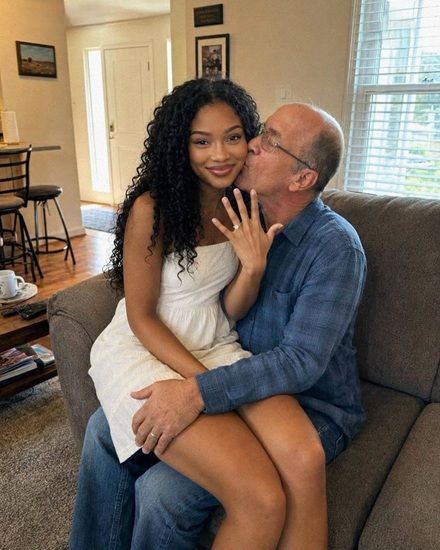
When my twenty-two-year-old daughter Chloe sent me a photograph announcing that she had married a fifty-six-year-old man named Arthur, my first reaction was not happiness or curiosity. It was anger. In the photograph, Chloe stood beside a silver-haired man wearing an elegant coat, and beneath it she had written only a few words explaining that they were married. I stared at my phone in disbelief, convinced that I already understood what had happened.
Without giving my daughter the opportunity to explain, I created an entire story in my mind about a wealthy older man and a young woman who had abandoned everything she had worked toward. For most of Chloe’s childhood, it had been just the two of us. After my marriage ended, money was constantly tight, and I accepted almost every job I could manage. I cleaned houses during the day and worked additional shifts at a care facility whenever someone needed coverage.
There were months when every unexpected bill felt like an emergency, but I kept reminding myself why I was working so hard. I wanted Chloe to have opportunities I had never received, and when she was eventually accepted into a nursing program in London, I considered it one of the proudest moments of my life. Helping her study abroad required sacrifices I had spent years preparing to make.
I used much of my savings and reorganized almost every part of my finances so she could concentrate on her education. During the first months in London, Chloe called almost every evening. She complained about the cold weather, described the tiny flat she shared with other students and worried constantly that she might fail an examination. I reassured her each time, telling her that she belonged there and that all the sacrifices were worthwhile if she could build the future she wanted.
Gradually, however, the calls became shorter. Chloe sounded tired and distracted, and sometimes several days passed without hearing from her. I tried not to interfere because she was an adult building an independent life thousands of miles away. Then the photograph arrived. She was standing beside Arthur, smiling gently, with a simple wedding band visible on her hand. Her message said that they had married and that she would explain everything when she came home.
Instead of waiting, I immediately called her and demanded answers. I accused her of marrying Arthur because he was wealthy and suggested that she had exchanged her independence for financial security. Some of the things I said were cruel, and even while saying them, part of me knew I was reacting from fear rather than knowledge. Chloe did not argue. She simply asked me to wait until she returned home before deciding what kind of person she had become.
For the following week, I barely slept. I imagined luxury apartments, expensive gifts and a relationship built entirely around money. By the time Chloe’s flight arrived, I had already judged her without hearing a single explanation. But when she walked through the airport doors, the story I had invented began falling apart. She did not resemble someone living a carefree millionaire’s lifestyle. She looked exhausted, thinner than I remembered, with dark circles beneath her eyes and an expression that suggested she had been carrying something heavy for months.
When we reached home, I asked the question directly. I wanted to know whether she had married Arthur for his money. Chloe remained silent for several seconds before opening her bag. She removed an old, faded document and placed it carefully on the kitchen table. I recognized the hospital name immediately. Ten years earlier, when Chloe was twelve, I had undergone treatment for cancer, and the document came from one of the most frightening periods of our lives.
The illness had terrified me, but so had the financial consequences. I remembered staring at medical bills late at night while Chloe slept and wondering how I could possibly manage everything. Then something unexpected happened. A charitable donor covered a substantial portion of expenses I could not afford. I never learned the person’s identity. I simply remembered the overwhelming relief of discovering that an enormous financial burden had suddenly been removed during a period when I was already fighting to recover.
Chloe pointed toward a signature connected with the old assistance paperwork. Then she placed another document beside it. Within this fictional story, the distinctive signatures matched. Chloe looked at me and quietly explained that Arthur had been connected with the charitable fund that helped cover my treatment. He had never met me and had not expected recognition. He had simply contributed money to programs helping patients experiencing severe financial hardship.
Chloe had encountered Arthur while completing part of her nursing training. He was living with advanced heart disease and required substantial medical care. As she learned more about him, she discovered his history of charitable giving. Eventually, she noticed details that reminded her of the paperwork our family had kept from my illness. After further conversation, she realized that Arthur’s generosity had helped our family during one of the most difficult periods of our lives.
When Chloe told Arthur who I was, he reportedly became emotional. He had donated money years earlier without knowing what ultimately happened to the people who received assistance. Now a nursing student standing beside him was telling him that his generosity had helped her mother receive treatment and remain present throughout her childhood. For Arthur, the connection gave an anonymous act from his past a human face. For Chloe, it transformed an elderly patient she respected into someone permanently connected with our family’s history.
Their friendship deepened, but Chloe insisted that wealth was not the reason for their marriage. Arthur’s health was deteriorating, and serious disagreements had developed within his family concerning his future care, finances and living arrangements. He had adult children with whom his relationships had become strained, and he worried that decisions about his remaining life were increasingly being discussed around him rather than with him.
I initially assumed that marrying Chloe had automatically given her complete control over his healthcare and finances, but the reality within the story was more complicated. Marriage alone does not necessarily give one spouse unlimited authority over another person’s medical care, property or legal affairs. Those questions depend on local laws and properly executed legal documents. Arthur had therefore consulted independent solicitors while he still had decision-making capacity and formally documented his wishes.
Chloe’s role was not to take control of Arthur’s life. She was there to support the decisions he had already made. He established appropriate legal arrangements regarding his medical preferences and financial affairs, and he made clear who he trusted to advocate for those preferences if his health deteriorated. Their marriage grew from an unusual combination of friendship, gratitude, companionship and mutual trust rather than the conventional romance I had automatically imagined.
I still struggled to understand why Chloe had agreed to something so enormous at twenty-two. She looked at me and explained that Arthur had helped a stranger years earlier without asking for recognition. His generosity had indirectly allowed her to grow up with her mother still beside her. Now she had an opportunity to stand beside him during a period when he felt increasingly alone. She did not see herself as repaying a financial debt. She saw herself as refusing to abandon someone who had once chosen compassion when our family needed it.
A week later, I traveled to London because I needed to meet Arthur myself. Nothing could have prepared me for how different he was from the wealthy, controlling man I had imagined. He was physically frail and often used a wheelchair, but he remained engaged in conversation and had a dry sense of humor. When Chloe introduced us, Arthur took my hands and smiled. I tried to thank him for what he had done years earlier, but he immediately redirected the credit toward the doctors who had treated me.
During the weeks that followed, I watched Chloe care for him. She helped organize medication schedules, attended appointments and communicated with healthcare professionals when Arthur wanted assistance. Most importantly, she listened to him. She did not make every decision on his behalf or treat him as though illness had erased his independence. Whenever he was capable of making his own choices, those choices remained his. Chloe’s role was to support his voice rather than replace it.
The conflict with Arthur’s family continued. Within this fictional narrative, some of his adult children questioned the marriage and raised concerns that Chloe might be exploiting a vulnerable older man. Considering the enormous age difference and Arthur’s wealth, I could understand why outsiders might initially ask difficult questions. I had asked exactly the same ones. The difference was that legal questions could not be resolved by suspicion alone. Evidence mattered.
Arthur’s solicitors had documented his intentions. Medical professionals had evaluated his decision-making capacity at relevant times, and witnesses could describe conversations in which he clearly explained what he wanted. When disagreements eventually reached a formal legal process, the issue was not resolved through one dramatic speech or emotional accusation. Documentation, professional assessments and established procedures were necessary to determine whether Arthur had made his decisions freely and understood their consequences.
Within the story, the challenge to Arthur’s arrangements was ultimately unsuccessful. The outcome did not suddenly turn Chloe into someone obsessed with his fortune, nor did it erase the complicated history between Arthur and his children. Family disputes involving serious illness, inheritance and end-of-life decisions can contain emotions and motivations far more complicated than outsiders initially understand. What mattered most to me was what I had personally witnessed inside Arthur’s home.
My daughter was not spending her days shopping or enjoying luxury. She was exhausted from studying, caregiving and trying to support a seriously ill person. Arthur’s health continued declining over the following months, and eventually it became clear that time was becoming short. Chloe remained beside him. I stayed as well whenever I could, and slowly the man I had once imagined as a threat to my daughter’s future became someone I cared about deeply.
Before his death, Arthur reportedly gave Chloe a piece of advice that remained with her. He told her not to allow difficult experiences or difficult people to make her hard. It was a simple sentence, but Chloe remembered it because Arthur had spent much of his life helping people he would never meet. Even during periods when his own family relationships became painful, he did not want bitterness to become the final lesson he left behind.
After Arthur died, I returned repeatedly to the photograph Chloe had originally sent me. The image had not changed. She was still twenty-two, standing beside a fifty-six-year-old wealthy man with a wedding band on her hand. What changed was everything I understood about the picture. Initially, I had looked at age and money and decided that those two facts explained the entire relationship. In reality, they explained almost nothing by themselves.
The experience did not teach me that every relationship with a large age difference should automatically be celebrated. Such relationships can raise legitimate questions, particularly when illness, wealth or vulnerability is involved. Real situations require careful attention to consent, decision-making capacity, independent legal advice and protection from financial or emotional exploitation. Marriage should never be treated as a shortcut around those safeguards.
What the experience taught me was something more personal. Questions are reasonable, but accusations made without evidence can deeply hurt the people we love. I had been frightened for Chloe and concerned about her future, but instead of asking her what had happened, I had immediately decided that she had become someone I could no longer respect. I had confused fear with certainty.
Arthur’s generosity had entered our lives years before either Chloe or I knew his name. During my illness, he helped remove a financial burden without asking for recognition. Years later, through an extraordinary coincidence inside this fictional story, Chloe found herself standing beside the same person when he needed support of his own.
I could never take back the words I said during that first angry telephone call. Chloe eventually forgave me, but forgiveness did not erase my responsibility for having judged her before listening. I learned that trust sometimes means allowing someone we love enough time to explain a situation that looks completely different from the outside.
When I look at Chloe’s wedding ring now, I no longer see proof that my daughter traded her future for money. I see a complicated chapter involving gratitude, responsibility and a relationship that did not fit neatly into the assumptions I originally imposed upon it. Most of all, I remember the faded hospital document Chloe placed on my kitchen table and the moment I realized how little I had understood.
I thought I was about to confront my daughter for betraying everything I had sacrificed to give her a better life. Instead, I discovered that the compassion I had tried to teach her had taken her somewhere I never expected. She had chosen to stand beside someone who had once helped our family without knowing our names, and whatever anyone thought about the unusual circumstances, she wanted to make sure his dignity and documented wishes were respected.
That realization humbled me more than any argument could have. Sometimes we look at one photograph, one age difference or one bank account and convince ourselves that we already know an entire story. But human relationships are rarely that simple. Before condemning someone we love, sometimes the most important thing we can do is stop, listen and allow them to tell us what the photograph cannot.
