John Wayne remains one of the most iconic figures in American cinema, known for defining the image of the classic Western hero across decades of film history. Born Marion Robert Morrison, he rose from small supporting roles in early Hollywood productions to become a central symbol of rugged masculinity and traditional American storytelling. His career spanned more than 50 years, during which he appeared in nearly 200 films and became one of the most recognizable actors in the world.
By the late 1970s, Wayne was already considered a living legend in Hollywood. His influence extended beyond film into American cultural identity, where his characters often represented strength, endurance, and moral clarity. However, behind his public image, Wayne had faced multiple serious health challenges over the years, including previous battles with cancer and heart-related complications. Despite these difficulties, he continued to remain active in public life whenever his health allowed.
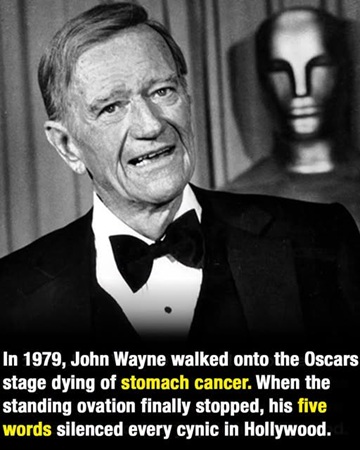
One of the most significant public moments of his later life came during the Academy Awards ceremony held on April 9, 1979, at the Dorothy Chandler Pavilion in Los Angeles. By this time, Wayne’s health had noticeably declined, but he still made a public appearance that would become one of the most memorable moments in Oscar history. His presence alone carried symbolic weight, as audiences recognized both his legacy and his personal struggles.
Earlier that year, Wayne had undergone major surgery after a serious medical diagnosis. He had previously dealt with cancer in the 1960s and other health complications, including heart surgery in the late 1970s. These medical challenges significantly affected his physical condition, and by 1979, he was visibly weaker than in his earlier years. Despite this, he accepted an invitation from longtime friend Bob Hope to attend the ceremony and present an award.
When Wayne appeared on stage that night, the audience response was immediate and powerful. The crowd consisted of major Hollywood figures, many of whom had grown up watching his films and were deeply aware of his contribution to the industry. As he walked onto the stage at the Dorothy Chandler Pavilion, the audience rose to their feet in a long standing ovation. This moment reflected not only admiration for his career but also respect for his resilience and long-standing influence in cinema.
Physically, Wayne appeared thinner and more fragile than in his earlier public appearances, but he maintained his characteristic presence. His posture, movement, and calm demeanor still reflected the screen persona that had defined him for decades. Even in a weakened state, he carried a sense of authority that audiences associated with his most famous roles in Western and war films.
After the applause settled, Wayne addressed the audience briefly. His remarks were simple and direct, reflecting his well-known preference for straightforward communication rather than elaborate speeches. He expressed gratitude to the audience and acknowledged the warm reception he received. One of his most remembered comments from the evening referred to the appreciation and support he felt from the people in the room, emphasizing the emotional connection between him and his audience.
During the ceremony, Wayne participated in presenting the award for Best Picture, which ultimately went to The Deer Hunter. His role that night was primarily ceremonial, but it carried symbolic importance, as it marked one of his final major public appearances in the entertainment industry.
Following the Oscars, Wayne’s health continued to decline. Although he remained mentally active and engaged with his family and close associates, his physical condition worsened over the following months. He spent time receiving medical treatment and exploring experimental options available at the time. His willingness to participate in emerging treatments reflected his long-standing resilience and determination in facing serious illness.
Despite his declining health, Wayne’s legacy continued to grow during this period. He was widely regarded not only as a film star but also as a cultural figure whose influence extended beyond entertainment. His earlier work in films such as Stagecoach and The Searchers had already established him as a defining figure in the Western genre. These films helped shape how Hollywood portrayed frontier life and heroism for generations.
In his final years, Wayne also became associated with efforts related to medical research and cancer awareness. After his passing, his family supported the creation of the John Wayne Cancer Institute, which continues to contribute to cancer research and treatment development. This institution became one of the most significant parts of his legacy outside of film.
John Wayne passed away on June 11, 1979, at the age of 72. His death marked the end of an era in Hollywood history. The response from the film industry and the public reflected his status as one of the most influential actors of the 20th century. Tributes highlighted not only his film achievements but also his long career longevity and cultural impact.
In the years following his death, Wayne’s final public appearance at the 1979 Academy Awards became one of the most discussed moments of his life. It is often remembered as a symbolic farewell from one of Hollywood’s most enduring figures. Rather than being defined only by illness, this moment is frequently viewed as a reflection of his lifelong relationship with cinema and his audience.
His burial took place at Pacific View Memorial Park in Newport Beach, California, overlooking the Pacific Ocean. For a period of time, his gravesite was kept private to maintain respect and privacy for his family. Over the years, his resting place has remained a point of reflection for fans who continue to study his films and legacy.
Today, John Wayne’s influence remains deeply embedded in film history. His performances helped define the Western genre, and his public image became a reference point for discussions about American cinema in the 20th century. His final Academy Awards appearance continues to be remembered not only as a moment of personal courage but also as part of Hollywood’s broader cultural memory.
More than four decades after his passing, Wayne’s legacy is still studied, debated, and recognized. His contribution to film, his iconic roles, and his enduring public image continue to place him among the most significant figures in cinematic history. His final years and public appearances remain a powerful reminder of the connection between Hollywood legends and the audiences who follow their work across generations.
