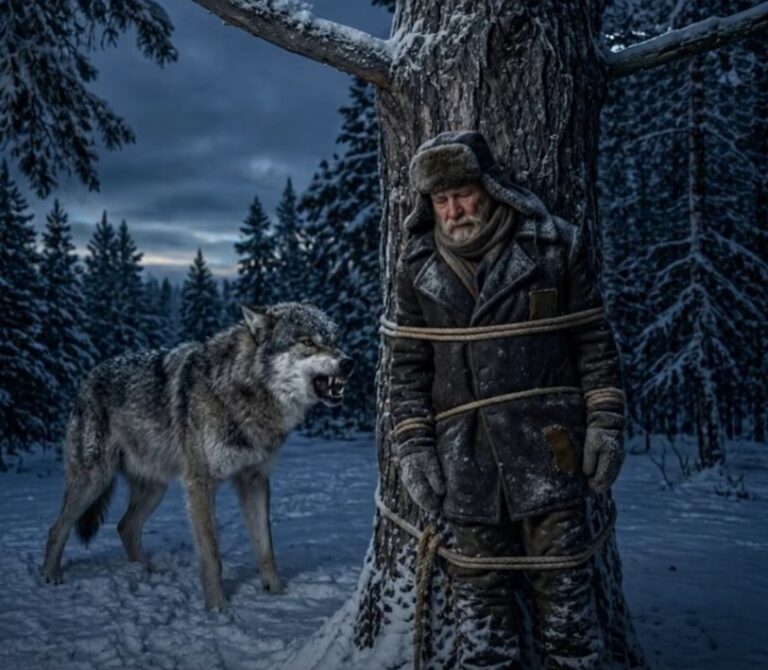
Deep within the vast and frozen wilderness of the Karelian taiga, an old gamekeeper named Alexei Orlov spent most of his life guarding the forest he had come to love more than anything else. The taiga was not just his workplace—it was his home, his responsibility, and the place where he understood every sound, track, and movement. Over decades of service, Alexei had seen the balance of nature shift, and he had dedicated himself to protecting wildlife from illegal hunting and environmental destruction.
During one particularly harsh winter patrol, Alexei’s routine inspection turned into something far more dangerous than usual. Reports of illegal poaching activity had reached local authorities, and he had gone deep into the forest to investigate. The snow was thick, the wind was sharp, and visibility was low, yet he continued forward, following subtle signs that something unnatural was happening in the area.
Eventually, he discovered hidden camps scattered through the forest. There were animal remains left behind, traps placed in strategic locations, and evidence suggesting organized poaching activity connected to influential individuals. Alexei understood immediately that what he had found was serious, and he carefully began documenting everything he could before leaving the area.
However, before he could safely return or report his findings, the situation took a violent turn. Three men appeared suddenly in the forest, ambushing him without warning. They overpowered the elderly gamekeeper, took the evidence he had collected, and destroyed his communication tools. In a brutal act meant to silence him, they tied him up and left him suspended in the freezing conditions of the storm.
As night fell over the taiga, the temperature dropped sharply. Alexei remained trapped beneath a pine tree, injured and exposed to the elements. The storm intensified, and snow covered the ground quickly, making movement almost impossible. The attackers had taken everything—his rifle, his phone, his knife, and the proof he had gathered. They believed nature itself would finish what they had started.
Yet, in the silence of the forest, something unexpected stirred. Months earlier, Alexei had encountered a wounded wolf caught in an old iron trap. Instead of ignoring it, he had carefully freed the animal, treated its injured leg, and allowed it to recover before releasing it back into the wild. That wolf had survived because of him, and it had never forgotten the encounter.
That same wolf eventually returned during the storm. Known in Alexei’s mind simply as Sever, the animal appeared through the snow-covered trees, moving cautiously but deliberately toward the struggling man. Without hesitation, Sever began pulling at the metal restraints that held Alexei, using strength and persistence until the cable finally gave way, releasing him into the snow below.
Though weak and severely injured, Alexei was not alone anymore. Sever remained by his side, refusing to leave him in the storm. The wolf stayed close as the old man struggled to regain strength, offering silent companionship in the freezing darkness. Together, they began moving slowly through the deep snow, with Alexei leaning heavily against the animal for support.
In the distance, the sound of engines and hunting dogs could still be heard. The men who had attacked him were searching the forest, attempting to ensure their actions remained hidden. At one point, Sever led Alexei toward a rocky gorge where the terrain echoed sound in unusual ways. The wolf’s howl echoed through the cliffs, confusing the pursuing dogs and disrupting the search efforts.
The chaos created just enough time for rescue teams, alerted by earlier signals and partial evidence, to locate Alexei alive. He was found in critical condition, suffering from frostbite, broken ribs, head trauma, and severe injuries caused by the cable and exposure. Emergency responders transported him immediately to medical care.
Although part of the evidence had been destroyed or stolen, enough material remained through backups, photographs, and supporting documentation to continue the investigation. Combined with witness accounts and additional digital traces, authorities were able to reconstruct the illegal operation linked to organized poaching activities in the region.
Eventually, legal action was taken against those involved. The investigation revealed a network of environmental crimes, corruption, and violent acts intended to silence opposition. Those responsible were arrested and faced multiple charges connected to poaching, bribery, and attempted harm against a forest officer.
Over time, Alexei recovered physically, though the experience left a lasting mark on his life. He often returned to the memory of that night in the forest and the unexpected presence that had saved him. Sever, the wolf he had once helped, remained a symbol of the fragile connection between humans and the wild world they often misunderstand.
Unlike a domesticated animal, Sever was never considered a companion in the traditional sense. The wolf remained wild, free, and independent, yet it occasionally returned to the edges of the forest near Alexei’s cabin. Those brief appearances were never predictable, but they left a lasting impression on those who knew his story.
In later years, Alexei’s story became something of a legend among younger forest rangers and conservation workers. It was shared as a reminder of the unpredictable relationship between humans and nature, and how small acts of compassion can sometimes return in unexpected ways. His experience became part of local teachings about respect for wildlife and the dangers of illegal exploitation of natural environments.
The tale of Alexei Orlov and the wolf known as Sever continues to circulate as a powerful narrative about survival, loyalty, and the balance of nature. Whether viewed as a symbolic story or a lesson in human responsibility toward wildlife, it remains a reminder that the natural world remembers both harm and kindness in its own way.
