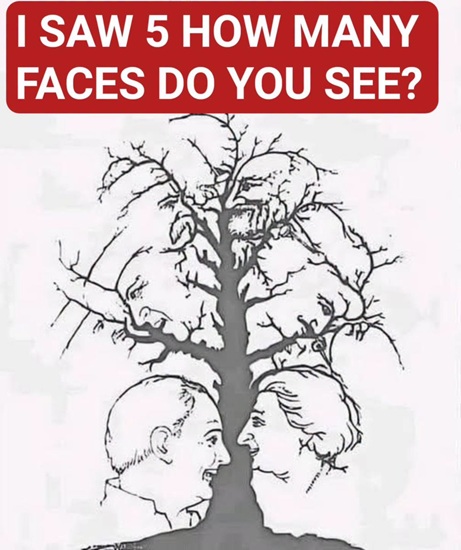
If you enjoy visual puzzles that test your attention and perception, then optical illusions like this one are exactly the kind of challenge that can capture your interest. These types of images often circulate widely online because they combine curiosity, entertainment, and a subtle test of observation skills. They encourage viewers to slow down, focus carefully, and look beyond what is immediately obvious at first glance.
One particularly popular example that has recently gained attention is known as the “National Leaders Tree.” At first sight, it appears to be a simple illustration of a tree. However, upon closer inspection, many hidden faces are embedded within its structure. This makes it a classic visual brain teaser that invites people to carefully examine every detail in the image.
The concept behind this illusion is straightforward but engaging. Viewers are asked to count how many human faces they can find hidden within the branches, trunk, and overall design of the tree. While some faces are immediately visible, others are cleverly integrated into the artwork, making them much harder to detect without careful observation.
Most people can easily identify at least two faces located near the bottom of the tree. These are the most obvious ones and serve as a starting point for the puzzle. However, as viewers continue scanning the image, they often realize that there are many more hidden elements blended into the natural shapes of the tree.

What makes this type of visual puzzle interesting is how it plays with human perception. Our brains are naturally wired to recognize familiar patterns, especially faces. This phenomenon, known as pareidolia, causes us to see meaningful shapes where none were intentionally designed. In optical illusions like this, artists often take advantage of that tendency to create layered and complex images.
As people spend more time examining the “National Leaders Tree,” they begin to notice additional faces hidden in unexpected places. Some are formed within the curves of branches, while others are subtly shaped within the bark or surrounding elements. The challenge is not just about counting, but about training the eye to notice details that are not immediately obvious.
Many viewers find that the longer they look at the image, the more faces they are able to identify. This is part of what makes optical illusions so engaging. They encourage patience, focus, and a shift in perspective. What initially looks like a simple illustration gradually transforms into a complex visual puzzle filled with hidden layers.
It is important to note that puzzles like this are designed purely for entertai
nment and cognitive stimulation. While some online posts attempt to assign deeper meanings to the number of faces a person finds, there is no scientific evidence to support claims that such activities can diagnose or measure medical conditions. Instead, they are simply fun exercises that challenge observation skills and attention to detail.
Depending on the viewer, the number of faces identified in the image can vary significantly. Some people may only notice a few, while others claim to find many more after extended observation. This difference often comes down to patience, visual focus, and the ability to recognize subtle patterns within complex designs.
Optical illusions like the “National Leaders Tree” have become increasingly popular on social media platforms because they are interactive and encourage discussion. People often compare their results with friends or family, turning a simple image into a shared experience. This social element adds to their appeal and makes them even more engaging.
Another reason these puzzles attract attention is because they are accessible to almost everyone. No special knowledge or tools are required—only time, focus, and curiosity. This makes them suitable for a wide audience, from casual viewers to puzzle enthusiasts who enjoy testing their perception skills.
As viewers continue to explore the image, they often develop different interpretations of what they see. Some may focus on larger, more obvious shapes, while others zoom in on smaller details that are easy to miss at first glance. This variety in perception is what makes optical illusions so unique and subjective.
In the end, the “National Leaders Tree” serves as a reminder of how complex and fascinating human perception can be. What appears simple at first can quickly reveal hidden depth when examined more closely. Whether you find a few faces or many, the real purpose of the puzzle is to enjoy the process of observation and discovery.
