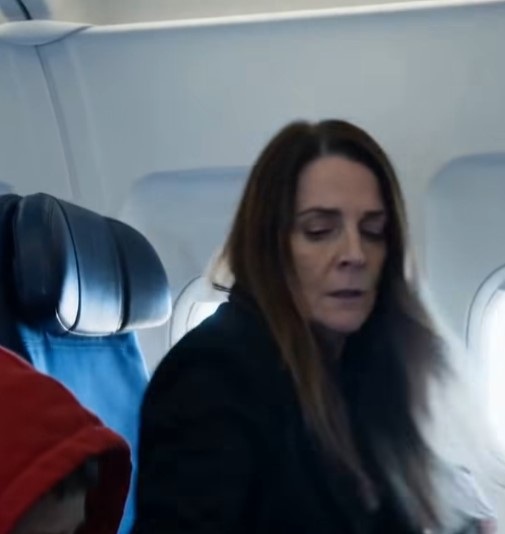
A Routine Flight Turns Tense After a Silent Distress Signal Is Spotted What began as an ordinary commercial flight unfolded like any other, with passengers settling into their seats, adjusting overhead luggage, and preparing for a routine journey filled with standard announcements and quiet cabin activity. Among those onboard was a woman traveling with a young boy. At first glance, they appeared to be a normal caregiver and child, but subtle details soon drew attention from nearby passengers seated across the aisle.
The boy remained unusually withdrawn throughout boarding and takeoff. He avoided eye contact, kept his head lowered, and spoke very little, showing signs of distress that seemed inconsistent with typical childhood travel behavior. Passengers also noticed a visible injury on his face, including a swollen and split lower lip. While injuries can occur accidentally, the combination of his demeanor and silence raised growing concern among those observing him closely.
The woman accompanying him appeared tense and controlling, maintaining a firm hold on his wrist at several points during the flight. Even when the cabin environment relaxed, her behavior toward the child remained restrictive and guarded. The boy did not engage with entertainment screens or surrounding passengers, remaining still for long stretches of time. His lack of interaction stood out, especially for his age, prompting quiet discussion among nearby travelers.
As the flight progressed, subtle discomfort among observing passengers increased. While no one could confirm anything was wrong, the overall behavior of both individuals created an atmosphere of unease that was difficult to ignore. The turning point occurred when the woman briefly became distracted during the flight. In that moment, the boy cautiously raised his hand and made a small, deliberate gesture that only a few passengers noticed.
He placed his thumb into his palm and closed his fingers over it, repeating the motion carefully and discreetly. The gesture was subtle, but clearly intentional, as though he was trying to avoid detection while communicating something important. A couple seated nearby recognized the movement as a widely known silent distress signal sometimes used to indicate a need for help when speaking is unsafe. The realization immediately changed their perception of the situation.
They understood that the boy was not simply anxious or shy, but potentially attempting to alert others to a serious problem. Without drawing attention, they discreetly informed a flight attendant about what they had observed. The flight attendant approached calmly, observing the situation from a distance to avoid alarming either passenger. After witnessing the same gesture, the crew member recognized the need to follow established safety procedures discreetly.
Cabin crew members quietly coordinated their response, maintaining a calm atmosphere to avoid escalating tension onboard. Communication was carefully relayed to ground personnel while ensuring passengers remained unaware of the developing situation. As the aircraft continued toward its destination, the woman appeared increasingly restless, frequently scanning the cabin and adjusting her position. The boy remained quiet, avoiding movement and keeping his gaze lowered throughout the remainder of the flight.
Passengers who had noticed the earlier signal remained anxious, uncertain about what might happen upon landing in a busy airport environment where individuals could easily move through crowds and disappear without immediate detection. Airport authorities were discreetly notified prior to landing, allowing law enforcement officers to position themselves near the arrival gate without causing disruption or alerting other passengers as the plane approached its destination.
Upon landing, passengers began collecting belongings and preparing to disembark in an atmosphere that appeared normal to most onboard. However, security personnel were already in place, monitoring the situation closely from nearby positions. The woman attempted to move quickly through the terminal with the child after exiting the aircraft, blending into the flow of arriving travelers. Officers, however, identified and intercepted them before they could leave the secure area.
A brief but controlled intervention followed as authorities separated the child from the woman for safety purposes. The situation was handled carefully to avoid causing additional distress or escalation in a public space. The boy, later identified as Leo, was taken to a secure area where medical personnel examined him and provided appropriate care for his visible injuries and emotional condition following the stressful experience onboard the flight.
Once safe, Leo began to relax for the first time since the journey began. The tension that had been evident throughout the flight gradually eased as he was placed under the protection of trained professionals. Authorities continued their investigation into the circumstances surrounding the situation, while ensuring the child remained safe and supported. The focus remained on his well-being and understanding the context of the reported concerns.
The most emotional moment came when Leo was reunited with his father after the situation was resolved. The reunion brought visible relief and emotion after a period of uncertainty and separation that had deeply affected both. The embrace between father and son marked a powerful conclusion to the incident, highlighting the importance of awareness and timely intervention when signs of distress are noticed, even in quiet and unexpected ways.
What began as an ordinary flight ultimately became a reminder that small, nonverbal signals can carry significant meaning. In this case, a simple gesture he lped communicate a need for help when words could not be spoken. The actions of attentive passengers, professional airline staff, and responsive authorities worked together to ensure the child’s safety after landing. Each step played a role in addressing a situation that could not be ignored.
For Leo, the silent hand signal became the first step toward safety and protection, demonstrating how awareness and careful observation can make a critical difference when someone is unable to speak openly about their situation.
