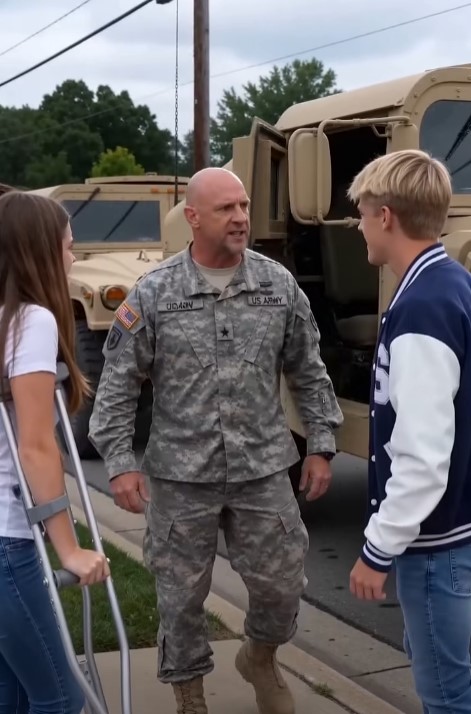
Major Jackson Miller had spent most of his adult life in military service, moving between deployments, training assignments, and long periods away from home. His career had taken him across different regions and environments, often leaving little time for a stable family routine. Despite the distance, he remained deeply connected to his daughter, Lily, who had grown up learning to adapt to her father’s absences while relying on the support of relatives at home in Texas.
When Jackson finally received a long-term instructor assignment closer to home, it felt like an opportunity to rebuild the everyday relationship he had missed during years of service. He looked forward to simple things—shared meals, school conversations, and being physically present for his teenage daughter. What he did not expect was that Lily had been quietly struggling in ways she had not fully revealed.
Lily had recently experienced a serious car accident that left her with a temporary mobility impairment. She relied on crutches during her recovery, which made everyday movement at school more challenging. While she tried to maintain a normal routine, the combination of physical discomfort and emotional vulnerability made her more sensitive to her surroundings than before. At first, she told her father that school was going fine, but subtle changes in her voice during phone calls suggested otherwise.
Concern grew when Jackson spoke to his sister-in-law Martha, who had been helping care for Lily during his absence. Martha explained that Lily had been dealing with repeated teasing and social exclusion at school. A small group of students had begun targeting her because of her limited mobility, initially through verbal comments and later through more direct and hurtful behavior. What started as isolated incidents gradually turned into a pattern that went unaddressed.
According to what Martha had observed and what Lily later confirmed, the behavior included knocking books from her hands, mocking her walking pace, and using unkind nicknames in hallways. These actions were not always visible to teachers or staff, which made intervention inconsistent. Over time, Lily began to withdraw socially, trying to avoid attention rather than report what was happening.
The situation escalated significantly on the day Jackson returned to town. A military convoy was passing through the area near Lily’s school as part of a scheduled movement. Jackson, who was traveling with the unit, happened to be nearby when school dismissal was taking place. From a distance, he noticed students gathering and moving through the school grounds, unaware that a critical moment was unfolding in front of him.
He then witnessed a student throw an object in Lily’s direction while she was using her crutches to navigate the walkway. The sudden impact caused her to lose balance and fall onto the pavement. The scene immediately shifted from an ordinary school afternoon to an urgent situation requiring medical attention. Jackson and several members of his unit quickly stopped their vehicles and moved toward her location.
A medic accompanying the convoy assessed Lily’s condition and confirmed that she was conscious but visibly shaken. She was carefully stabilized and later transported for further evaluation. The atmosphere among nearby students changed instantly, as confusion and concern replaced earlier noise and movement. Jackson’s immediate focus was on his daughter’s safety, but he also recognized that the incident was part of a larger, ongoing issue.
After ensuring Lily was receiving care, Jackson confronted the situation at the school directly. He requested an explanation from staff and asked for clarity regarding previous incidents involving his daughter. The school administration initially attempted to describe the event as an isolated misunderstanding, but Jackson challenged that interpretation based on what he had just witnessed and what he had already learned from family members.
As more students became aware that the situation was being taken seriously, several began sharing information about earlier incidents. Some admitted they had seen repeated harassment but had not reported it. Others provided details that helped establish a clearer pattern of behavior involving the same group of students. In some cases, digital recordings taken by students showed earlier moments of mistreatment that had not been formally addressed.
The emergence of this evidence shifted the understanding of the situation significantly. What had initially been presented as a single event was now seen as part of an ongoing pattern that had persisted over time. This raised concerns not only about student behavior but also about how previous complaints had been handled by the school.
Lily was later evaluated at a hospital, where medical professionals confirmed she had sustained a mild concussion as a result of her fall. Additional examination revealed signs of earlier physical strain consistent with repeated stress on her mobility during the period of bullying. While none of the injuries were life-threatening, the emotional impact was considered significant and required continued support.
During her recovery, Lily eventually shared more openly with her father about her experiences. She explained that she had not initially reported the bullying because she did not want to worry him while he was deployed. She also admitted that she felt isolated and uncertain about whether speaking up would make the situation better or worse. Her silence had been driven more by fear and protection than by resignation.
Jackson responded by reassuring her that vulnerability was not a weakness and that asking for help was an important part of facing difficult situations. This moment marked a turning point in their relationship, as Lily began to express emotions she had previously kept hidden. The conversation helped rebuild trust and allowed her to feel supported rather than alone in what she had endured.
As awareness of the incident spread, the school community began to respond more actively. Parents requested meetings with administrators, students discussed the issue more openly, and school officials initiated a review of how previous reports of bullying had been managed. The situation highlighted gaps in communication and response that had allowed the behavior to continue unchecked.
Administrative consequences followed as the district began reviewing the actions of school leadership. The principal’s handling of earlier complaints came under formal investigation, and broader policies related to student safety and reporting procedures were reassessed. While these processes were ongoing, the immediate focus remained on ensuring the safety and well-being of affected students.
Within the community, the incident prompted broader reflection on how bullying can escalate when early warning signs are overlooked. Many parents expressed concern that students often feel unable to report problems, especially when they believe their concerns will not be taken seriously. The event became a catalyst for renewed discussions about responsibility, awareness, and intervention.
For Lily, recovery was gradual but meaningful. With continued support from her family, medical guidance, and a more attentive school environment, she began to regain confidence. She slowly returned to daily activities, focusing on rebuilding both her physical strength and emotional stability. Her father adjusted his professional responsibilities to remain more present during this period, ensuring she had consistent support at home.
Three months after the incident, Lily attended a school event where she was able to participate more comfortably, still using a cane but standing with greater confidence. Her presence reflected not only physical healing but also emotional progress. Support from classmates who had become more aware of her experience contributed to a sense of inclusion that had previously been missing.
The situation ultimately became a reminder of how quickly unresolved issues can escalate when left unaddressed. It also demonstrated the importance of listening, early intervention, and creating safe environments where students feel empowered to speak. While the events had been painful, they led to meaningful changes within the school and the broader community.
In the end, what began as a difficult and deeply personal experience evolved into a wider lesson about awareness and responsibility. It showed how silence can allow harmful behavior to continue, but also how attention, accountability, and support can help restore safety and dignity for those affected.
