A young woman arrived at a local animal shelter with a deeply personal intention that had taken her a long time to act upon. Living with paralysis, she had spent many months reflecting on how important companionship could be in her daily life. For her, adopting a dog was not simply about having a pet, but about finding emotional support, stability, and a sense of connection that could accompany her through everyday challenges. The decision to visit the shelter was not impulsive; it was thoughtful, deliberate, and filled with quiet hope.
As she entered the shelter, she was immediately surrounded by a wave of sound and movement. Dozens of dogs reacted to her presence in different ways—some barking loudly, others jumping against kennel doors, and many wagging their tails in excitement. The environment was energetic and overwhelming, filled with constant noise and motion. Despite this, she remained calm and observant, carefully taking in each detail as she moved through the corridors in her wheelchair.
Each kennel she passed became a moment of quiet observation. She looked carefully into the eyes of every dog she encountered, searching for something she could not fully define. It was not just about appearance or behavior, but about a deeper sense of connection. Even though several dogs showed interest in her, none of them created the emotional response she had hoped for. She continued moving forward, patient and focused, refusing to make a rushed decision.
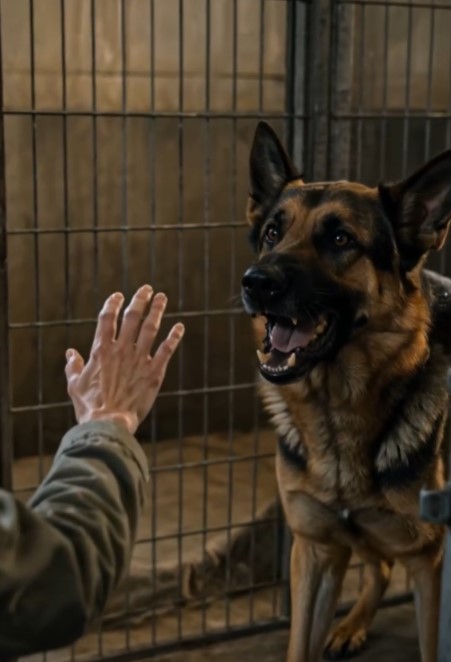
As she approached the end of one section of the shelter, she noticed a shift in atmosphere. In a quieter, more isolated corner, a German Shepherd lay apart from the rest. Unlike the other dogs, it did not bark or react to passing visitors. It remained still, observing quietly from its kennel with a distant and guarded presence. There was something unusual about its calmness, something that set it apart from the rest of the shelter environment.
The dog’s physical presence was strong and imposing, yet its behavior was restrained and controlled. It did not attempt to attract attention, nor did it show the same excitement as the other animals. Instead, it watched quietly, as if analyzing its surroundings. The young woman paused in front of the kennel, noticing that although the dog appeared intimidating, its eyes carried a different kind of emotion—one that suggested caution rather than aggression.
Without hesitation, she made her decision. She pointed toward the German Shepherd and told the shelter staff that this was the dog she wanted to meet. Her choice surprised the people working there, who were familiar with the animal’s background and behavior history. They exchanged concerned glances, clearly unsure about what might happen next. The dog had a reputation within the shelter for being difficult and unpredictable.
A staff member carefully explained the situation to her, emphasizing that the German Shepherd had shown signs of aggression in the past. They described incidents in which the dog had been difficult to handle and had not responded well to previous attempts at socialization. The tone of their warning was serious, reflecting genuine concern for safety. They suggested that she might consider another dog, one with a calmer and more predictable temperament.
However, the young woman did not change her decision. She listened carefully but responded with calm understanding. She acknowledged the concerns but explained that she believed every living being carried its own history and challenges. In her view, difficulty did not make something unworthy of compassion. Her response was steady and thoughtful, showing that her choice was based on instinct rather than fear.
After a brief discussion, the staff agreed to allow a controlled introduction. The German Shepherd was carefully brought out of its kennel, and the atmosphere in the shelter shifted immediately. Conversations quieted, and attention focused on the upcoming interaction. Visitors and staff members stepped back slightly, creating space while observing carefully. There was a noticeable tension in the air, as no one could predict how the dog would react.
The German Shepherd stood at a distance, alert and cautious. Its body language reflected uncertainty, and its gaze remained fixed on the young woman. For a few moments, neither moved. The silence in the room became heavy, as if time itself had slowed. Then, suddenly, the dog barked loudly and took a few steps forward, causing several people to react instinctively with concern.
For a brief moment, it appeared as though the warnings might come true. The dog’s movements were strong and direct, and the tension in the room increased. However, something unexpected happened. Instead of continuing aggressively, the dog slowed down. Its steps became more measured, and its posture shifted from tension to hesitation. The energy in the room began to change in response.
The young woman remained completely still. She did not raise her voice or move away. Instead, she maintained steady eye contact, showing no visible fear. Her calm behavior created a contrast to the tension around her. As the dog approached closer, its pace became even slower, as if it was reconsidering its initial reaction. The intensity of the moment gradually began to soften.
When the German Shepherd finally reached her, it lowered its body and leaned gently against her legs. It sniffed carefully around her wheelchair, exploring her presence without aggression. Then, in a surprising and unexpected gesture, it lay down at her feet. The transformation in behavior was immediate and striking, changing the entire atmosphere of the room.
The young woman slowly extended her hand. The dog did not resist or pull away. Instead, it remained calm and receptive, allowing her to gently touch its fur. Within moments, the dog relaxed completely, releasing tension and settling into a resting position. It appeared comfortable, as though it had accepted her presence fully for the first time.
The shelter room fell into silence. Staff members and visitors watched in disbelief, processing what they had just witnessed. The same dog that had been described as aggressive was now calm and peaceful. For those familiar with its past behavior, the transformation was difficult to understand. A quiet sense of surprise spread throughout the room.
The young woman leaned slightly closer and spoke softly to the dog. Her voice carried reassurance and calm certainty. She expressed that they would stay together and that everything would be fine moving forward. Her words reflected not control, but acceptance and connection. In that moment, a bond seemed to form that did not rely on explanation, only mutual understanding.
By the end of the visit, the decision was finalized. The adoption process was completed, and preparations were made for them to leave the shelter together. The German Shepherd, once considered difficult and unpredictable, walked calmly beside her. The transition from isolation to companionship had taken place in a single encounter that surprised everyone present.
As they exited the shelter, what remained was a sense of quiet reflection among staff and witnesses. The moment challenged assumptions about behavior, trust, and connection between humans and animals. It showed that first impressions do not always define outcomes and that understanding can sometimes emerge in unexpected ways.
The story serves as a reminder that patience, calm presence, and openness can influence even the most uncertain situations. In a place filled with different personalities and histories, an unexpected connection formed that changed the direction of two lives. What began as a simple visit ended as the beginning of a shared journey built on trust and understanding.
