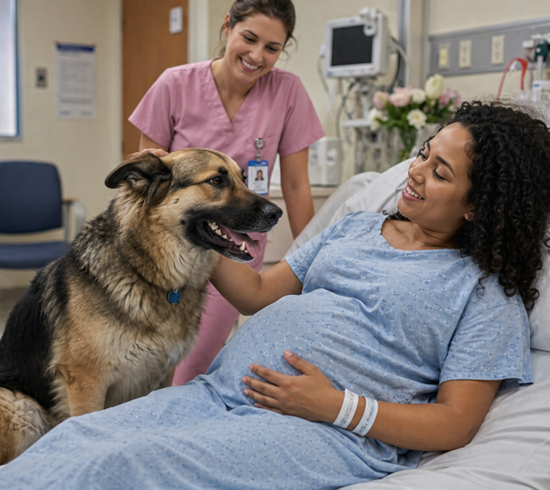
Sarah had been working as a charge nurse in the maternity unit at St. Jude’s Medical Center in Portland for nearly two decades. Over the years, she had seen countless deliveries, emergencies, and moments of both joy and fear. Most mornings followed a predictable rhythm—monitoring patients, coordinating with doctors, and ensuring that expectant mothers received steady care. That particular rainy morning began like any other, with soft lighting in the corridors and a calm atmosphere throughout the ward.
One of Sarah’s patients that day was Emily, a thirty-six-week pregnant woman admitted for observation due to high blood pressure concerns. Emily was experiencing her first pregnancy and carried a natural sense of anxiety about the process. The medical team had placed her under close monitoring to ensure both her safety and the baby’s well-being. Although she was stable, she remained nervous, frequently asking questions and seeking reassurance from the nursing staff.
A Routine Check That Turned Into Something Unusual
By mid-morning, Emily’s doctor recommended a short supervised walk through the hallway. This is a common practice in maternity care, often used to support circulation and reduce discomfort during late pregnancy. Sarah observed as Emily slowly made her way down the corridor, moving carefully in her hospital gown and socks.
For a brief moment, everything appeared completely normal. The sound of machines, footsteps, and quiet conversations filled the ward in a steady rhythm. However, that sense of calm was suddenly disrupted by an unusual sound echoing through the hallway—rapid movement and the unmistakable sound of paws striking the floor.
Sarah immediately looked up from the nurses’ station, unsure of what she was hearing. Within seconds, a large, wet German Shepherd mix appeared in the corridor, moving quickly and erratically. The animal was clearly soaked from the rain and appeared disoriented yet determined.
A Hospital Security Concern Emerges
The presence of a stray animal in a restricted medical area immediately raised concerns among staff. Hospitals maintain strict security protocols, especially in sensitive units such as maternity care. Sarah and other staff members instinctively attempted to redirect the dog away from patients.
However, the animal did not behave in a typical aggressive or random manner. Instead, it moved directly toward Emily, ignoring the surrounding staff. Emily, startled and frightened, stepped backward but lost her balance when the dog made contact with her, causing her to fall.
Medical staff quickly rushed to assist her, primarily concerned about potential injury to both mother and baby. Initial reactions focused on ensuring there were no immediate trauma-related complications from the fall.
Observations That Shifted the Situation
Once the initial shock passed, the staff observed that the dog’s behavior was not consistent with aggression. It did not attempt to bite or attack. Instead, it remained close to Emily, whining and focusing its attention toward her abdominal area.
This unusual behavior caused confusion among the medical team. While one staff member attempted to gently remove the animal, it resisted but still showed no signs of hostility. The situation required hospital security and animal control intervention, who eventually escorted the dog from the maternity floor.
With the situation under control, Emily was immediately moved for a medical evaluation to ensure there were no complications from the fall.
A Critical Medical Discovery
In the ultrasound room, Dr. Harrison performed a detailed examination of Emily and the baby. The initial expectation was to confirm that everything remained stable after the incident. However, the scan revealed unexpected complications.
The medical team identified abnormal findings that suggested internal concerns that had not been previously detected. These findings required immediate attention and significantly changed the course of Emily’s care.
Due to the seriousness of the situation, the team made the decision to proceed with emergency intervention. Time became a critical factor as both maternal and fetal conditions required urgent monitoring.
Emergency Delivery and Intensive Care Response
Emily was transferred to the operating room, where a full surgical team was assembled. The atmosphere was tense but highly coordinated, as doctors and nurses worked together under strict emergency protocols.
A baby boy was delivered, but initial moments were critical, as he required immediate respiratory support. The neonatal intensive care unit team responded quickly, providing life-saving interventions. After several tense minutes, the baby’s condition stabilized, and signs of improvement were observed.
Meanwhile, medical staff continued working to stabilize Emily, who required additional treatment and monitoring. Over time, her condition also began to improve with appropriate medical intervention and care.
Investigating the Dog’s Arrival
After the emergency had been managed, Sarah began reviewing hospital security footage to understand how the dog had entered the facility. The footage showed the animal being dropped near the hospital entrance from a passing vehicle before running inside during the rain.
From there, the dog appeared to navigate through the building and reach the maternity ward without hesitation. This behavior, while unusual, was likely influenced by sensory cues such as scent and movement within the hospital environment.
The animal was later taken to a local shelter for evaluation. Due to its unpredictable entry into a secure medical facility, it was temporarily classified as a potential safety concern.
Emotional Interpretations and Human Reactions
While medical staff focused on clinical facts, emotional interpretations naturally emerged among those involved. Emily’s family later shared that she had a childhood dog named Buster, who had been an important companion during her early years.
Although no scientific connection could be established, the coincidence of resemblance and timing led to emotional discussions among family members. Such interpretations are common in high-stress medical situations where emotional memory and real-life events intersect.
Sarah herself remained focused on medical facts but acknowledged how deeply human emotions shape the way people understand unexpected events.
A Broader Reflection on Medicine and Unexpected Events
From a medical perspective, the incident ultimately reinforced an important reality of healthcare: unexpected factors sometimes lead to earlier detection of hidden conditions. In Emily’s case, the fall led to additional examinations that revealed complications requiring immediate attention.
While the presence of the dog was unusual, the medical outcome centered on swift diagnosis and treatment by the hospital team. The coordinated response between doctors, nurses, and emergency staff played the most critical role in ensuring both mother and child received timely care.
In the end, both Emily and her baby survived and continued to recover under medical supervision. The incident became a memorable experience for hospital staff, not because of speculation, but because of how quickly circumstances can shift in a clinical environment.
Sarah continued her work at the maternity ward with renewed awareness of how unpredictable situations can unfold. The event served as a reminder that in healthcare, vigilance and rapid response are essential at all times.
What began as a routine morning ultimately became a complex medical case shaped by coincidence, timing, and swift professional intervention. While interpretations of the dog’s behavior varied emotionally among those involved, the medical outcome remained clear: timely action saved lives.
