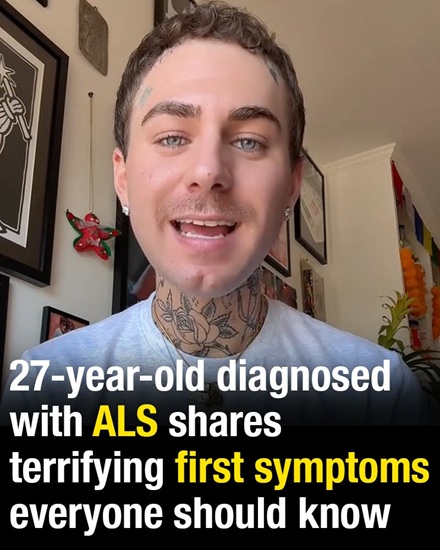
Mikey Stone was only 26 years old when he received a diagnosis that dramatically changed the course of his life: amyotrophic lateral sclerosis, better known as ALS. Now 27, Stone has spoken publicly about how his symptoms developed and why it took years before he finally received an explanation. What makes his experience particularly striking is how subtle the beginning seemed. There was no dramatic event or sudden loss of movement.
Instead, Stone has said that one of the first things he noticed was simply a strange sensation in his left foot while he was working as a server in Colorado. At the time, he could describe it only as feeling “weird,” and there was little reason for him to imagine that it could be connected to a serious neurological disease. ALS is a progressive neurological disease that damages the nerve cells responsible for controlling voluntary muscle movement. As these motor neurons deteriorate, communication between the brain and muscles becomes increasingly disrupted.
Over time, affected muscles weaken, and people can lose their ability to walk, use their hands and arms, speak, swallow and eventually breathe independently. There is currently no cure for ALS, although treatments and supportive care can help manage symptoms and, in some cases, slow aspects of disease progression. The course of ALS can also differ considerably from person to person, which is one reason diagnosis can be challenging, particularly when the earliest symptoms are mild or resemble those caused by more common conditions.
For Stone, the unusual feeling in his foot did not immediately disappear. He has explained that the sensation gradually developed into stiffness, and that stiffness eventually moved upward into his left calf. He later began noticing muscle twitching in the affected areas. According to his account, the twitching also became more widespread over the following years. Initially, these changes did not seem alarming enough for him to assume that something serious was happening. Eventually, however, the symptoms became difficult to overlook.

Walking became increasingly challenging, and his legs began feeling unusually heavy, weak and exhausted. Stone has compared the experience of trying to move his legs to walking through the shallow end of a swimming pool, where every step requires additional effort. In an interview with PEOPLE, Stone described another significant change: losing normal movement in one of his feet. He recalled that his walking became noticeably abnormal, comparing his gait to that of someone walking with a peg leg.
Early symptoms such as foot weakness can have many possible explanations, and Stone said his difficulties were initially attributed to being overworked. His experience demonstrates one of the complications surrounding ALS diagnosis. There is no single early symptom that automatically establishes that someone has the disease, and symptoms such as weakness, fatigue, cramps or twitching can occur for numerous reasons. Doctors therefore have to consider and rule out other potential explanations while evaluating how a patient’s symptoms develop over time.
Stone also recalled experiencing other health problems during the period when he was searching for answers. At a friend’s birthday gathering, he said he felt feverish and mentally foggy, and he later experienced severe abdominal discomfort that felt like a stabbing pain. When he sought medical attention, doctors initially suspected COVID-19. Those symptoms should not automatically be interpreted as signs of ALS, however, and Stone’s personal medical journey should not be used as a diagnostic checklist. His eventual diagnosis followed a much longer process involving multiple medical professionals and specialists. According to his public accounts, approximately three years passed between the beginning of his unexplained symptoms and receiving the ALS diagnosis.
Receiving that diagnosis at such a young age was understandably overwhelming. Stone told PEOPLE that it felt as though his life flashed before his eyes when he learned what was happening. ALS is more commonly diagnosed later in adulthood, making a diagnosis in someone’s twenties comparatively unusual. Stone has also discussed a genetic finding associated with his individual case, saying that he has a very rare mutation involving the SLC1A2 gene. Genetic factors are known to contribute to some cases of ALS, but ALS is a complex disease and most people experiencing ordinary muscle twitching, stiffness or weakness do not have ALS. A particular person’s genetic findings also cannot be generalized to everyone diagnosed with the condition.
Today, Stone has chosen to discuss his experience publicly, including through social media, where his story has reached a large audience. He has spoken about wanting to continue walking for as long as he is physically able before potentially needing a wheelchair. Sharing such an intensely personal experience gives people a glimpse into the practical and emotional realities that can accompany a progressive neurological illness. At the same time, stories like Stone’s are most useful when understood as individual experiences rather than medical predictions. Two people with ALS can experience different initial symptoms, different rates of progression and different challenges as the disease develops.
According to the ALS Association, early signs of ALS can include muscle weakness or stiffness, muscle cramping and twitching, and difficulties involving ordinary movements. A person might begin tripping more frequently, have trouble walking, struggle with everyday tasks involving the hands, or unexpectedly drop objects. Changes can also involve speech, including speech becoming slower or slurred. Some people can develop difficulty swallowing. ALS can additionally affect the neurological control of emotional expression, sometimes causing episodes of laughing or crying that are difficult to control. Importantly, none of these symptoms by themselves proves that a person has ALS, because many far more common and often less serious conditions can produce similar symptoms.
This distinction is especially important when discussing ALS online. Muscle twitching, tired legs or occasionally dropping an object can happen to healthy people and can have numerous explanations. A responsible interpretation of Stone’s experience is therefore not that everyone who notices a strange feeling in a foot should fear ALS. Rather, his experience illustrates why persistent, progressive or otherwise unexplained changes in muscle strength, coordination or movement deserve appropriate medical evaluation. A qualified healthcare professional can examine the symptoms in their full context and determine whether additional neurological testing or referral to a specialist is appropriate.
Scientists continue working to understand why ALS develops. Both genetic and non-genetic factors are believed to contribute, and only a portion of ALS cases have a clearly established family history. Researchers are studying genes, cellular processes, environmental influences and other possible mechanisms involved in motor-neuron degeneration. ALS is also considered a relatively rare disease. Although its seriousness understandably attracts significant attention, the rarity of the condition is important context when discussing possible symptoms. Public awareness should encourage appropriate medical attention without suggesting that common symptoms automatically indicate a devastating diagnosis.
Diagnosing ALS can require multiple evaluations because there is no single symptom that conclusively identifies the disease. Physicians may perform neurological examinations and use tests designed to evaluate muscle and nerve function while investigating other conditions that can resemble ALS. The diagnostic process depends on an individual’s symptoms and medical history. This is another reason that comparing symptoms with someone else’s story online cannot replace professional evaluation. Stone’s multi-year journey represents his own circumstances, rather than a timeline that every person with ALS will experience.
Stone’s story has resonated with many people because it demonstrates how a life-changing medical journey can begin with something seemingly insignificant. What started as an unusual sensation in his foot gradually became stiffness, weakness, muscle twitching and increasing difficulty walking. After years of seeking answers, he ultimately learned that ALS was responsible for his progressive motor symptoms. By speaking publicly about what happened, Stone is helping raise awareness of a disease that remains challenging for patients, families, clinicians and researchers alike.
His experience also provides an opportunity to emphasize a broader and more practical message about health. Persistent changes in movement, strength, coordination or muscle function should not simply be diagnosed through social-media posts, and people should avoid assuming the worst after recognizing one symptom from another person’s experience. Instead, unexplained symptoms that persist, worsen or interfere with everyday activities should be discussed with a healthcare professional. Doctors can evaluate the complete clinical picture, consider more common explanations and determine whether specialist assessment is necessary.
For Stone, the sensation that once seemed merely “weird” eventually became part of a much larger medical story. At 27, he continues sharing that journey while adapting to the realities of living with ALS and hoping to preserve his mobility for as long as possible. His experience is a reminder of both the seriousness of ALS and the importance of presenting medical stories with appropriate context. Awareness can be valuable, but it should be accompanied by accurate information, recognition that symptoms vary widely, and an understanding that an individual’s experience cannot establish another person’s diagnosis.
Medical disclaimer: This article is intended for informational and awareness purposes only and does not provide medical advice or a diagnosis. Symptoms such as weakness, muscle twitching, stiffness, fatigue or walking difficulties can have many different causes and do not necessarily indicate ALS. Anyone experiencing persistent, worsening or unexplained neurological or muscular symptoms should contact a qualified healthcare professional for appropriate evaluation.
