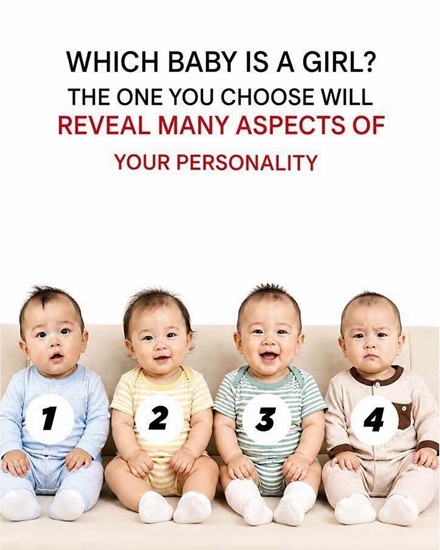
“Which baby is a girl?” sounds like a simple question, and that simplicity is exactly what makes this type of visual puzzle so appealing. A group of baby pictures is presented, viewers make a quick choice, and the accompanying text may promise to reveal something surprising about their personality. These quizzes can be entertaining and can encourage people to think about how they form first impressions. However, there is an important distinction between entertainment and psychological assessment.
Choosing one baby rather than another from a photograph cannot reliably determine a person’s personality, character, intelligence, or emotional traits. Babies do not come with reliable visual markers that allow strangers to determine whether they are girls or boys simply by examining facial features. Many assumptions people make are influenced by clothing, hairstyles, colors, expressions, poses, and other contextual cues.
When those cues are deliberately removed or made ambiguous, identifying a baby’s sex from appearance alone can become extremely difficult. That uncertainty is part of what makes these puzzles interesting. Rather than demonstrating a hidden ability to identify someone’s personality, they can illustrate how quickly the human mind tries to categorize unfamiliar information.
Imagine being shown four photographs of babies wearing similar neutral clothing. One baby may have a serious expression, another may be smiling, another may have slightly longer hair, and a fourth may have rounder facial features. A viewer might immediately decide that one of them “looks like” a girl. Another person looking at exactly the same images could confidently select someone completely different. Neither choice necessarily reveals a deep personality characteristic. Instead, the choices may reflect expectations and associations that people have learned from their environment and previous experiences.
Researchers in psychology have long studied how humans form impressions and categorize information. People routinely make rapid judgments based on limited visual information, sometimes without consciously realizing they are doing it. These mental shortcuts can be useful in everyday situations because processing every detail from the beginning would require considerable attention. However, quick impressions can also be inaccurate. When information is incomplete, the brain may rely on previous experiences, expectations, or familiar patterns to fill in what is missing.
This is particularly relevant when people try to infer gender from appearance. Adults frequently associate certain visual characteristics with masculinity or femininity, but many of those associations are shaped by cultural conventions rather than dependable biological indicators. Clothing provides an obvious example. Colors and styles that societies associate with girls or boys have varied across places and historical periods. Hair length, accessories, toys, and even photography styles can similarly influence people’s expectations without providing reliable evidence about the child in the photograph.
Facial expressions can influence judgments as well. A smiling baby might be interpreted as gentle, outgoing, or affectionate, while a serious expression could lead someone to imagine that the baby is quiet or determined. Yet a photograph captures only a brief fraction of someone’s behavior. A baby who happens to be serious during one photograph may have been laughing moments earlier. Assigning lasting personality characteristics on the basis of a single expression therefore goes far beyond what the photograph can actually establish.
This is where online personality quizzes need to be approached carefully. A quiz might claim that choosing Baby A means someone is logical, while Baby B supposedly represents creativity, Baby C sensitivity, and Baby D independence. Such descriptions can be enjoyable to read, particularly when they sound personally relevant. But unless a test has been developed and scientifically validated using appropriate psychological methods, those descriptions should not be treated as established conclusions about an individual’s personality.
Real personality assessment is considerably more complicated. Psychologists studying personality typically use carefully developed measures and examine whether those measures consistently evaluate the characteristics they claim to measure. Researchers may test large groups of participants, examine reliability, compare results with other evidence, and repeatedly evaluate whether conclusions are supported by data. A single preference between several photographs does not provide the same kind of evidence. Calling the result entertainment or a perception exercise is therefore much more accurate than presenting it as a psychological diagnosis.
That does not mean visual puzzles have no value. They can be useful conversation starters about perception. Two friends can look at identical pictures and notice completely different characteristics first. One person may focus on facial expression, another on hair, and someone else on clothing or posture. Comparing those observations can demonstrate how differently people process visual information. The interesting part is not that one answer secretly reveals someone’s character, but that different observers can interpret ambiguous information in different ways.
Consider what happens when someone makes a decision almost immediately. The viewer may feel certain about the answer without being able to explain exactly why. After thinking longer, that same person might notice that the original judgment was based on something as simple as hairstyle or facial expression. Recognizing this process can be valuable because first impressions occur far beyond online puzzles. People regularly encounter situations in which they have incomplete information but nevertheless feel tempted to reach a confident conclusion.
There is also a broader lesson concerning stereotypes. Humans learn associations from families, communities, entertainment, advertising, and broader cultural environments. Over time, these repeated patterns can influence expectations about how different groups supposedly look or behave. A visual puzzle involving babies can unintentionally activate some of those expectations. When viewers discover that their assumptions were incorrect, the experience can provide a harmless reminder that appearance alone often tells us much less than we think.
This point becomes especially important when discussing children. Babies and young children should not be assigned rigid personality characteristics based simply on appearance. Development occurs over time and is influenced by many interacting factors. A photograph cannot tell viewers what kind of adult a child will become, how intelligent the child will be, what interests the child will develop, or what personality characteristics will eventually become prominent. Claims suggesting otherwise should be treated skeptically.
Likewise, there is no reliable basis for saying that choosing a particular baby’s photograph proves someone is compassionate, stubborn, intelligent, romantic, dominant, introverted, or adventurous. A person may happen to recognize themselves in a broad description attached to their choice, but recognition alone does not validate the test. Many generalized personality descriptions contain characteristics that can apply to large numbers of people. Readers naturally pay more attention to portions that feel personally accurate while overlooking parts that do not fit as well.
A more responsible version of the activity is therefore simple: make your choice for fun, then examine why you made it. Did you notice the baby’s hairstyle first? Was your decision influenced by clothing? Did one facial expression seem more feminine or masculine to you? Did you choose immediately, or did you compare every picture carefully? These questions can encourage reflection without claiming that the answer provides a scientifically verified personality profile.
Someone who studies every detail before answering should not automatically be labeled an analytical personality. Perhaps that person simply found the puzzle difficult. Similarly, someone who chooses immediately should not automatically be described as impulsive or intuitive. A single decision made during an online activity cannot establish a stable behavioral pattern. Meaningful conclusions about personality require considerably more evidence across different situations and over time.
The entertainment value remains intact even with this clarification. In fact, understanding the limitations can make the puzzle more interesting. Instead of waiting for an algorithm or article to tell you what your choice supposedly means, you can examine your own reasoning. You might discover that you relied on a stereotype you had never consciously considered. Another participant might explain a completely different interpretation, demonstrating how strongly context influences perception.
Parents are particularly familiar with the unpredictability of assumptions about babies. Strangers can make incorrect guesses about a child’s sex even when they feel confident about their judgment. Clothing colors, blankets, hairstyles, names, and accessories often influence those assumptions. Removing such contextual clues makes visual identification even less reliable. The resulting uncertainty does not demonstrate poor observational ability; it demonstrates how much people normally depend on contextual information.
This is also why photographs should not be treated as complete representations of people. Images capture appearance at one particular moment, under specific lighting, from a particular angle, with one expression. They provide limited information and leave enormous amounts of context unseen. The same principle applies whether someone is looking at a baby, an adult, or an everyday social-media photograph. What appears obvious at first glance may become much less certain when additional information becomes available.
Online quizzes often use dramatic titles because curiosity encourages participation. Asking readers to “choose one” creates an immediate challenge, while promising a surprising personality revelation provides another reason to continue reading. There is nothing inherently wrong with enjoying that format when its entertainment nature is clear. Problems arise when unsupported interpretations are presented as medical, psychological, or scientific facts. Clear labeling helps readers understand the difference.
For publishers and social-media pages, accuracy matters particularly when content touches psychology, pregnancy, maternity, parenting, or child development. Entertainment should be distinguishable from professional advice and scientifically supported information. Statements about personality should not be presented as proven merely because they accompany an appealing visual test. Similarly, an article should not suggest that parents can determine important developmental characteristics through a photograph or another simplistic method.
The safest conclusion from a “Which Baby Is a Girl?” challenge is therefore not that one answer reveals hidden secrets about the viewer. Instead, the exercise demonstrates how easily people form impressions from limited information. Our brains look for patterns, use contextual clues, and compare what we see with things we have encountered previously. Sometimes those processes produce correct guesses, and sometimes they do not. One correct answer does not establish a special psychological ability, just as an incorrect answer does not reveal a personality flaw.
If you participate in such a puzzle, there is no reason to worry about getting the answer “wrong.” The interesting question is what influenced your decision. Perhaps it was the eyes, hairstyle, expression, clothing, or simply an immediate feeling that was difficult to explain. Thinking about those influences can turn a lightweight visual game into a useful reminder about the limits of first impressions.
The same lesson can extend into everyday interactions. People are often more complicated than the first impression they create, and limited information can encourage assumptions that later prove inaccurate. Taking additional time to gather facts can improve understanding, particularly when a judgment concerns another person. An entertaining baby-picture puzzle cannot measure personality, but it can illustrate why confidence and accuracy are not always the same thing.
Ultimately, the choice you make in this type of challenge should be treated as exactly that: a choice made from limited visual information. It does not scientifically reveal many aspects of your personality, predict your future behavior, or provide a psychological diagnosis. What it can do is encourage curiosity about perception, assumptions, stereotypes, and the ways people interpret visual clues differently.
So, which baby would you choose? Make your selection if you enjoy the challenge, compare your reasoning with other people’s observations, and treat the experience as entertainment rather than a scientific personality test. The most meaningful takeaway is not a label assigned to you after clicking an image. It is the reminder that first impressions can feel convincing even when the information behind them is incomplete—and that looking more carefully can sometimes reveal how much our expectations influence what we think we see.
