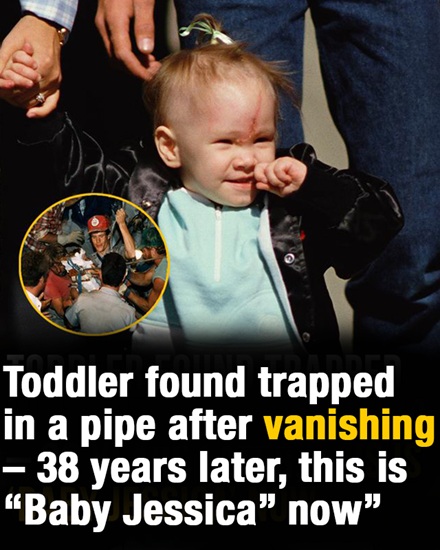
The story of Jessica McClure Morales, widely known in media as “Baby Jessica,” remains one of the most widely reported child rescue cases in modern American history. In October 1987, in Midland, Texas, an 18-month-old toddler was playing in the backyard of her aunt’s home when a tragic accident occurred. She fell into an abandoned water well that had been partially covered. The incident quickly escalated from a family emergency into a nationwide rescue operation. Over the following days, the case captured the attention of millions across the United States and beyond.
According to multiple historical reports and interviews given by family members, Jessica’s mother, Cissy McClure, immediately contacted emergency services after realizing what had happened. First responders arrived within minutes and quickly identified the severity of the situation. The well was narrow and deep, making direct access to the child extremely difficult. Early efforts focused on locating her exact position and determining how far she had fallen. These initial hours were critical in shaping the rescue strategy that would follow.
Rescue teams soon confirmed that Jessica had fallen approximately 22 feet into the narrow shaft. The confined space made traditional rescue methods impossible, requiring specialized equipment and engineering support. Emergency responders, drilling experts, and volunteers worked together around the clock. The operation quickly expanded into a coordinated effort involving multiple agencies. The primary challenge was to safely reach the child without causing the walls of the well to collapse.

Reports from responders at the scene describe how initial communication with Jessica was limited but crucial. First responders reportedly heard faint sounds from within the well after repeated attempts to call out to her. These early responses provided reassurance that she was still alive. In such rescue operations, even minimal sound or movement can help guide rescuers in determining survival and positioning. Teams carefully adjusted their strategy based on these small but vital signs.
As the rescue continued, a parallel drilling operation began near the original well. This method was chosen to avoid disturbing the narrow shaft directly above Jessica. Workers carefully excavated a parallel access point, gradually working toward the area where she was trapped. The process required extreme precision, as any miscalculation could have endangered the child further. Heavy machinery operated continuously, while engineers monitored soil stability and structural conditions.
Throughout the nearly 60-hour operation, rescuers maintained continuous communication with Jessica whenever possible. According to widely reported accounts, she occasionally cried or responded to voices from above. Rescue personnel provided verbal reassurance, attempting to keep her calm during the ordeal. In emotionally intense situations like this, such communication is often used to help reduce panic and maintain awareness of the victim’s condition.

The rescue effort became a major national news event in the United States. Television networks broadcast live updates, and viewers followed the operation in real time. The case became known simply as “Baby Jessica,” and the emotional nature of the situation drew widespread public concern. The combination of uncertainty, time pressure, and the involvement of a very young child contributed to the intense media attention.
After approximately 58 hours, rescue teams successfully reached Jessica through the carefully constructed access point. She was carefully extracted from the well and immediately transferred to medical personnel on site. Reports confirmed that she was alive at the time of rescue, marking a successful conclusion to one of the most closely followed rescue operations of its time. Emergency responders later described the moment as both highly emotional and deeply relieving.
Following her rescue, Jessica required medical treatment for injuries sustained during the fall and the time spent trapped underground. Historical accounts indicate that she underwent multiple surgeries over the years to address complications, including issues related to circulation and tissue damage. Despite the severity of the incident, she survived and gradually recovered under medical care. Her long-term recovery became part of her widely reported life story.
In the years following the incident, a trust fund was established to support her future needs. Donations reportedly came from individuals across the United States and other countries, reflecting the global attention the case had received. Over time, portions of the fund were affected by financial market conditions, but it contributed to her long-term financial stability and support. Such public responses are not uncommon in highly publicized rescue cases involving children.
As Jessica grew older, she gradually learned more about the events that had made her known worldwide. According to later interviews, she did not remember the incident itself due to her young age at the time. Instead, she learned about it through media coverage and family discussions later in life. This is common in early childhood trauma cases, where memory of events is often absent but reconstructed through external accounts.
In adulthood, Jessica McClure Morales built a private family life. Reports indicate that she married and had children, later becoming a grandmother. She has occasionally spoken publicly about her experience, reflecting on how the incident shaped her identity in the eyes of the public. Despite the widespread recognition of her childhood rescue, she has emphasized living a relatively normal life away from constant media attention.
Over the years, she has also shared that the “Baby Jessica” label remained part of how some people recognized her, even decades later. This reflects how major media events can permanently influence public identity. Individuals involved in widely broadcast incidents often find that their past becomes part of public memory, even as they move forward with private lives.
Medical records and historical reports confirm that Jessica underwent several surgeries as a result of injuries sustained during the fall. These treatments were necessary to address complications that developed from prolonged entrapment and restricted circulation. Despite these challenges, her recovery was successful, and she continued to live a full life with her family.
The 1987 rescue remains an important case study in emergency response coordination. It is frequently referenced in discussions about rescue engineering, media coverage of emergencies, and crisis management. The combination of rapid mobilization, technical innovation, and community involvement contributed to its successful outcome. It is also remembered for the emotional impact it had on the public at the time.
Today, the story of Jessica McClure Morales is often revisited as an example of resilience, teamwork, and human determination. It highlights how emergency responders, engineers, and volunteers can work together under extreme pressure to save a life. While the incident itself was tragic, the outcome remains one of survival and recovery. The case continues to be remembered as a significant moment in modern American rescue history.
