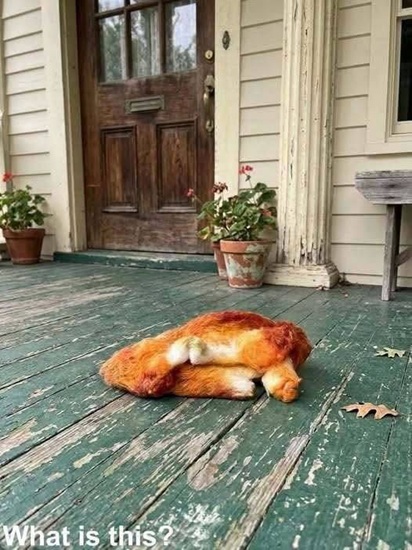
For several long moments, everything around me felt strangely suspended, as if time itself had slowed down while I stood frozen at the edge of my porch. My eyes were locked onto an unfamiliar shape resting on the wooden boards just outside my door. At first glance, it looked like a small animal curled tightly into itself, its reddish-brown fur contrasting sharply with the pale, weathered wood beneath it. The shape was unsettlingly still, and something about its form created an immediate sense of hesitation within me.
It resembled something that had wandered in during the night and simply fallen asleep where it landed, undisturbed by the world beginning to wake around it. Despite that initial impression, an underlying sense of unease prevented me from accepting the scene at face value. The stillness felt too complete, too unnatural to belong to anything alive and resting peacefully. The early morning environment around me—normally filled with subtle movement, distant sounds, and shifting light—seemed unusually quiet in that moment.
My attention narrowed entirely to that single point on the porch, and I found myself unable to look away. It was as though the rest of the world had temporarily faded, leaving only questions behind. What exactly was lying there? How had it arrived without notice? And why did it feel so out of place? As I slowly gathered the courage to observe more closely, I searched for any sign that might confirm it was simply a sleeping animal.
I looked for the faint rise and fall of breathing, the smallest twitch of movement, or any subtle reaction to sound or light. Each second that passed seemed to stretch longer than the last, adding to the tension building inside me. Yet there was nothing—no movement, no sound, no indication of life. The silence surrounding the form felt heavier with every passing moment, pressing against the familiar comfort of my home and turning it into something unfamiliar and uncertain.

A quiet sense of concern began to settle in as I continued to observe. Encounters with wildlife are not unusual in areas where natural environments overlap with human living spaces, but discovering something that appears lifeless directly at one’s doorstep creates a different kind of emotional response. It forces a moment of confrontation with uncertainty, where curiosity and caution exist side by side. I hesitated between stepping closer or maintaining distance, unsure of what I might discover. In that moment, even the most ordinary surroundings felt subtly transformed into something more fragile and unpredictable.
Eventually, I carefully moved closer, allowing myself to inspect the shape in greater detail. What had initially appeared to be a complete animal slowly began to reveal a different reality. The texture, structure, and arrangement of the fur suggested that what I was looking at was not a living creature at all, but rather remains—specifically a detached piece of fox fur and skin. The realization shifted the entire emotional weight of the moment. What had been uncertainty mixed with concern quickly transformed into understanding, replacing fear with a more grounded sense of clarity.
It became increasingly likely that the remains had been left behind after a nighttime encounter with a predator. In many natural environments where wildlife activity overlaps with rural or suburban areas, animals such as coyotes often move through quietly during the night in search of food.
These predators are highly adaptable and can pass through human-inhabited spaces without being noticed. In some cases, they may leave behind remnants of their activity, especially when scavenging or hunting occurs in low-visibility conditions. The scene on my porch appeared to be one such trace of that natural process, left behind without intention or awareness of human presence.
The emotional reaction that followed was complex and layered. The immediate relief of realizing that no injured animal was present was quickly followed by a quieter sense of sadness. Even without witnessing what had happened, the evidence itself represented the end of a life somewhere beyond my view. It served as a reminder that nature operates continuously, regardless of human awareness or involvement. Life in the wild is shaped by survival, instinct, and necessity, where every outcome is part of a larger and often harsh cycle that exists independently of human perception.
Standing there, I became more aware of how easily modern life can create a sense of separation from the natural world. Homes, roads, artificial lighting, and structured environments often give the impression that human spaces exist apart from nature. However, moments like this challenge that assumption in a quiet but powerful way. Wildlife does not recognize the boundaries created by human design. Animals move through neighborhoods, forests, and open land without distinction between what is considered “urban” or “wild,” following patterns shaped by instinct and survival rather than human planning.
This realization brought with it a deeper sense of reflection. The presence of the remains on my porch highlighted how closely connected human environments remain to natural systems, even when that connection is not immediately visible. Predation, decay, growth, and renewal continue continuously in the background of daily life, regardless of human schedules or routines. While it is easy to appreciate nature in controlled or distant settings, encountering its raw reality up close can feel unexpected and emotionally complex.
As time passed, the initial shock gradually faded, leaving behind a more thoughtful perspective. The experience no longer felt like a moment of fear or confusion, but rather like a reminder of coexistence. Human life and natural life are not separate systems, but overlapping ones that influence each other in subtle and constant ways. Even something as small as a fragment of fur on a porch can represent a much larger story of movement, survival, and ecological balance unfolding just beyond human attention.
In the end, what began as a brief moment of uncertainty became a quiet reflection on the presence of nature in everyday life. The discovery served as a reminder that the natural world is never truly distant, even when it seems hidden from view. It exists alongside human spaces, moving through them in ways that are often unnoticed until evidence appears unexpectedly. And when it does, it invites a pause—a moment to observe, to reflect, and to recognize the shared environment that both humans and wildlife inhabit together.
