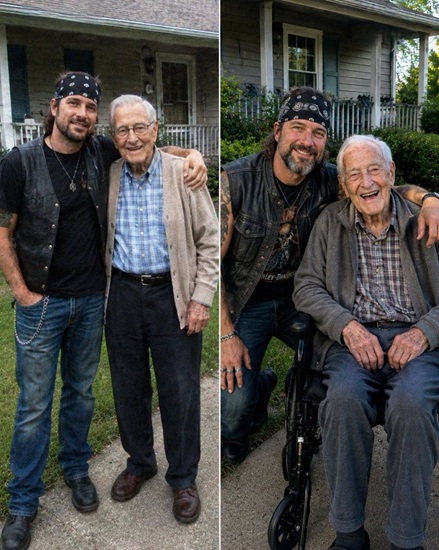
Some moments arrive so quietly that you never realize they are about to change your life forever. For me, it happened on an ordinary Sunday afternoon after the funeral of my elderly neighbor, Ezra Harrison. The sky was gray, the streets were unusually still, and I believed I was simply saying goodbye to a kind man I had known for many years. Instead, I walked away carrying an old leather suitcase that would reveal a story far more meaningful than anything I could have imagined.
I first met Ezra shortly after moving into the neighborhood. At the time, I was focused almost entirely on building my career and assumed the little house I had purchased would only be temporary. Ezra had lived there for decades. He was a quiet widower in his eighties who spent most mornings tending his small garden or reading on his front porch. We exchanged friendly greetings from time to time, but our conversations never lasted more than a few minutes. We were simply neighbors living separate lives until one unexpected afternoon changed everything.
I was unloading groceries from my car when I noticed Ezra struggling to carry several heavy paper bags from the trunk of his sedan. One of the bags suddenly tore open, sending canned food rolling across his driveway. Without thinking, I hurried over to help him gather everything before anything was damaged. He thanked me warmly and invited me inside for a cup of coffee as a gesture of appreciation. I almost declined because I still had plenty to do that afternoon, but something about his gentle smile convinced me to stay for a little while.
That first conversation lasted much longer than either of us expected. Ezra shared stories about the neighborhood from decades earlier, when open farmland surrounded the area and families knew every person on the street by name. He spoke lovingly about his late wife, Margaret, whose photographs still decorated nearly every room of the house. Although years had passed since her death, it was clear she remained a constant part of his memories. Before leaving, I casually told him that if he ever needed help with groceries again, he only had to call.
What began as a simple offer gradually became an important weekly tradition. Every Sunday morning I stopped by the grocery store before visiting Ezra’s home. Together we unpacked the groceries, organized the kitchen shelves, prepared lunch, and spent time talking about everything from local news to favorite books and family memories. Some weeks we laughed over old stories, while other days we simply enjoyed the comfortable silence that develops between people who genuinely appreciate each other’s company. The visits became just as important to me as they were to him.
As the years passed, Ezra’s health slowly declined. Walking became more difficult, driving was no longer safe, and everyday tasks required increasing amounts of effort. Even so, he rarely complained. Instead, he remained grateful for every visit and always tried to offer payment for the groceries or my time. I politely refused each offer because our friendship had never been about money. Helping him felt like the natural thing to do, and over time he became almost like another member of my own family.
During those years my own life changed as well. I married Claire, changed jobs, and celebrated many personal milestones. Ezra was there to congratulate us when we bought our first family car, and he never forgot birthdays or anniversaries. Claire quickly grew fond of him too, often joining our Sunday visits with homemade desserts or fresh bread. Looking back, I realize those afternoons became some of the happiest and most peaceful moments of our week.
Everything changed one autumn morning when I noticed Ezra’s porch light still glowing long after sunrise. That immediately struck me as unusual because he was always careful with even the smallest household expenses. Concerned, I knocked on his front door several times but received no answer. Later that day emergency responders arrived, confirming what I had quietly feared. Ezra had passed away peacefully in his sleep during the night. The neighborhood felt noticeably quieter after his passing, and I struggled to accept that our Sunday tradition had come to an end.
The funeral was modest, attended mostly by a few distant relatives, longtime acquaintances, and neighbors. Among those present was Ezra’s nephew, Marcus, whom Ezra had mentioned only occasionally over the years. After the service, Marcus questioned why I had spent so much time helping his uncle, suggesting there must have been some hidden reason behind my kindness. I calmly explained that friendship required no reward and that Ezra had simply become an important part of our lives. Rather than argue, I quietly walked toward my car, believing that chapter of my life had closed.
Before I could leave, Ezra’s longtime attorney approached carrying an old leather suitcase with worn brass latches. He explained that Ezra had left clear written instructions requesting that the suitcase be delivered directly to me after the funeral. According to the attorney, it was completely separate from the rest of the estate and represented a personal gift rather than part of the inheritance. Marcus objected immediately, but the attorney politely explained that he was simply carrying out his client’s legally documented wishes.
When Claire and I opened the suitcase later that evening, we found no jewelry, cash, or valuable collectibles. Instead, it contained carefully organized letters, family photographs, several journals, and one envelope resting on top with my name written across the front. Inside, Ezra explained that he had written a letter after nearly every Sunday we spent together. The letters described our conversations, the encouragement he had received from our visits, and the gratitude he felt for never having to face loneliness completely alone. Reading his words brought tears to both of our eyes.
Toward the back of the suitcase we discovered another surprise. Ezra had quietly established a modest savings fund years earlier, asking that it eventually be used to help elderly people living alone in the community. Inspired by his generosity, Claire and I created a local volunteer program providing groceries, small household repairs, transportation, and regular visits for seniors who needed companionship. Every Sunday before leaving to visit someone new, I still open Ezra’s suitcase and read one of his letters. It reminds me that genuine kindness rarely seeks recognition, yet its impact can continue long after both the giver and receiver are gone.
