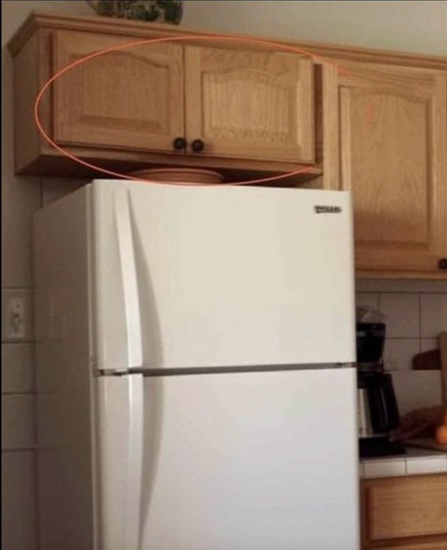
A clean and thoughtfully organized kitchen can make everyday tasks easier, especially when frequently used items have predictable places. One area that often receives little attention is the small cabinet installed above the refrigerator in many kitchens. Because it sits higher than standard cabinets and can sometimes be awkward to reach, homeowners may leave it nearly empty or fill it with miscellaneous objects. Yet with sensible organization, this space can provide useful additional storage.
The key is choosing items that are appropriate for a high cabinet and that do not need to be accessed constantly. Before deciding what belongs above the refrigerator, it helps to consider why this cabinet is different from ordinary kitchen storage. Its elevated position makes it less convenient for everyday plates, drinking glasses, mugs, or other objects used several times each day.
Depending on the kitchen layout, the refrigerator itself can also make reaching the cabinet more difficult. For these reasons, the space generally works better for lightweight or moderately sized items that are needed only occasionally. Accessibility and safety should always be more important than fitting as much as possible into the available space.
Start by Understanding the Space
Not every cabinet above a refrigerator has the same dimensions. Some are surprisingly deep but relatively short, while others offer only a narrow storage area. Before reorganizing yours, measure its interior height, width, and depth. Knowing the available dimensions can prevent you from purchasing storage containers that do not fit. It can also help you determine whether the cabinet is suitable for small appliances, serving pieces, kitchen linens, or other supplies.
You should also examine how easily the cabinet can be reached. If you need to stretch dangerously or stand on an unstable object to open it, frequently used items should not be stored there. A proper step stool can make occasional access safer, but even then, heavy objects may not be appropriate. Think about how you will remove an item before placing it inside. Something that is easy to lift upward may be considerably more difficult to lower safely from above your head.
Store Infrequently Used Kitchen Appliances
One possible use for an above-refrigerator cabinet is storing small kitchen appliances that are not needed every day. Depending on the cabinet’s dimensions and the weight of the appliance, items such as a compact waffle maker, small food processor, hand mixer accessories, or similar equipment may fit. Moving occasionally used appliances away from the countertop can free valuable preparation space. It can also make lower cabinets available for cookware and equipment that you use more frequently.
Weight is an important consideration, however. A large blender, heavy food processor, or other substantial appliance may technically fit but still be unsafe to retrieve from a high shelf. Before storing any appliance overhead, consider whether you can comfortably lift it down using both hands. You should also avoid overloading shelving beyond the cabinet manufacturer’s intended capacity. If an appliance feels difficult to handle at shoulder level, a lower cabinet is generally the better storage location.
Consider Certain Shelf-Stable Pantry Goods
Some people use upper cabinets for shelf-stable pantry products, but this requires more care than simply placing any food item above the refrigerator. Unopened canned goods and other shelf-stable foods are designed for pantry storage under appropriate conditions, yet manufacturers’ storage instructions should still be followed. The area surrounding a refrigerator can sometimes become warmer than other parts of a kitchen, particularly depending on the appliance’s ventilation design and surrounding cabinetry.
For that reason, temperature-sensitive foods should not automatically be stored above a refrigerator. Check product labels and your refrigerator manufacturer’s guidance before using the cabinet as a pantry extension. If the cabinet remains within suitable storage conditions, lightweight shelf-stable items that are used occasionally may be practical there. Regularly checking expiration or best-quality dates can also prevent forgotten products from remaining in the back of a deep cabinet for years.
Organize Occasional Baking Equipment
Baking equipment is another category that can work well in this location. Many households have cake-decorating supplies, cookie cutters, silicone molds, piping bags, specialty measuring tools, or seasonal baking accessories that are not needed every day. Keeping these items together in a clearly labeled container can make the cabinet more organized. When it is time to bake, you can remove the container rather than searching through several different drawers.
Dry baking ingredients require more consideration. Flour, sugar, chocolate, yeast, and other ingredients have individual storage recommendations, and heat or moisture can affect quality. Instead of assuming that every baking ingredient belongs above the refrigerator, follow the manufacturer’s instructions printed on the package. In many kitchens, the cabinet may be better suited to baking tools and accessories rather than ingredients themselves.
Create a Home for Cookbooks
Cookbooks can consume valuable countertop and shelf space, especially if you have collected them for many years. An upper cabinet can potentially provide a convenient location for cookbooks that you consult only occasionally. Seasonal recipe books, specialty cuisine collections, and older family cookbooks can be kept together rather than occupying the most accessible shelves in the kitchen.
There are some practical limitations. A large collection of books can become surprisingly heavy, so avoid loading a shelf with more weight than it is designed to support. Books can also be affected by excessive heat, humidity, and cooking grease. If the cabinet becomes noticeably warm or damp, another location may protect them better. A small selection of lightweight cookbooks is generally more sensible than trying to move an entire library above the refrigerator.
Use Baskets or Containers for Small Items
Deep cabinets often become disorganized because small objects disappear toward the back. Storage baskets or bins can help solve this problem. Instead of reaching deep inside the cabinet for an individual item, you can carefully remove a lightweight container and see everything inside. Transparent containers can make identification easier, while labels can be useful when opaque bins are used.
Categories are usually more effective than simply filling containers with whatever fits. One bin might hold cake-decorating equipment, another could contain reusable party supplies, and another might store spare kitchen accessories. Keeping related objects together reduces the chance of forgetting what is inside the cabinet. It also makes periodic cleaning and decluttering considerably easier.
Store Lightweight Kitchen Linens
Kitchen towels, cloth napkins, spare dishcloths, and other lightweight linens can be excellent candidates for high storage. They are relatively easy to lift, unlikely to cause serious damage if accidentally dropped, and often purchased in quantities larger than what needs to remain immediately accessible. You can keep the towels currently in rotation in a convenient drawer while placing extra supplies above the refrigerator.
Linens should be completely clean and dry before long-term storage. Folding them consistently can help maximize space, and a lightweight basket can keep stacks from becoming disorganized. If you entertain seasonally, holiday table linens can also be stored separately and brought down only when needed. This approach reserves easier-to-reach kitchen storage for everyday essentials.
Keep Occasional Serving Pieces Together
Special serving dishes and entertaining accessories that are used only a few times each year may also be candidates for this cabinet. Lightweight platters, serving baskets, decorative bowls, or holiday accessories can sometimes fit comfortably. Keeping these items together can make preparation easier when guests arrive or when you are organizing a special meal.
Fragile and heavy objects require extra caution. Expensive china, glass serving dishes, and heavy ceramic pieces can be difficult to retrieve safely from an elevated position. Although placing fragile items high up may keep them away from small children, the risk of dropping them while retrieving them should also be considered. If an item is valuable, heavy, or difficult to grip, secure storage at a more manageable height is usually preferable.
Make Space for Seasonal Kitchen Items
Seasonal items are particularly well suited to less-accessible storage because they may remain untouched for most of the year. Holiday cookie cutters, decorative napkin rings, specialty serving accessories, reusable birthday decorations, and seasonal table items can be grouped together. Once the occasion has passed, they can return to the upper cabinet until they are needed again.
Labeling is especially useful for seasonal storage. A simple label such as “Holiday Baking” or “Party Supplies” can prevent unnecessary searching. Avoid packing containers so tightly that they become heavy or difficult to remove. Several smaller lightweight containers may be safer and more practical than one large box filled with many objects.
Be Selective With Spices
It might seem convenient to use the cabinet as overflow storage for spices, but placement conditions matter. Herbs and spices generally maintain their quality best when stored away from excessive heat, moisture, and direct sunlight. Because the area above or near some refrigerators may become warmer, it is not automatically an ideal location for them.
If you are considering storing spices there, first determine whether the cabinet stays appropriately cool and dry. Frequently used spices are usually better placed somewhere easier to reach during cooking. An upper cabinet might instead hold sealed backup containers if their storage requirements can be met. Always follow manufacturer recommendations when they provide specific instructions.
Avoid Medicines and Temperature-Sensitive Products
A high cabinet can appear to be a convenient place to keep medicines away from children, but the kitchen—and particularly an area that may experience temperature changes—is not necessarily appropriate. Medicines should be stored according to their labels, including any specified temperature and humidity requirements. Child-resistant packaging and secure storage are also important considerations.
The same principle applies to foods or household products requiring controlled conditions. Chocolate, certain oils, supplements, and other products can have particular storage recommendations. Height alone should never determine where something is kept. When a label specifies storage conditions, those instructions should take priority over convenience.
Think About Refrigerator Ventilation
One frequently overlooked issue is refrigerator ventilation. Refrigerators release heat while operating, although the location and amount of heat vary by model. Manufacturers specify required clearances around their appliances so air can circulate appropriately. Cabinets, stored objects, or decorative items should never block required ventilation areas.
Consulting the appliance manual is the safest way to determine clearance requirements for a specific refrigerator. Avoid assuming that a setup is safe simply because another kitchen uses something similar. Different models can have different ventilation designs. Maintaining appropriate airflow can help the appliance operate as intended.
Don’t Overfill the Cabinet
Unused space often creates the temptation to fill every available centimeter, but an overpacked cabinet can become inconvenient and potentially unsafe. Objects pushed tightly together are harder to remove, and retrieving something from the back may require moving several other items while standing on a step stool. Leaving some open space can make the cabinet far easier to use.
A simple organizational rule is to prioritize visibility. Ideally, you should know what is stored inside without unloading half the cabinet. Containers, labels, and sensible categories can help. If you cannot remember what is behind the front row, the cabinet may contain too much.
Put Safety Before Convenience
Safety is the most important consideration when using elevated storage. Never stand on a chair, countertop, refrigerator edge, or unstable object to reach an upper cabinet. Use a sturdy step stool or appropriate household step ladder on a stable floor, following its safety instructions. If possible, position yourself so you can maintain balance without leaning excessively.
Heavy objects should generally remain at lower levels where they can be lifted using safer body mechanics. A cast-iron appliance or large stack of ceramic dishes might physically fit above the refrigerator, but that does not make the location sensible. Consider what could happen if the item slipped while being lowered. Lightweight objects are usually the better choice for difficult-to-reach cabinets.
Periodically Review What You Store There
Because the cabinet is not opened as frequently as everyday storage, forgotten items can accumulate. A quick review every few months can prevent it from becoming a permanent home for things you no longer need. Remove expired products where applicable, donate usable equipment you never use, clean the shelves, and reorganize anything that has become difficult to access.
This is also an opportunity to reconsider whether your storage system still matches your lifestyle. An appliance that was once used only twice a year might suddenly become part of your weekly routine and deserve a more accessible location. Conversely, something rarely used can move upward and free valuable lower-cabinet space.
Use the Space According to Your Own Kitchen
Ultimately, there is no universal rule requiring a cabinet above the refrigerator to contain a particular category of items. Kitchen layouts, refrigerator models, cabinet dimensions, household needs, and accessibility vary enormously. A solution that works perfectly in one home may be inconvenient in another.
The most practical approach is to reserve this high cabinet for relatively lightweight, infrequently used items that can tolerate the conditions inside it. Kitchen linens, seasonal accessories, lightweight baking equipment, selected cookbooks, and occasional serving supplies are among the possibilities. Food products should be stored there only when the location meets their recommended storage conditions.
A well-organized kitchen is not necessarily one in which every cabinet is completely full. Good organization is about making everyday activities simpler while keeping belongings accessible and safely stored. The small cabinet above the refrigerator can contribute to that goal when it is used thoughtfully.
Instead of treating the space as a forgotten corner, consider it secondary storage for items that do not deserve prime kitchen real estate. Measure the cabinet, check the refrigerator’s ventilation requirements, choose lightweight objects, use clearly labeled containers, and avoid anything that could be unsafe to retrieve. With those precautions, an awkward little cabinet can become a surprisingly useful part of an organized kitchen.
