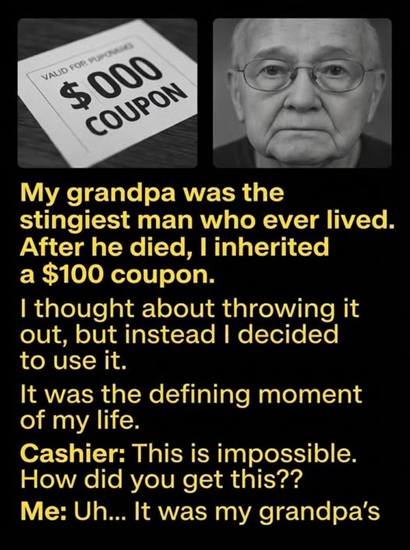
The story of the coupon I almost threw away begins not with the paper itself, but with the kind of man my grandfather was remembered to be. He was someone who lived with a quiet awareness of value in things that others often overlooked. To many people, he might have simply appeared careful or overly cautious with money and possessions, but within our family, his habits were familiar and consistent. He rarely wasted anything, and he often kept objects long after others would have discarded them without a second thought.
As children, we did not fully understand his way of living. We would sometimes laugh at the small habits he carried with him, such as reusing items that seemed worn out or keeping objects that appeared to have no clear purpose anymore. To us, it looked unnecessary at the time. However, those habits were part of a broader mindset that we were too young to appreciate. It was only later, with time and distance, that some of us began to realize that his actions were not random, but guided by a deeper sense of discipline and respect for resources.
After he passed away, the process of sorting through his belongings became a quiet and reflective experience. Among the items he left behind, there was a worn book that looked ordinary at first glance. Inside it, tucked between pages filled with handwritten notes, I found an old coupon. The paper was faded, slightly creased, and unremarkable in appearance. Nothing about it suggested importance or value. In fact, my first instinct was to dismiss it as something that no longer mattered.
For a brief moment, I considered simply throwing it away. It seemed like a leftover fragment of something that had long lost its relevance. Yet something held me back. It was not urgency or curiosity alone, but a growing sense that my grandfather did not keep things without reason. Even when his actions seemed unclear, there was usually a purpose behind them that revealed itself only with time or reflection. That thought alone made me pause and take a closer look instead of making a quick decision.
As I examined the coupon more carefully, I began to understand that its importance was not immediately visible. It was not valuable in a conventional sense, nor did it represent something rare or significant on its own. However, it carried something more subtle. It was connected to a pattern of behavior, a way of thinking that had defined my grandfather’s approach to life. The more I reflected on it, the more I began to see that the real value was not in the object itself, but in what it represented.
That realization led me to reconsider many of the assumptions I had formed over the years. I had often viewed his habits through a modern lens, where efficiency and convenience tend to dominate decision-making. In that context, saving small items or avoiding waste can appear unnecessary or outdated. But stepping back from that perspective allowed me to see something different. What once seemed like excessive caution now began to resemble intentional stewardship, a careful approach to using what life provides.
In many ways, his behavior reflected values that are increasingly rare in today’s fast-paced environment. Modern life often encourages replacement over repair, speed over patience, and consumption over preservation. Objects are frequently treated as temporary, and their usefulness is measured by how quickly they can be replaced. Against this backdrop, my grandfather’s habits stood out as something more deliberate, even if they were not fully understood at the time.
The experience also led me to think more deeply about the idea of patience. Patience is often misunderstood as simply waiting for something to happen, but in reality, it is much more than that. It involves trusting that small actions, repeated consistently over time, can create meaningful outcomes. My grandfather’s life seemed to reflect this principle. He paid attention to small details, maintained things carefully, and avoided unnecessary waste. Individually, these actions may not have seemed significant, but together they formed a consistent philosophy of living.
What struck me most was how easily these patterns had been overlooked. As a younger person, I had focused on appearance rather than intention. I judged behavior based on immediate usefulness rather than long-term meaning. This is something many people experience when reflecting on older generations. Actions that seem unclear at first often carry layers of experience and knowledge that are not immediately visible. Understanding them requires time, perspective, and sometimes distance from the moment in which they were observed.
The coupon itself eventually became less important than the realization it triggered. It was not about financial value or practical use. Instead, it became a reminder of how easily assumptions can shape perception. For years, I believed I understood my grandfather’s way of thinking, but I had only seen it from the outside. The deeper meaning behind his habits was something I only began to appreciate after I was no longer able to ask him directly.
In that sense, the coupon became an unexpected form of inheritance. It did not represent wealth or material gain, but rather a shift in perspective. It encouraged a more thoughtful approach to how value is defined and recognized. It also highlighted the importance of humility in understanding other people’s choices, especially those who come from different experiences or generations.
Looking back, what remains most clear is not the object itself, but the lesson attached to it. The memory of that small piece of paper serves as a reminder that meaning is not always obvious at first glance. Sometimes, the things we dismiss too quickly carry insights that only become visible when we slow down and reflect. My grandfather’s life, in its quiet and careful way, continues to speak through those small details.
Ultimately, the story is not about a coupon at all. It is about perception, patience, and the way understanding develops over time. It is about recognizing that wisdom is often hidden in ordinary habits and that what appears insignificant may carry deeper value when viewed from a different perspective. And most importantly, it is about learning that some of the most important lessons in life are not delivered through grand gestures, but through simple, everyday actions that only reveal their meaning later on.
