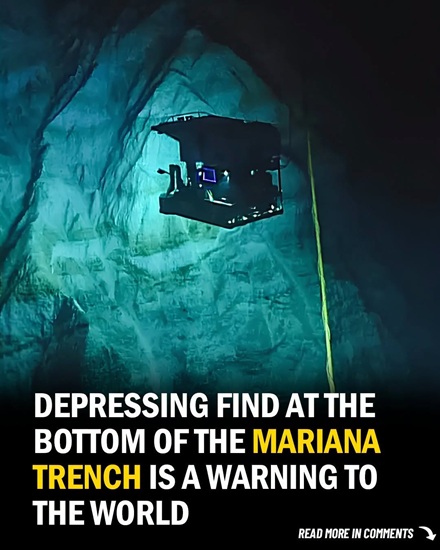
The Mariana Trench, the deepest known point on Earth, represents a realm so extreme that it was long assumed to be untouched by human activity. Located in the western Pacific Ocean, this immense oceanic trench plunges nearly 11,000 meters below sea level, where darkness is absolute and pressure is hundreds of times greater than at the surface. For decades, scientists believed that such an environment was too remote and hostile for everyday human pollution to reach in any significant way.
Yet modern deep-sea exploration has gradually overturned that assumption, revealing that even the most isolated parts of the planet are no longer beyond the influence of human activity. Among the most striking discoveries has been the presence of human-made debris, including plastics, in environments once considered pristine and unreachable. This finding has become a powerful symbol of how far human impact has extended into the natural world.
Oceanographers and deep-sea researchers, using advanced submersibles and remotely operated vehicles, have documented various forms of waste on the seafloor, including plastic fragments, packaging materials, and abandoned fishing equipment. These observations do not represent a single isolated incident but rather part of a broader global pattern of marine pollution. Ocean currents act as vast transport systems, carrying lightweight debris across thousands of kilometers until it eventually sinks to the deepest ocean floors.
In this way, even the most remote trenches are indirectly connected to human activity taking place on land and in coastal regions around the world. Scientific studies on marine pollution have consistently shown that plastic is one of the most persistent and widespread materials found in ocean ecosystems. Unlike organic waste, plastic does not fully biodegrade in a short time frame.
Instead, it breaks down slowly into smaller fragments known as microplastics, which can persist in the environment for decades or even centuries. These particles have been detected in surface waters, deep-sea sediments, and even within marine organisms themselves. Researchers have raised concerns about the long-term ecological consequences of this accumulation, particularly in fragile deep-sea environments where ecosystems are still poorly understood.
The presence of debris in the Mariana Trench also highlights the global scale of waste management challenges. A significant portion of marine pollution originates from land-based sources, including improperly managed waste, littering, and runoff carried by rivers into the ocean. Once plastic enters the marine environment, it can travel vast distances, influenced by currents, wind patterns, and gravitational sinking processes. Some items remain floating near the surface for years, while others eventually descend into deep ocean basins. This movement demonstrates that ocean pollution is not confined to any single region but is instead a shared global issue that crosses national boundaries.
Marine biologists have also documented the impact of plastic pollution on deep-sea ecosystems. Although these environments may appear lifeless at first glance, they are in fact home to a diverse range of specialized organisms adapted to extreme conditions. Species living in the deep ocean often rely on limited food sources, making them particularly vulnerable to environmental disruption. When plastic waste enters these ecosystems, it can interfere with natural feeding behaviors, introduce toxic substances, and alter the physical environment of the seafloor. In some cases, organisms may mistake plastic particles for food, leading to ingestion that can harm their health and survival.
Another concern raised by researchers is the role of “ghost gear,” or abandoned fishing equipment, which can continue to trap and harm marine life long after it has been lost or discarded. In deep-sea environments, such debris can remain intact for extended periods due to the cold temperatures and lack of sunlight, posing a long-term hazard to marine organisms. This type of pollution illustrates how human activities, even when unintended, can have lasting consequences far beyond their original purpose.
The discovery of human-made materials in the Mariana Trench has prompted scientists and environmental organizations to emphasize the urgency of addressing marine pollution at its source. Efforts to reduce plastic waste, improve recycling systems, and develop alternative materials are seen as critical steps in mitigating further damage. At the same time, international cooperation is considered essential, as ocean currents do not recognize political boundaries. What enters the sea in one part of the world may eventually affect ecosystems thousands of kilometers away.
Beyond its scientific significance, the presence of debris in the deepest part of the ocean carries a broader symbolic meaning. It serves as a reminder of the interconnectedness between human society and the natural environment. Actions taken on land—whether in cities, industries, or households—can ultimately influence ecosystems that are far removed from everyday human experience. This realization has encouraged a growing awareness of environmental responsibility and the importance of sustainable consumption practices.
The situation also underscores the importance of continued deep-sea exploration and research. Much of the ocean remains unexplored, and scientists believe that understanding these environments is essential for assessing the full impact of human activity on the planet. Technological advancements in underwater exploration have made it possible to study regions that were once completely inaccessible, providing valuable data about both natural processes and human influence.
Ultimately, the presence of plastic and other debris in the Mariana Trench is not just a scientific observation but a global environmental warning. It highlights the need for long-term changes in how materials are produced, used, and disposed of. While the deep ocean may seem distant from daily human life, it is in fact an integral part of Earth’s ecological system. Protecting it requires coordinated efforts, informed policy decisions, and a collective shift toward more sustainable practices.
The lesson drawn from these discoveries is clear: no part of the planet exists in isolation from human impact. The deepest point in the ocean, once thought to be untouched, now reflects the consequences of modern consumption and waste. Addressing this challenge is not only about preserving marine ecosystems but also about ensuring the long-term health of the planet as a whole.
