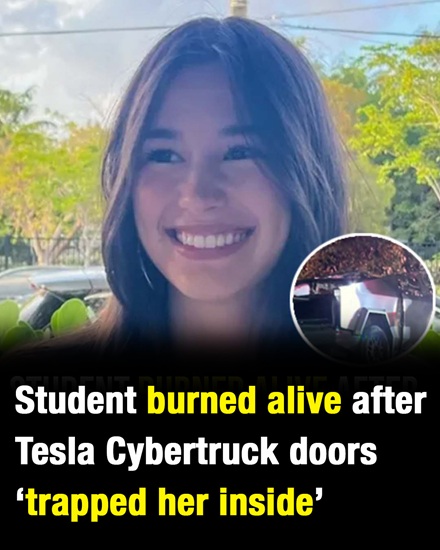
A devastating crash in Northern California on November 27, 2024, has drawn widespread attention to vehicle safety concerns and ongoing legal battles involving Tesla and its Cybertruck model. According to reports from local authorities and statements shared publicly, the incident involved a single-vehicle collision in Piedmont that ended in a fatal fire. The case has since become the subject of multiple wrongful death lawsuits and renewed scrutiny over emergency exit systems in modern electric vehicles, particularly those designed with advanced electronic controls.
The victims in the crash were identified as 19-year-old Krysta Tsukahara, 19-year-old driver Soren Dixon, and 20-year-old passenger Jack Nelson. All three were recent graduates of Piedmont High School and had reportedly returned home for the Thanksgiving holiday period. A fourth passenger, Jordan Miller, survived the incident after being rescued by a friend who followed behind the vehicle and helped break a window to pull him from the burning Cybertruck.
The Piedmont Police Department later confirmed that officers arrived to find the vehicle fully engulfed in flames, with multiple fatalities at the scene. Investigations cited by media outlets, including reporting from sources such as Tesla, Inc., indicate that the vehicle struck a retaining wall before catching fire. Preliminary findings from the California Highway Patrol suggested that speed and impairment may have contributed to the crash.

Toxicology reports referenced in court filings alleged the presence of alcohol and controlled substances in the system of the driver, while other occupants were also reported to have tested positive for substances. These details have been included in ongoing legal arguments but remain part of broader investigative context surrounding the incident.
One of the central issues raised by the victims’ families involves the ability of passengers to escape the vehicle after the collision. According to wrongful death lawsuits filed against Tesla and the vehicle owner’s estate, the Cybertruck’s electronic door systems allegedly became inoperable following damage to the low-voltage electrical system during the fire. Attorneys for the families claim that this left occupants unable to open the doors in a rapidly spreading blaze, contributing to the inability of some passengers to escape in time.
The lawsuits further argue that while manual release mechanisms exist within the vehicle, they may be difficult to locate or operate under emergency conditions such as smoke, fire, or panic. Legal representatives for the families have stated that these design elements created what they describe as a dangerous delay in evacuation. In particular, they allege that visibility and accessibility of emergency exits are critical factors that were not adequately addressed in the vehicle’s interior design.
According to court documents and statements reported by outlets such as Fox Business and the San Francisco Chronicle, Krysta Tsukahara initially survived the immediate impact of the crash but became trapped as fire conditions intensified inside the vehicle. Attorneys for her family claim she was unable to exit due to a combination of mechanical failure and fire progression, ultimately succumbing to smoke inhalation and thermal injuries. These claims are part of an active civil case and have not yet been resolved in court.

Legal representatives for the families have also accused Tesla, Inc. of having prior knowledge of potential risks associated with electronic door systems in extreme conditions. They argue that despite awareness of these risks, sufficient design changes were not implemented to ensure reliable emergency egress in all scenarios. Tesla has not admitted wrongdoing in relation to these allegations and, as with many product liability cases, disputes over design responsibility are expected to be examined in detail during litigation.
Statements from the families describe profound grief and frustration over the circumstances of the crash. Krysta Tsukahara’s father has been quoted in media reports emphasizing that his daughter was a bright and promising young student with significant academic and personal potential. Similar sentiments were expressed by the family of Jack Nelson, who also criticized the difficulty of emergency escape mechanisms in high-stress post-collision environments.
The case has also sparked broader public discussion about the design of electric vehicles and the increasing reliance on electronic systems for basic functions such as door operation. Critics argue that while advanced technology improves efficiency and innovation, it must also account for worst-case emergency scenarios, including power loss, fire, and structural damage. Supporters of the technology, however, note that modern vehicles are subject to extensive safety testing and that investigations are still ongoing.
As the legal process continues, the incident has become part of a wider debate about automotive safety standards, corporate responsibility, and the balance between innovation and reliability. The Tesla, Inc. Cybertruck, launched with significant public attention, now faces increased scrutiny as regulators, attorneys, and safety experts examine its design and performance under extreme conditions.
Ultimately, the tragedy has left a lasting impact on the families involved and the broader public conversation about vehicle safety. While investigations and lawsuits are still in progress, the case continues to raise difficult questions about how modern vehicles are engineered, how emergency systems are designed, and what safeguards are necessary to prevent similar outcomes in the future.
