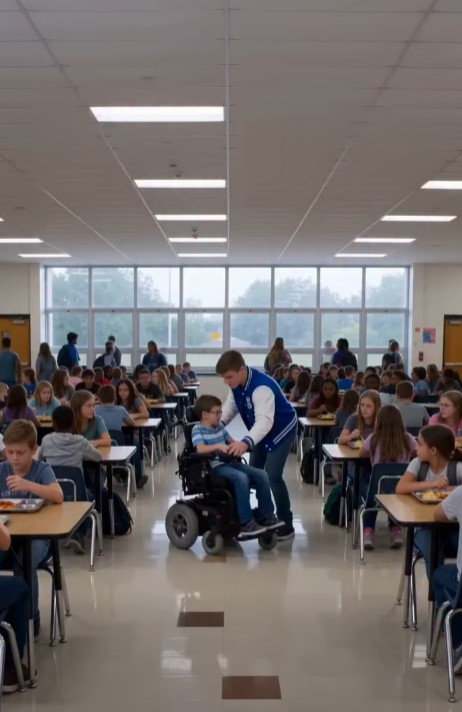
David Miller had spent most of the last three years stationed away from home, moving between deployments, training exercises, and long stretches of silence where letters and short phone calls were the only connection to his son. Coming back to Northwood felt strange, almost unreal, like stepping into a life that had continued without him but never truly stopped belonging to him. He didn’t announce his return. There were no messages, no warnings, just a quiet decision to walk into his son’s world and finally be present again.
Northwood Middle School looked the same as he remembered, with its faded brick walls and crowded hallways echoing with student voices. The cafeteria was loud, chaotic, and full of the everyday rhythm of school life. David stood for a moment at the entrance, scanning the room for Leo. He expected excitement, maybe laughter, maybe even surprise. What he didn’t expect was tension — something subtle but wrong in the way a group of students were gathered near the back corner.
That’s where he saw him. Leo sat in his wheelchair slightly apart from the other tables, his tray untouched, his posture tense in a way David immediately recognized. Around him stood a few older boys, their body language aggressive, their attention focused not on conversation but control. David’s instincts sharpened instantly, the same instincts that had once guided him through hostile environments overseas. But this was different. This was his son.
Before he could move closer, he heard Leo’s voice — quiet, shaky, but clear enough to cut through the noise. “Please… that’s for my dad.” Something in those words froze David in place. One of the boys was holding a crumpled piece of paper, and in that moment David realized it was something Leo had made for him — something personal, something meant to be special. The casual laughter from the group around them made the moment feel even worse.
David stepped forward without raising his voice. He didn’t need to. The uniform alone changed the atmosphere as he approached. “Is there a problem here?” he asked calmly. The reaction was immediate. The boys turned, saw him, and suddenly their confidence disappeared. The cafeteria noise softened, then faded, as attention shifted toward the confrontation unfolding in the corner.
Leo looked up and froze. For a second, disbelief crossed his face, followed by recognition that broke through everything else. “Dad?” he said, barely audible. David didn’t answer right away. He knelt beside him instead, helping him pick up the fallen paper and checking him carefully, not just physically but emotionally, noticing the fear Leo had been holding in for too long. That silence between them said more than words ever could.
What followed in the principal’s office painted a much larger picture. Reports, incident notes, and vague explanations filled the conversation, but none of them fully addressed what Leo had been experiencing. Minor “conflicts,” “accidental falls,” and “misunderstandings” were listed in paperwork, but the pattern told a different story. David’s expression hardened as he read through them, realizing this wasn’t isolated.
Sarah, Leo’s mother, arrived shortly after, visibly distressed. She explained that she had raised concerns before, multiple times, but felt dismissed or reassured without real action. Her voice carried frustration, not just at the situation but at how long it had been allowed to continue. David said very little, but his silence was focused, analytical, and heavy with concern.
As they continued discussing what had happened, attention drifted to other issues surrounding the school, including a construction project near the property. Locals had mentioned irregularities before, but nothing had been clearly addressed. David wasn’t looking for trouble, but he couldn’t ignore patterns that suggested something deeper going on beneath the surface of the town’s calm appearance.
For the first time in a long time, David and Leo spent real time together without interruptions. At home, the distance between them slowly began to close. Leo talked more than he had in months — about school, about feeling isolated, about avoiding attention because it felt safer. David listened, realizing how much he had missed while believing duty elsewhere was his only responsibility.
Over the following days, concern within the community began to grow quietly. Parents started asking questions, teachers exchanged uncertain conversations, and inconsistencies in communication became harder to ignore. What had once been brushed aside as routine school matters began to feel more complicated. David remained focused on protecting Leo, but he also understood the importance of clarity and truth.
In time, what mattered most wasn’t just the investigation or the reports or the confusion surrounding the school. It was the relationship rebuilding between a father and son who had been separated not just by distance, but by silence. Leo began drawing again, filling pages with images of open spaces and calm places where he felt safe. David kept those drawings close, understanding them more than any report or conversation.
One afternoon, they stood outside the school together. The tension in the air hadn’t completely disappeared, but something had changed. Leo sat beside him with his sketchbook, no longer withdrawn, no longer alone in the same way he had been before. The world around them was still uncertain, but their connection wasn’t.
David looked at his son and realized that returning home hadn’t just been about coming back to a place. It had been about seeing what had been happening in front of him all along. And this time, he wasn’t going to look away.
