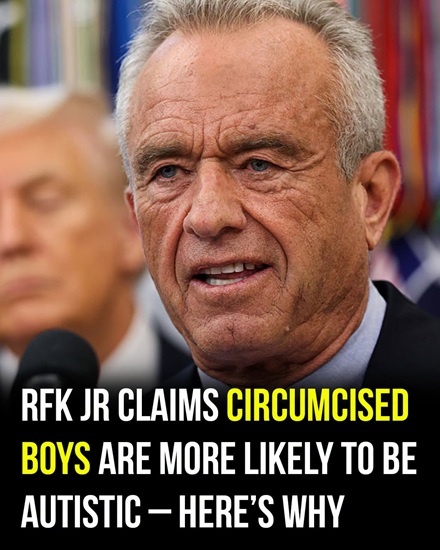
Health Secretary Robert F. Kennedy Jr. has once again become the center of public debate following controversial remarks made during a recent high-level meeting with former President Donald Trump and other Cabinet officials. The discussion reportedly touched on public health issues, but quickly shifted when Kennedy revisited one of his most widely criticized claims: a supposed link between the common painkiller acetaminophen (often sold under the brand name Tylenol) and autism.
Despite acknowledging that no definitive medical proof exists, he reiterated his belief that further investigation is needed, reigniting an already heated controversy. This is not the first time such claims have surfaced. In earlier public appearances, Kennedy and Trump had both suggested that the use of certain medications during pregnancy could be associated with developmental conditions such as autism. However, these statements have been repeatedly challenged by medical experts and scientific organizations worldwide.
Major health authorities, including pediatric and public health institutions, have consistently stated that there is no established causal link between acetaminophen use during pregnancy and autism spectrum disorder. While research continues into the complex causes of autism, the scientific consensus remains that no single environmental factor has been proven to directly cause it.

Following the renewed comments, pharmaceutical manufacturers and medical organizations responded quickly. The maker of Tylenol publicly rejected the claims, emphasizing that its product is considered safe when used according to medical guidance. At the same time, autism advocacy groups and healthcare professionals criticized the remarks, arguing that spreading unverified associations could lead to unnecessary fear among pregnant women and families.
Some organizations described the comments as misleading and potentially harmful, especially when coming from high-ranking government officials with influence over public opinion. During the Cabinet meeting, Kennedy reportedly maintained that more research should be conducted, stating that he believes existing studies are not sufficient to fully rule out potential connections.
He also cautioned against the use of medications during pregnancy unless absolutely necessary, though this position was met with concern from medical professionals who stressed the importance of evidence-based guidance. Experts argue that discouraging medically approved treatments without strong scientific backing could create confusion and anxiety among expectant mothers.

One particularly controversial moment came when Kennedy made an incorrect anatomical reference while discussing pregnancy, which drew immediate attention from health experts and commentators. He suggested a scenario involving medication use affecting a baby in the placenta, a statement that was factually inaccurate according to basic medical science, as fetal development occurs in the uterus rather than the placenta. This misstatement was widely circulated and criticized as an example of misinformation on a sensitive health topic.
Kennedy also referenced an earlier observational study that had explored a possible statistical correlation between infant circumcision and autism diagnoses. However, researchers involved in that study explicitly noted that correlation does not imply causation and that their data did not account for other variables, such as pain management methods or medication use. Medical experts have repeatedly emphasized that such studies cannot be used to establish direct causal relationships, and they caution against drawing conclusions without rigorous controlled research.
The renewed focus on these claims has sparked broader concern within the medical community. Public health specialists warn that when influential political figures discuss complex medical issues without clear scientific support, it can undermine trust in established healthcare guidance. This is particularly significant in areas related to pregnancy and child development, where misinformation can have lasting effects on decision-making and public perception.
Critics also argue that such statements contribute to a growing challenge in public health communication, where scientific findings are sometimes overshadowed by viral claims and political debate. Organizations representing autistic individuals and their families have expressed concern that repeated speculation about causes not supported by evidence can reinforce stigma and distract from efforts to support neurodiversity and improve care.
At the same time, supporters of Kennedy’s position argue that questioning existing research is part of scientific progress and that further studies should always be encouraged. However, most experts agree that any new research must be grounded in established methodology and peer-reviewed evidence, rather than public speculation or anecdotal interpretation.
As the discussion continues, the incident highlights the ongoing tension between political discourse and scientific consensus in public health matters. It also raises questions about the responsibility of high-profile officials when communicating about sensitive medical topics. Many observers believe that clarity, caution, and reliance on verified data are essential when addressing issues that affect millions of families worldwide.
Ultimately, the debate surrounding Kennedy’s comments reflects a larger conversation about how health information is shared in the public sphere. While open discussion is important, medical experts emphasize that claims must be supported by strong evidence before being presented as potential risks. In the absence of such evidence, they warn, misinformation can spread quickly and have unintended consequences for public understanding and trust in healthcare systems.
