Tattoos and body markings have been used by human societies for thousands of years as a form of expression, identity, and cultural storytelling. Across different civilizations, tattoos have carried meanings ranging from spiritual protection to social status, rites of passage, and personal identity. While modern tattoo culture often focuses on aesthetics and personal expression, its roots are deeply connected to tradition and symbolism. In some societies, tattoos are still used to represent ancestry, tribal affiliation, or religious beliefs.
In others, they are primarily artistic or decorative. The meaning of a tattoo is never universal—it changes depending on cultural context and personal interpretation. Historically, archaeological evidence shows that tattooing existed in ancient Egypt, Polynesia, Japan, and Indigenous cultures across the Americas and Pacific Islands. For example, the famous mummified remains of Ötzi the Iceman, dating back over 5,000 years, show evidence of tattoos believed to have had therapeutic or symbolic purposes.
In Polynesian cultures, tattoos such as traditional “tatau” designs represent genealogy, rank, and personal achievements. In Japan, traditional irezumi tattoos have long been associated with storytelling and spiritual meaning, though their perception has shifted over time. These examples show that body art has always been more than decoration—it is a form of communication deeply tied to human history.

In modern society, tattoos are widely accepted in many parts of the world, especially in Western countries. However, perceptions still vary significantly depending on cultural, religious, and social contexts. In some regions, tattoos are seen as artistic self-expression and individuality, while in others they may still carry stigma or be associated with rebellion or nonconformity. This contrast highlights how body art is interpreted differently across societies. What is considered fashionable or meaningful in one place may be misunderstood or even discouraged elsewhere. Because of this, tattoos often carry both personal and cultural layers of meaning.
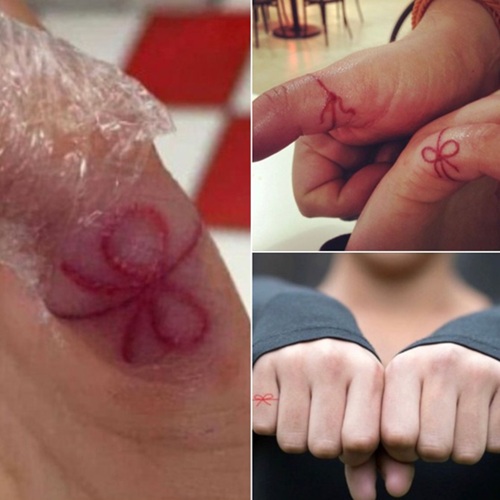
One interesting aspect of tattoo culture is the repetition of certain symbols across different individuals. People often notice the same design appearing on multiple bodies, which naturally raises curiosity about its meaning. Some tattoos are chosen for aesthetic reasons, while others represent deeper emotional or philosophical beliefs. Symbols such as infinity signs, anchors, feathers, or coordinates often reflect personal experiences or relationships. Among these recurring designs is a particularly intriguing symbol known as the “red string of fate,” which has gained attention in recent years due to its cultural background and emotional symbolism.
The “red string of fate” originates from East Asian mythology, particularly Chinese and Japanese cultural traditions. In Chinese folklore, it is associated with the belief that two people who are destined to meet are connected by an invisible red thread tied by a spiritual matchmaker. This concept is often linked to the deity Yuè Lǎo, known as the old lunar matchmaker in Chinese mythology, who is believed to bind destined lovers together regardless of time, distance, or circumstances. The idea reflects a long-standing cultural belief in fate and predetermined relationships. Over time, this symbolic concept has spread across East Asian cultures and evolved in interpretation.
In Japanese culture, a similar concept exists known as the “akai ito” or red thread of destiny. It carries the same essential meaning: two individuals are connected by an invisible red string that binds their destinies together. According to the belief, the string may stretch or tangle, but it will never break, symbolizing an unbreakable connection between destined individuals. This idea is often associated with romantic relationships but can also represent deep bonds such as friendship or family connections. The symbolism has become popular in literature, anime, and modern storytelling, contributing to its global recognition.

In contemporary tattoo culture, the red string of fate is often represented as a simple red line or bow-like design, sometimes placed on fingers such as the thumb and pinky. The design is minimalistic but carries strong symbolic meaning for those who choose it. For many, it represents the idea of destiny, soul connections, or meaningful relationships that feel “meant to be.” While interpretations vary, the core idea remains centered around connection and fate. Because of its simplicity, it is often chosen as a subtle but meaningful tattoo rather than an elaborate design. However, its meaning is deeply personal and varies from individual to individual.
It is important to note that while the red string of fate has cultural origins in East Asian mythology, its modern use as a tattoo symbol is often more personal than religious or traditional. Many people who choose this design are not necessarily referencing the original myth but instead adapting its meaning to their own beliefs about relationships and destiny. In this way, cultural symbols often evolve as they move across different societies. This transformation is common in global tattoo culture, where symbols are frequently reinterpreted in new and personal ways.
The popularity of symbolic tattoos like the red string of fate reflects a broader human tendency to seek meaning through visual representation. People often use tattoos to express emotions, memories, or beliefs that are difficult to describe in words. Whether it represents love, connection, loss, or personal growth, each tattoo carries a story unique to the individual. This is why identical designs can hold completely different meanings depending on who wears them. The same symbol can represent romance for one person and friendship or personal destiny for another.
While symbolic tattoos can be deeply meaningful, it is also important to understand their cultural origins. Many symbols come from traditions with long histories and specific cultural significance. Learning about these origins helps promote cultural respect and awareness. It also allows individuals to make more informed choices when selecting body art. In recent years, there has been growing awareness about the importance of understanding cultural symbols before adopting them into personal expression. This awareness helps preserve the meaning behind traditional designs while allowing for respectful adaptation.
Ultimately, tattoos and body markings remain one of the oldest and most universal forms of human expression. From ancient tribal markings to modern minimalist designs, they continue to evolve with society. The red string of fate is just one example of how ancient cultural beliefs can influence modern personal expression. It reflects the human desire to believe in connection, meaning, and destiny. Whether viewed as myth, symbolism, or personal philosophy, it continues to resonate with people around the world. In every form, tattoos remain a powerful reflection of identity, belief, and human storytelling.
