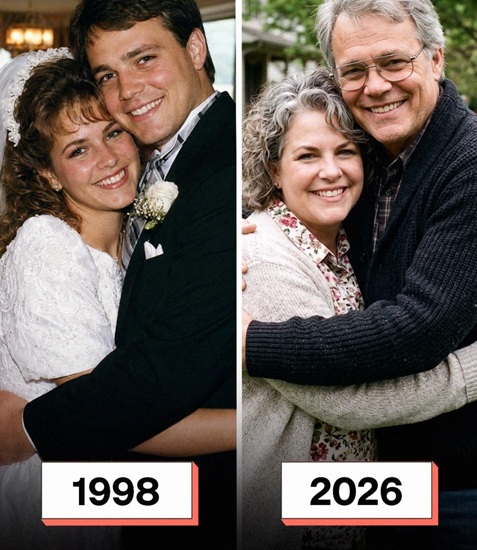
I thought losing my husband on our anniversary would be the hardest moment of my life, the kind of grief that defines everything afterward. I was wrong in ways I never could have imagined. Michael and I had been married for twenty-eight years. That evening, we were supposed to celebrate at the small Italian restaurant where he first proposed to me when we were young and struggling. He had texted me earlier that day, just like always, short and simple.
“Already left work. Be home in 20 to pick you up.” It felt like a normal, ordinary message from a man who loved routine. I remember standing by the window in my navy dress, watching the rain slide down the glass. I kept thinking about how life had a way of feeling stable right before it changed forever. The call came just before sunset. The officer’s voice was careful, distant, and formal, the kind of tone that immediately tells you something irreversible has happened.
“There’s been an accident involving your husband,” he said. “He didn’t survive.” The world didn’t go dark right away. It just felt like it stopped making sense. When I arrived at the crash site, flashing lights cut through the rain. Michael’s car had left the road and ended up near a ditch, heavily damaged and unrecognizable. An officer tried to stop me from getting closer, but I pushed past him, unable to accept what I was seeing or what I already knew in my heart.
They said it looked like brake failure combined with wet road conditions. They spoke gently, but their explanation felt too simple for someone like Michael. Because Michael didn’t ignore his car. He checked everything. He maintained it carefully. He never took mechanical risks, not even small ones. The funeral came four days later, filled with people who spoke about how reliable and kind he had been. I listened, but something inside me kept questioning everything.
Michael wasn’t careless. He was precise. He would cancel plans over the smallest mechanical concern. So how could he have missed something so critical? Three days after the funeral, our daughter Sarah came home unexpectedly. She looked pale, shaken, and different in a way I couldn’t immediately understand. She held a manila envelope tightly in her hands, as if it weighed more than paper should. Her voice trembled when she finally spoke.
“Mom… Dad left this at my apartment the night before he died,” she said. My body went cold instantly, because none of that made sense. Sarah had been staying with me after the funeral. She had only recently returned home, so she couldn’t have received anything days earlier without us knowing. She explained that she found the envelope near her door, and later checked her security camera to understand how it got there.
The footage showed Michael arriving at her apartment late at night, alone, carefully leaving the envelope before walking away without knocking or speaking. Inside the envelope was an old phone and a handwritten note in Michael’s familiar handwriting. My hands shook as I opened it slowly. The note instructed me to watch the last video saved on the phone. It also said he was trying to protect us from something he couldn’t fully stop.
When I played the video, Michael appeared tired, sitting in his office at the garage. His face looked heavier, as if he had been carrying something for a long time. He explained that he had been supporting a scholarship program for local trade students, using personal funds to keep it running when the business became unstable. He also mentioned pressure from his business partner, Arthur, who wanted to cut the program entirely to reduce financial strain on the company.
Michael said he discovered irregular financial activity and asked us to look for a ledger hidden in a floor safe at the garage. He also explained why he left the phone with Sarah. He believed it was the safest place because her apartment was empty at the time. After the video ended, the silence in the room felt heavier than before. Sarah and I both knew we couldn’t ignore what Michael had left behind.
We went to the garage the next morning. Arthur was already there, acting surprised but quickly shifting into a defensive posture when we asked questions. He insisted the accident was caused by mechanical failure and that investigators had already confirmed it. His confidence felt rehearsed, not natural. When I showed him the phone, his expression changed slightly, just for a moment, before he tried to regain control of the conversation.
Sarah began recording the interaction quietly. Arthur noticed, and his tone shifted from defensive to angry within seconds. He admitted Michael had been under financial pressure, claiming the scholarship program was draining the business and causing serious instability. But when we pressed further, contradictions began to appear in his explanations, especially regarding maintenance records and brake inspections.
Arthur tried to block us from entering Michael’s office, but I refused to leave without answers. Sarah kept recording every moment. Eventually, he admitted that he had warned Michael about brake issues, but insisted Michael chose to drive anyway for work-related reasons. That statement didn’t match anything I knew about my husband. Michael never ignored safety warnings, especially involving vehicles.
When Arthur realized we weren’t accepting his version of events, his frustration finally broke through his professional facade. He admitted the business was deeper in debt than Michael had told anyone, and that the scholarship program was being used to cover financial gaps. Inside Michael’s office, we found the floor safe exactly where he had described. Inside were financial records, invoices, and hidden transactions.
The documents revealed that Arthur had been manipulating accounts and concealing debts to keep the business afloat while shifting blame elsewhere. Michael had discovered the truth and was quietly documenting everything while continuing to protect the scholarship program. He wasn’t hiding money for himself. He was trying to preserve opportunities for students depending on that funding.
Standing there, I finally understood why Michael had been so careful in his final days. He wasn’t just managing a business. He was protecting people. Arthur eventually resigned after the investigation began, unable to justify the inconsistencies in the records and maintenance reports. The garage struggled financially afterward, but the scholarship program survived through careful restructuring and outside support.
I sold part of the business and redirected the funds into continuing the program in Michael’s name, ensuring it would not disappear. Months later, I returned to the garage alone. It was quiet, but not empty in the way grief feels empty. Michael’s toolbox was still in its place, untouched, as if waiting for him to return and continue what he had started.
I stood there for a long time, not speaking, simply remembering the man who believed helping others was more important than protecting himself. In the end, I realized something that grief had been slowly teaching me. The people we lose are not defined only by how they leave us. They are defined by what they chose to protect while they were still here, even when no one else was watching.
