In a quiet and nearly forgotten European village, an unusual discovery in an old estate archive has sparked renewed interest among historians, archivists, and cultural researchers across multiple countries in recent years. The discovery was not initially expected to be significant. It began as part of a routine cataloging effort inside a decaying mansion that had remained untouched for decades, holding centuries of personal records and forgotten family artifacts.
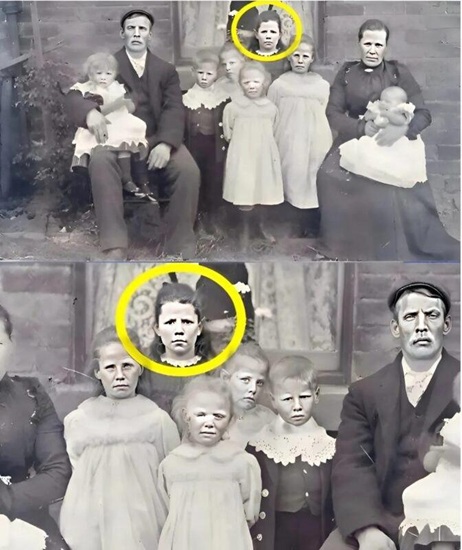
Among stacks of letters, faded documents, and damaged portraits, researchers reportedly found a small, unusually preserved photograph. Its appearance immediately raised questions about its origin and historical accuracy. The image was said to depict a family standing in front of a red brick house, dressed in clothing consistent with early nineteenth-century European fashion, arranged formally as was customary in staged family portraits of that era.
The father appeared in traditional period attire, standing upright with a stern expression. The mother held a young child carefully in her arms, while other children were positioned neatly beside them in a structured composition. However, what drew the most attention was an unexpected and unsettling detail in the background of the image. Behind the children, there appeared to be the faint outline of another figure, partially obscured and visually ambiguous.
This figure, described by some observers as a pale-faced woman with a fixed, emotionless expression, did not seem to belong naturally within the composition. Her presence raised immediate questions among those who examined the image. According to speculative interpretations circulated later, some local narratives associated the image with a family tragedy involving a missing daughter named Maria, who was reportedly absent from later historical records.

These accounts suggest that Maria, believed to be the eldest child in the household, disappeared under unclear circumstances approximately one year before the supposed date associated with the image. Official historical documentation from that period is incomplete, and surviving records do not provide definitive confirmation of her fate, leaving only fragmented references and inconsistent accounts.
Over time, folklore within the region developed surrounding the estate, including legends describing unexplained occurrences tied to the property and stories of what locals referred to as “foundation spirits.” Such legends often describe symbolic or supernatural interpretations of unresolved tragedies, where emotional memory is believed to linger metaphorically within physical spaces like homes or walls.
One version of the story suggests that the figure behind the children represents Maria, appearing in the image as a symbolic reflection of unresolved loss within the family history. However, historians emphasize that early nineteenth-century photography, as understood today, did not exist in practical or documented form in 1820, making the photograph’s claimed date highly questionable.
The earliest verified photographic processes were developed in the late 1820s and 1830s, meaning any image dated earlier would require extraordinary evidence and validation to be considered authentic. Because of this chronological inconsistency, many researchers approach the discovery as either a misdated artifact, a later reproduction, or a modern fabrication inspired by historical aesthetics.
Despite skepticism, the image gained attention in popular media, where it was often presented with dramatic interpretations that blended folklore, mystery, and speculative storytelling. In response to growing curiosity, additional archival investigations were reportedly conducted in connection with the estate and surrounding property, focusing on verifying historical burial and residency records.
Some accounts claim that excavation work in the area surrounding the old house revealed human remains consistent with a young individual, though these claims remain unverified in formal academic literature. If such findings were confirmed, they would still require careful archaeological and forensic analysis to establish identity, timeframe, and any connection to the historical family in question.
Historians caution that linking physical remains to undocumented narratives without rigorous evidence can lead to misinterpretation and the reinforcement of local myths as factual history. Further examination of the photograph itself has produced no conclusive evidence of manipulation techniques that would align with modern digital editing, though this does not confirm authenticity of its dating.
Experts note that photographic artifacts, chemical degradation, and reproduction errors in old prints can sometimes create visual anomalies that are easily misinterpreted as additional figures or shapes. The story gained additional attention when later circulated digital versions of the image appeared online, where viewers claimed that subtle differences could be seen in the background figure’s expression.
Some interpreted these differences as changes in facial expression, while others attributed them to scanning quality, compression artifacts, or inconsistent image restoration processes. From a scientific perspective, digital alterations in scanned archival material can occur unintentionally due to contrast adjustments, resolution loss, or reconstruction algorithms used in restoration.
As interest continued to grow, researchers emphasized the importance of separating verified historical data from speculative narratives that often emerge around mysterious artifacts. While the emotional weight of stories involving missing individuals can strongly influence interpretation, academic methodology requires consistent documentation and reproducible evidence.
The estate itself remains a subject of historical interest, primarily due to its architectural age and preserved materials rather than the contested interpretations of the discovered image. Today, the photograph is often referenced in discussions about how folklore, incomplete records, and modern media can combine to create powerful but uncertain historical narratives.
Ultimately, the case serves as an example of how gaps in documentation can invite imaginative interpretation, especially when emotional storytelling intersects with ambiguous visual material. While the mystery continues to circulate in popular retellings, historians maintain that without verifiable evidence, the image should be treated as an intriguing but unconfirmed artifact.
What remains certain is that the story reflects a broader human tendency to search for meaning in unexplained objects, blending history, memory, and imagination into compelling narratives.
