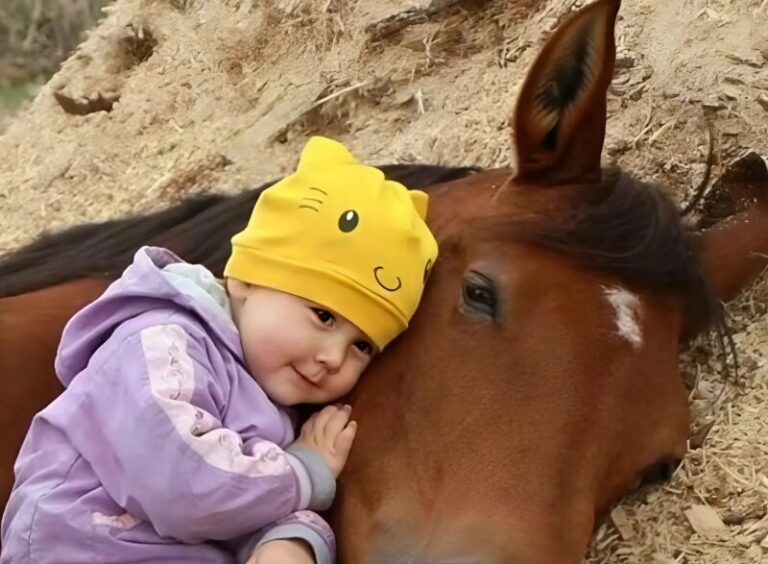
In a quiet rural neighborhood, a small child of just two years old formed an unusual but gentle connection with a horse living in a nearby stable. While most children her age were still learning basic coordination and language, she found comfort in simply being near the large animal. The horse, calm and patient by nature, seemed to tolerate her presence without distress, allowing her to observe, touch, and sit nearby in a peaceful way. To the child, the horse was not intimidating or frightening.
Instead, it represented something steady and comforting in her early world. She would spend time near the stable fence, often watching the animal move slowly within its space. Her curiosity was natural and innocent, and her behavior showed a sense of trust that is not always common at such a young age. Her parents were cautious at first, as any responsible caregivers would be. They supervised her closely during every visit and made sure she remained at a safe distance.
Over time, however, they noticed that the horse consistently displayed calm behavior around her, which gradually eased their initial concerns. The interaction remained peaceful and controlled, becoming a small part of their daily routine.
A Routine That Seemed Harmless and Gentle
As weeks turned into months, the visits between the child and the horse became a familiar part of life. The child would often approach the stable with excitement, reaching out to touch the horse’s mane or stand quietly nearby while it rested. On some occasions, she would sit on the soft hay under supervision, appearing completely relaxed in its presence.
The horse, known in the neighborhood for its gentle temperament, showed no signs of aggression or discomfort. Instead, it behaved with an unusual level of patience. It moved slowly, avoided sudden gestures, and often positioned itself in a way that kept the child within its view. To observers, the interaction appeared calm and stable, reinforcing the belief that the relationship was harmless.
This growing routine gave the family a sense of reassurance. What had started as a cautious interaction slowly turned into something they saw as safe and even positive for the child’s emotional development. There were no visible incidents, no signs of danger, and nothing that suggested concern during these early stages.
Subtle Behavioral Changes in the Animal
After several months, however, a subtle change began to appear in the horse’s behavior. It was not sudden or alarming, but rather a gradual shift that someone familiar with the animal could notice. The horse became more attentive whenever the child was nearby, often focusing its attention on her in a way that seemed more concentrated than before.
The animal would sometimes stand closer than usual or follow her movement along the fence line with increased awareness. At times, it appeared to sniff the air near her more frequently or pause longer when she was present. These changes were not aggressive or fearful, but they were noticeably different from its earlier relaxed behavior.
The neighbor who cared for the horse began to observe these patterns more closely. While animals can change behavior for many reasons, he felt that the consistency of this shift was worth paying attention to. It was not something he could easily explain, but it stood out enough for him to feel concerned in a quiet, cautious way.
A Conversation That Raised Awareness
Eventually, the neighbor decided to share his observations with the child’s parents. He approached them respectfully but seriously, explaining that he had noticed changes in the horse’s behavior whenever the child was around. His tone was careful, as he did not want to cause unnecessary fear, but he believed it was important to speak up.
The parents were initially surprised by the conversation. They had never seen any signs of danger or distress during their daughter’s interactions with the horse. However, they listened carefully as the neighbor described what he had observed over time. He emphasized that while he could not explain the reason, the behavior seemed unusual enough that it should not be ignored.
He suggested, in a cautious and non-alarming way, that the family consider having their daughter evaluated by a medical professional, simply as a precaution. The suggestion was not based on certainty, but on concern and attentiveness to subtle changes that others might overlook.
A Decision Made With Care and Responsibility
Although the child appeared healthy and active in daily life, the parents chose to take the recommendation seriously. They arranged a medical check-up to ensure that nothing was being missed. Their decision was driven not by fear, but by a sense of responsibility and willingness to be cautious when unusual observations were mentioned.
The medical evaluation included standard examinations and tests appropriate for the child’s age. The family waited with uncertainty, hoping that everything would be normal. The process itself was emotionally tense, as even routine medical visits can feel significant when prompted by unexpected concern.
Eventually, the doctors identified a health condition that required attention. Importantly, it was detected at an early stage, which significantly improved the potential for effective treatment. Early detection often plays a critical role in medical outcomes, especially in young children, where timely intervention can make a substantial difference.
Early Treatment and Positive Progress
Because the condition was identified early, medical professionals were able to begin treatment promptly. The family followed medical guidance carefully, attending appointments and supporting the child through the recommended care plan. Over time, the child’s condition improved under supervision and treatment.
The experience was emotionally challenging for the family, but the early discovery allowed them to respond before the condition progressed further. This timing was considered extremely important by medical staff involved in early-stage treatment cases. It gave the child a significantly better path toward recovery.
As the months passed, the child continued to improve. Her energy returned, her daily activities became normal again, and she was able to enjoy her childhood experiences without the same level of concern that had emerged earlier. The family gradually returned to a more stable routine.
A Return to Normal Life and Gentle Reflection
With time, the child resumed her visits near the horse, though always under careful supervision. The bond they had formed in early childhood did not disappear. Instead, it continued in a calmer and more mindful way. The horse remained part of her environment, still gentle and present, as it had always been.
The family often reflected on how a series of small observations and decisions had influenced their journey. They recognized that it was not a single dramatic event, but a combination of subtle details that led them to act at the right time. The neighbor’s concern, the horse’s behavioral changes, and the parents’ willingness to listen all played a role in the outcome.
A Lasting Message About Awareness
The experience left a lasting impression on everyone involved. It became a reminder of the importance of paying attention to subtle changes in behavior, whether in animals or in daily life. While interpretations can vary, the key lesson for the family was the value of awareness and timely action.
They also developed a deeper appreciation for the neighbor who chose to speak up, even without certainty. His decision to share what he observed contributed to an outcome that ultimately supported the child’s health. The horse, too, remained a quiet presence in the story, remembered as part of a meaningful chapter in the child’s early years.
In the end, the story is not about extraordinary claims, but about observation, care, and responsibility. It reflects how small details, when noticed and acted upon thoughtfully, can sometimes contribute to meaningful outcomes in unexpected ways.
