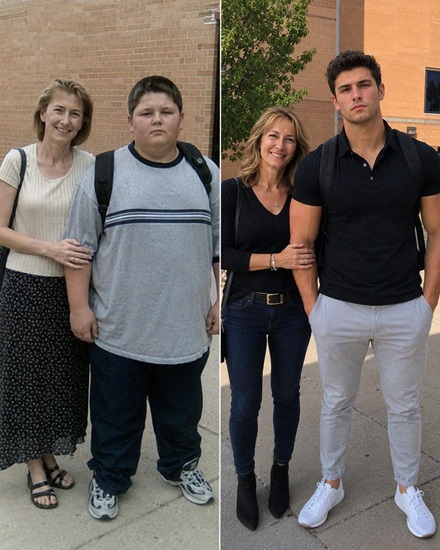
For years, my son was the quiet student everyone seemed to overlook at school. He wasn’t invited to gatherings, rarely included in conversations, and often spent lunches alone without complaint or resentment. Even during important school milestones, he blended into the background. While others formed friendships easily, he remained on the outside, observing more than participating, slowly becoming accustomed to being unnoticed by most classmates.
Then, nearly a decade after graduation, something unexpected happened. His entire graduating class organized a ten-year reunion, yet somehow, once again, my son was not included on the invitation list. At first, he simply laughed it off when he discovered it. But beneath that calm reaction was a familiar story repeating itself—years of being excluded, even when time had supposedly moved on from the past. That evening, he didn’t show frustration or anger. Instead, he calmly told me he was going to the reunion anyway, even without an invitation, because something inside him had clearly shifted over time.
A few days before the event, I noticed him quietly preparing, sending messages, making calls, and organizing something he refused to fully explain, simply saying I would understand everything later. When the night of the reunion arrived, he dressed carefully in a simple suit, calm and confident, carrying himself differently than I had ever seen during his younger years. As he left the house, he smiled and told me not to worry. That moment felt different, like he wasn’t seeking approval anymore, but instead walking into something he had already decided within himself.
While I waited at home, I couldn’t help but think about everything he had endured growing up—the loneliness, the exclusion, and the quiet strength it took to never become bitter despite it all. Years earlier, he had been the kind of child who always tried to be kind. He helped others, shared what he had, and never treated people differently, even when he himself was left out. But kindness alone didn’t change how others treated him. Over time, school became a place where he learned invisibility rather than belonging, as group work and social circles formed without him.
Still, he never stopped trying. Each school year brought new hope, new attempts to connect, and new moments of disappointment when things inevitably returned to the same pattern of exclusion. By the time graduation arrived, both of us had accepted a quiet truth. He had survived the experience, but the feeling of not truly belonging had shaped much of his early life. After high school, he moved away for college and slowly began building a different version of himself, one that wasn’t defined by the people who had ignored him in the past.
Over time, his confidence grew. He worked part-time jobs, studied business, and eventually began forming friendships with people who valued him for who he actually was. After college, he co-founded a small consulting company with a couple of friends. It started in a modest office, but gradually expanded as their work gained recognition and clients increased. Years passed, and the company continued to grow steadily. What mattered most to him was not the success itself, but finally being surrounded by people who respected and appreciated his presence.
Then, almost ten years after graduation, everything changed again when he discovered online discussions about the upcoming class reunion he had somehow not been invited to. He showed me the posts quietly, almost amused at first, pointing out that everyone seemed to know about it except him, as if history had repeated itself in an unexpected way. For a moment, I felt the same old anger rise inside me—the frustration of knowing he had once again been overlooked after everything he had already endured.
But he remained calm. Instead of reacting emotionally, he simply said he was going to attend the reunion anyway, even if no invitation had been sent to him at all. That decision surprised me, but something in his voice suggested this was not about proving anything to anyone else, but about closure for himself. On the evening of the reunion, I waited anxiously at home while he drove to the event, unsure of what he intended to say or do when he arrived there uninvited.
A couple of hours later, my phone rang. I could hear background noise, laughter, and music, but his voice sounded calm and strangely peaceful when he began speaking. He told me people had noticed him entering the room, but no one stopped him. Instead, he signed in casually and simply walked inside like any other guest. At first, he observed quietly, watching familiar groups reconnect, reliving memories from their teenage years while he remained mostly unnoticed in the background.
Eventually, someone recognized him. The interaction was awkward at first, as if the past still lingered between them in ways neither side fully knew how to address. But slowly, more people approached. Conversations began. People who had once ignored him now spoke as though time had softened the distance between them. Then the organizers called attention to the stage, announcing recognitions for former students who had achieved notable success in their careers since graduation.
As names were called, applause filled the room repeatedly. My son sat quietly, unaware that his own name was about to be included in the announcements. When his name was finally mentioned, the room reacted with visible surprise. Many people turned toward him, realizing he was not just present, but relevant in a way they had not expected. He was then invited to speak. As he walked to the stage, the room grew quiet, and every eye in the ballroom focused on him with sudden curiosity.
He began by acknowledging that he had not been invited and that, years ago, he would never have imagined standing in that room addressing all of them. Then he calmly shared that his company had recently acquired a major technology firm, a detail that immediately changed the atmosphere inside the room. Silence followed. People began to realize the scale of what he had built, and how far his life had moved beyond the version of him they once knew.
He continued speaking, not with anger, but with reflection about his school years and the feeling of being overlooked by almost everyone around him. He explained that while some people had been kind, many others had simply treated him as if he did not exist during those formative years. However, he made it clear that he did not come to the reunion seeking apology or validation from anyone in that room.
Instead, he spoke about a guidance counselor who had once taken time to notice him when few others did, offering encouragement during difficult years. He shared how that one person’s support had helped him see his own value differently, changing the direction of his confidence and future decisions.
That moment shifted the tone of the entire room. What began as curiosity turned into silence filled with reflection and emotional recognition. He then announced the creation of a foundation through his company, focused on supporting students who feel overlooked or disconnected during their school years. The goal, he explained, was to ensure that future students would not have to question their worth simply because others failed to notice them.
When he finished speaking, the room erupted into applause. Even those who had once ignored him were now standing, acknowledging what he had achieved. Later that night, he called me again, explaining everything that had happened, including the reactions, the speech, and the overwhelming response from attendees. But what stayed with me most was not the success or recognition. It was the calmness in his voice, as if he had finally closed a long chapter of his life.
He told me he didn’t attend to impress anyone, but simply to show up as himself, without needing approval from people who had never truly seen him. And in that moment, I realized the reunion was never about the past. It was about freedom from it, and the quiet strength of moving forward without resentment. Because sometimes, the people who are overlooked the most in their early years are the ones who later redefine their own story entirely. And by the time others finally notice them, they no longer need to be seen in the same way they once were.
