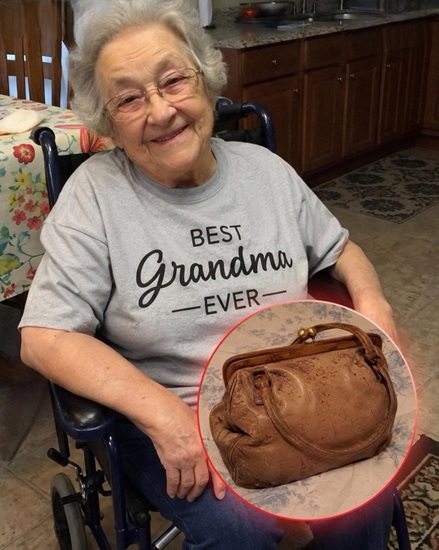
There were eleven grandchildren in our family, and somehow Grandma Nancy had a remarkable way of making every one of us feel as though we were the person she had been waiting all week to see. Whenever we arrived at her modest house, she greeted us with the same warm smile, asked about school, work, marriages, children, and whatever small problem happened to feel enormous at the time. She remembered birthdays without checking a calendar and kept handwritten notes about the things each grandchild liked.
Yet among all the familiar objects in her home, there was one possession that remained surrounded by mystery: an old brown handbag stored on the highest shelf of her bedroom closet. The handbag itself did not look valuable. Its leather had faded with age, the brass clasp had lost most of its shine, and one corner was visibly worn from years of use. Grandma owned nicer purses, including several that her children had given her for birthdays and Christmas, but she treated none of them with the seriousness she reserved for that old bag.
Nobody was permitted to open it, move it, or even ask too many questions about what might be inside. Whenever curiosity became too persistent, Grandma’s normally gentle expression changed, and the conversation quickly ended. Her instruction was always the same. If anything happened to her, the entire handbag and everything inside it were supposed to be placed with her before she was buried.
She did not want anyone sorting through its contents or deciding that something should be kept. She wanted the bag to remain exactly as it was. At first, the family treated the request as one of Grandma’s harmless peculiarities. Everyone has possessions that carry private memories, we reasoned, and perhaps the handbag simply contained old photographs, letters, or personal objects she did not want anyone else to see.
One afternoon, however, my uncle made the mistake of treating the mystery as a joke. Several relatives were gathered in Grandma’s bedroom while helping her reorganize some boxes. He spotted the handbag on the shelf and reached toward it with an exaggerated grin. Before his fingers could touch the handle, Grandma slapped his hand away. The sudden reaction shocked everyone. Grandma almost never raised her voice, yet she stared directly at him and said, with unmistakable seriousness, “I told you not to touch that bag.”
Nobody laughed after that. My uncle apologized immediately, and Grandma returned to her usual calm manner a few minutes later. Still, the incident changed the way we thought about the handbag. Whatever it contained clearly mattered to her far more than we had understood. Over the following years, speculation occasionally surfaced during family conversations, but no one dared investigate. Some relatives guessed that it contained love letters. Others imagined jewelry, money, or documents connected to a part of Grandma’s life she had never discussed.
As Grandma became older and physically weaker, her instruction became more frequent. Sometimes she would mention it while I was helping her prepare dinner. On other occasions, she brought it up while we were simply sitting together in the living room. “Remember the handbag,” she would tell me. I always promised that I would. Once, unable to contain my curiosity, I asked why it was so important. Grandma looked at me for several seconds before answering. “When the time comes,” she said quietly, “you’ll understand why I kept it.”
Grandma died peacefully in her sleep at seventy-eight. Even though everyone knew she had been growing frailer, her death left the family feeling strangely unprepared. The following days passed in a blur of telephone calls, flowers, photographs, relatives arriving from different places, and conversations about memories that had not been discussed in years. By the morning of the funeral, nearly the entire family had gathered. Children, grandchildren, cousins, longtime friends, and neighbors filled the room to remember the woman who had connected so many people.
The service was about to begin when I suddenly remembered something that made my stomach tighten. The handbag was still sitting in Grandma’s closet. In the confusion of the previous days, nobody had remembered her repeated request. I told my mother, who looked toward the clock and reminded me that everything was already running behind schedule. But I could hear Grandma’s voice in my memory. She had asked us for years to do one specific thing. Whatever anyone else thought about the request, I could not knowingly ignore it.
I hurried back to Grandma’s house. Without the familiar sounds of her television, footsteps, and voice, the rooms seemed completely different. I walked into her bedroom, dragged a chair toward the closet, and climbed carefully onto it. The brown handbag was exactly where it had always been. A thin layer of dust covered part of its surface. When I lifted it from the shelf, however, something surprised me immediately. It was considerably heavier than an empty handbag should have been.
I stood there holding it and remembering my promise. Grandma had told us not to open the bag while she was alive. She had also said that when the time came, we would understand. Those words now seemed less like a prohibition and more like an invitation she had deliberately postponed. After several moments of hesitation, I sat on the edge of her bed and placed the handbag beside me. My hands trembled slightly as I released the old brass clasp.
Inside were several carefully organized bundles. There was no shocking fortune, no secret collection of expensive jewelry, and nothing dangerous or sinister. Instead, the first thing I saw was a thick stack of envelopes held together with faded ribbon. Beneath them were small photographs, children’s drawings, birthday cards, handwritten notes, school pictures, and tiny objects that initially seemed almost worthless. A plastic bracelet rested beside an old movie ticket. There was a broken keychain, a dried flower pressed between pieces of paper, and a small wooden ornament with one corner missing.
Then I began reading the names.
Every grandchild was represented inside the handbag.
There were eleven separate bundles, each containing memories connected to one of us. Grandma had kept the first card I had ever made for her as a child. My handwriting was barely recognizable, and several words were spelled incorrectly. She had saved a photograph from my first school performance, a note I had written after moving away, and a tiny ribbon from a birthday gift I had given her years earlier. Things I had completely forgotten had apparently been precious enough for Grandma to preserve for decades.
I opened another bundle and recognized my cousin’s childhood drawings. Another contained a photograph of my brother proudly holding a fish he had caught with Grandpa. There were hospital visitor stickers from the days grandchildren were born, graduation announcements, wedding invitations, postcards, and notes thanking Grandma for small acts of kindness. Nothing had much financial value. Together, however, the objects formed a private archive of the family she had spent her life loving.
At the bottom of the handbag was one final envelope. My name was written on the front because Grandma had apparently expected that I might be the person who eventually opened it. Inside was a short handwritten message. Rather than revealing some dramatic secret, Grandma explained why she had protected the bag so fiercely. These were the possessions she considered most valuable, not because they could be sold, but because each one reminded her of a moment when someone she loved had allowed her to be part of their life.
Her request to bury the handbag with her suddenly made sense. Grandma had never been guarding a secret from us. She had been protecting something deeply personal for herself. The handbag represented birthdays, ordinary afternoons, childhood mistakes, graduations, weddings, reconciliations, and countless small moments that might have looked insignificant to everyone else. She wanted those memories beside her at the end because, in her mind, they represented the richest part of her life.
I began crying before I finished reading.
My emotional reaction was not caused by fear or by discovering something terrible. It came from realizing how much importance Grandma had placed on moments that the rest of us barely remembered. For years, we had imagined that the handbag contained something mysterious because we assumed secrecy must indicate scandal, money, or some hidden chapter of her past. The truth was far simpler and, to me, far more meaningful. Grandma had quietly collected evidence of a lifetime spent caring about her family.
I carefully returned every photograph, letter, drawing, and keepsake to its original bundle. Nothing belonged to me simply because my name appeared on it. Grandma’s instruction had been clear, and opening the bag had not changed that. I closed the brass clasp, held the handbag against my chest, and hurried back to the funeral. By the time I arrived, several relatives were wondering what had delayed me.
I did not explain everything immediately. There was neither enough time nor enough emotional composure. I simply told my mother that I had found what Grandma wanted us to find and that we needed to honor her request. Later, I described the contents to the family. Some people cried. Others smiled when they heard about the forgotten objects Grandma had preserved. My uncle, remembering the day he had tried to grab the handbag as a joke, became especially quiet.
We ultimately respected Grandma’s fictional final wish within the story. The old handbag remained with the collection she had spent years protecting. Nobody removed the photographs they wanted or divided the keepsakes among family members. That decision was difficult because suddenly every insignificant object seemed precious. Yet keeping our promise felt more important than possessing the objects themselves.
The experience also changed the way I thought about family memories. We often assume that major milestones are the events people will remember most, but affection is frequently preserved through much smaller moments. A crooked birthday card can matter more than an expensive present. A child’s badly drawn picture can survive in someone’s memory long after the child has forgotten making it. An ordinary photograph can become priceless because of the people and circumstances surrounding it.
Grandma’s handbag also taught us why privacy should not automatically be interpreted as evidence that someone is hiding wrongdoing. People can protect private possessions for emotional reasons that outsiders do not understand. Our curiosity had encouraged us to invent increasingly dramatic explanations, yet none of those guesses reflected what was actually inside. The truth could only be understood once the context became clear.
In the weeks after the funeral, family conversations frequently returned to the handbag. Each relative began remembering other small things Grandma had saved or comments she had made over the years. Gradually, we realized that her habit of preserving memories had never really been hidden. The clues had always surrounded us. We simply had not connected them because the mysterious handbag had encouraged us to expect something extraordinary.
Perhaps the most important realization was that Grandma had never needed expensive possessions to measure the value of her life. The things she protected were evidence of relationships. Eleven grandchildren had grown up believing each was somehow her favorite because she had paid attention to each of us individually. The handbag showed that this feeling had not been accidental. She had genuinely treasured something about every person.
That is why the discovery remained with me long after the funeral was over. The initial mystery was memorable, but the deeper lesson came from understanding what Grandma had chosen to value. Her collection did not reveal a scandal, hidden wealth, or a sensational family secret. It revealed years of ordinary affection preserved one small object at a time.
The fictional story ultimately becomes less about what was hidden inside an old handbag and more about why people attach meaning to seemingly insignificant possessions. Curiosity can make us expect dramatic answers, while reality is often quieter. Sometimes an object matters because it carries memories that cannot be replaced once the people connected to them are gone.
For Emily and her family, the handbag becomes a final reminder to pay attention while people are still present. Photographs and letters can preserve pieces of the past, but they cannot replace conversations, shared meals, visits, forgiveness, laughter, or time spent together. Those experiences become valuable precisely because they cannot be repeated indefinitely.
And that was the real surprise waiting inside Grandma Nancy’s old brown handbag. It was not a frightening secret she had spent decades trying to hide. It was a collection of ordinary evidence showing how deeply she had valued her family. What initially appeared to be the greatest mystery in her house ultimately became one final expression of love—and one final lesson about the memories people choose to carry with them.
