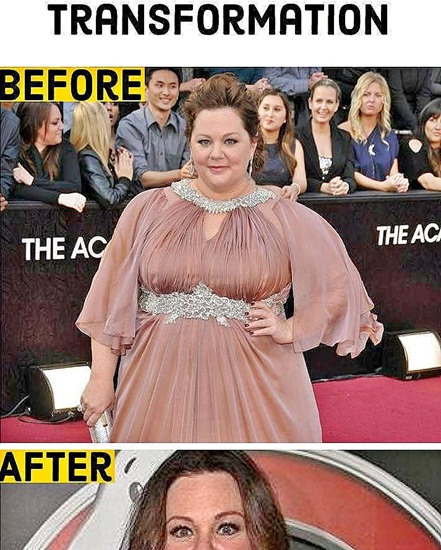
Melissa McCarthy has spent decades building a career that reaches far beyond conversations about her appearance. Born on August 26, 1970, the actress, comedian, writer and producer became widely known through television and later established herself as a major film performer. As of August 2026, McCarthy is 55, not 52 as stated in some older or recycled articles. Her career has included broad comedy, dramatic performances and producing work, demonstrating that her professional success was established independently of any later changes in her body or weight.
Public interest in McCarthy’s appearance has followed her for much of her career, sometimes overshadowing conversations about her acting. She has spoken openly about experiencing criticism over her size, including being told early in her career that losing weight would improve her prospects in Hollywood. According to McCarthy, such comments were painful, but they also strengthened her determination to prove that her talent could not be measured by her body size. Her subsequent career provided considerable evidence of that point.
McCarthy became particularly recognizable through roles that allowed her distinctive comedic timing and energetic screen presence to stand out. Rather than waiting until she fit a conventional Hollywood image, she continued auditioning and working. Her career expanded substantially, and eventually she became one of the entertainment industry’s most recognizable comedic performers. Discussions about her physical transformation should therefore be placed within the larger context of a career that was already highly successful before any significant weight change became a recurring subject in entertainment coverage.

One of the clearest demonstrations of her professional standing came with Bridesmaids. McCarthy played Megan in the 2011 comedy, and the performance earned her an Academy Award nomination for Best Supporting Actress. The official Academy Awards records confirm that she was nominated at the 84th Academy Awards in 2012. The nomination was particularly significant because it demonstrated that her comedic work was receiving recognition from one of the film industry’s major institutions.
Several years later, McCarthy demonstrated a different side of her acting ability in Can You Ever Forgive Me? Her performance as writer Lee Israel earned her a second Academy Award nomination, this time for Best Actress. At the 91st Academy Awards in 2019, she was nominated alongside Yalitza Aparicio, Glenn Close, Lady Gaga and eventual winner Olivia Colman. The two Oscar nominations are important factual details because McCarthy has not merely been “close to an Oscar multiple times”; she has officially received two acting nominations from the Academy.

Her achievements also challenge the suggestion that losing weight was necessary for her to be taken seriously professionally. McCarthy’s first Oscar nomination came while her larger body was already a highly visible part of her public image. She was obtaining major roles and receiving industry recognition long before entertainment outlets began publishing extensive stories about her changing appearance. Her talent, rather than reaching a particular number on a scale, established her Hollywood career.
McCarthy has nevertheless discussed weight changes throughout her life. Her comments reveal a more complicated history than the simple transformation narrative frequently presented online. Her weight has fluctuated at different periods, and she has acknowledged trying different approaches. In a 2016 interview referenced by PEOPLE, she said that she expected she might continue going “up” and “down” throughout her life. That perspective is notably different from portraying her journey as a single dramatic transformation with one definitive beginning and ending.

One particularly important part of that history occurred years before her more gradual changes attracted widespread attention. McCarthy has discussed trying a medically supervised all-liquid diet in 2003. According to her later recollections, she lost weight rapidly during that period but disliked the experience and how it made her feel. She described herself as feeling extremely hungry and mentally uncomfortable while following the restrictive program. That experience is one reason it would be misleading to present extreme dieting as the successful secret behind her later appearance.
Her later approach was notably different. By 2018, McCarthy had spoken publicly about losing a significant amount of weight over a period of years rather than through a dramatic crash program. Reports about her comments emphasized a more relaxed attitude and gradual changes. Instead of describing one miraculous diet, supplement or procedure, McCarthy increasingly discussed reducing the amount of stress and obsession she attached to weight.

That distinction matters because celebrity weight-loss stories frequently become simplified online. A dramatic before-and-after photograph can create the impression that there must have been one diet, medication or secret responsible for the difference. McCarthy’s own public comments do not support such a simple explanation. Her history includes fluctuations, different approaches and a gradual evolution in how she thinks about health and appearance.
Similarly, precise claims that McCarthy went specifically from approximately 110 kilograms to exactly 70 kilograms should be treated cautiously unless they can be tied to direct, reliable statements from McCarthy or verified medical information she voluntarily disclosed. Celebrity weight estimates frequently circulate through entertainment websites without clear sourcing. A photograph cannot reliably establish someone’s weight, and repeating an unverified number as a confirmed medical fact can create misinformation.
The same caution applies to claims about her height or current weight. Public biographies may provide estimated measurements, but such information is not equivalent to a recent medical measurement. McCarthy herself has placed considerably more emphasis on how she feels and how she approaches life than on encouraging people to focus on an exact number.

In recent years, public discussion about celebrity weight loss has also become closely connected with medications such as Ozempic and other GLP-1 drugs. McCarthy became part of that conversation in 2024 after Barbra Streisand commented on one of her social-media photographs and publicly asked whether she had used Ozempic. Streisand later explained that she had intended her comment as a compliment rather than criticism.
McCarthy responded humorously rather than confirming that she had used the medication. She focused on the fact that Barbra Streisand, whom she admires, had noticed her and thought she looked good. Therefore, it would be inaccurate to take Streisand’s question as evidence that McCarthy used Ozempic. A question posted on social media is not confirmation of someone’s medical treatment.
That episode illustrates a broader problem surrounding public discussions of people’s bodies. When someone’s appearance changes, observers often attempt to identify a medical explanation without evidence. Weight can change for numerous reasons, and medication use is personal health information unless the individual chooses to disclose it. Responsible coverage should distinguish clearly between a person’s own statements and speculation generated by social media.
McCarthy’s comments over the years also suggest that her relationship with body image changed as she became older. Rather than allowing the scale to occupy the same emotional importance it once did, she increasingly emphasized family, happiness and feeling comfortable with herself. PEOPLE’s review of her public statements notes that her priorities shifted as she grew older and raised her family with husband Ben Falcone.
Motherhood appears to have influenced that perspective as well. McCarthy has spoken about wanting her daughters to develop healthy attitudes toward their bodies. That is particularly significant for someone who has spent much of her professional life in an industry where women’s appearances are routinely scrutinized and compared.
Her experiences have also informed her criticism of limited fashion choices available to plus-size women. McCarthy has publicly discussed how difficult it could be to find clothing in larger sizes despite the large number of women who needed those sizes. Her interest in fashion therefore became connected to a broader conversation about inclusion rather than simply her own changing body.
For years, McCarthy demonstrated that confidence and style were not privileges reserved for people within a narrow weight range. That message remains relevant even when discussing her later physical changes. Praising someone only after they become thinner can unintentionally suggest that their earlier body was a problem requiring correction, which does not accurately reflect the way McCarthy has described her own career or worth.
Her story is therefore better understood as one involving both professional persistence and an evolving personal relationship with health. She experienced periods of weight gain and weight loss, tried approaches she later disliked, and eventually spoke about taking a less obsessive attitude toward the subject. None of those stages erased what came before.
Professionally, McCarthy continued demonstrating considerable range. The transition from the uninhibited comedy of Bridesmaids to the restrained dramatic performance of Can You Ever Forgive Me? showed audiences and critics that she could operate successfully in very different genres. Her second Academy Award nomination reinforced that versatility.
It is also worth correcting another common framing in articles about her: McCarthy has not won an Academy Award as of August 2026. She has received two acting nominations. Describing her as someone who has “nearly won several Oscars” is less precise than simply stating the documented achievement—two Academy Award nominations for two very different performances.
Those nominations remain significant regardless of whether she eventually wins. Awards are only one measure of a performer’s career, and McCarthy has sustained a prominent place in entertainment across television and film. Her longevity is particularly notable given the criticism about her appearance that she encountered earlier in her career.
McCarthy’s experience also demonstrates why dramatic celebrity transformation stories deserve careful treatment. Images taken years apart can make physical changes appear sudden even when they occurred gradually. Headlines may then attach precise weight figures, diets or medical explanations that the celebrity never confirmed.
A more accurate account recognizes uncertainty.
McCarthy has lost weight at different points.
She has discussed that publicly.
She has also experienced fluctuations.
She previously tried a restrictive liquid diet and later spoke negatively about that experience.
And her later public comments emphasized a more sustainable and less stressful relationship with weight rather than promoting an extreme method.
What should not be claimed without reliable evidence is an exact current weight, an exact total amount lost, or the use of a particular medication merely because her appearance changed.
That distinction is particularly important when articles are intended for broad audiences. Celebrity health stories can influence readers who may try to reproduce whatever method they believe produced a transformation. What works appropriately for one individual may be unsuitable for another, and significant weight changes should not automatically be treated as instructions for readers.
McCarthy herself has offered a more useful message through the broader arc of her career. Her professional value did not suddenly increase because her body changed. She was talented before losing weight, remained talented while her weight fluctuated, and continued working afterward.
Her first Academy Award nomination provides an obvious example. In 2012, Academy voters recognized her supporting performance in Bridesmaids. Seven years later, they nominated her in the leading-actress category for Can You Ever Forgive Me? These nominations came from performances with markedly different tones and demonstrated abilities that have nothing to do with a number on a scale.
That context makes the phrase “remarkable transformation” more meaningful when it is not restricted to physical appearance. McCarthy’s career itself has involved transformation—from television performer to movie star, from broad comedy to acclaimed dramatic acting, and from someone who faced industry criticism over her body to a performer whose work earned two Oscar nominations.
Her approach to body image evolved as well.
Earlier in life, she experimented with severe restriction.
Later, she described fluctuations more openly.
Over time, she increasingly emphasized balance and reducing the mental pressure associated with weight.
That evolution is considerably more nuanced than a before-and-after photograph.
McCarthy has also remained willing to joke about the enormous attention directed toward her appearance. Her lighthearted response to Streisand’s accidental Ozempic question in 2024 demonstrated that she was not interested in turning the incident into a public feud. Instead, she focused on being delighted that an entertainer she admired thought she looked good.
That response was consistent with the humor audiences have associated with McCarthy for years, but it also avoided validating speculation about private medical choices. She did not owe the public an explanation simply because people noticed that her body looked different.
For readers interested in McCarthy’s journey, the most responsible takeaway is therefore not a particular target weight or supposed secret method. Her documented story is about a person whose body changed repeatedly while her professional determination remained remarkably consistent.
She continued acting when people told her appearance could limit her.
She earned major roles.
She received two Academy Award nominations.
She experimented with weight-loss approaches, rejected methods that made her miserable, and later adopted a less obsessive perspective toward weight and body image.
Her experience also serves as a reminder that photographs capture only one moment. They cannot tell viewers how healthy someone is, what they weigh, what medications they use, or how they feel about themselves. Those conclusions require information from the person involved, not assumptions based on appearance.
As of 2026, Melissa McCarthy’s public story is much larger than any physical transformation. She is an established actress whose career survived and flourished despite years of scrutiny about her body. Her achievements were not created by becoming thinner, and her earlier body should not be presented as a failure that needed to be corrected.
Instead, her changing appearance can be discussed as one part of a much longer personal journey—one McCarthy herself has described in terms of fluctuations, experimentation, family priorities and gradually becoming less consumed by weight.
That is ultimately what makes the story more interesting than a dramatic number on a scale.
Bodies change.
Careers change.
Priorities change.
McCarthy’s record shows that her talent and determination were present throughout those changes.
The most verifiable transformation is not simply how different she may look in photographs taken years apart. It is the evolution of an actress who continued working despite industry criticism, expanded from comedy into acclaimed dramatic performances, earned two Oscar nominations, and developed a more measured public perspective on body image along the way.
Her journey does not provide a universal formula for weight loss, nor should it be treated as one. It instead illustrates something more grounded: personal health decisions are individual, physical appearance is only one part of a person’s life, and professional worth cannot reasonably be measured in kilograms or pounds.
For Melissa McCarthy, that lesson was already visible long before anyone started comparing before-and-after photographs.
