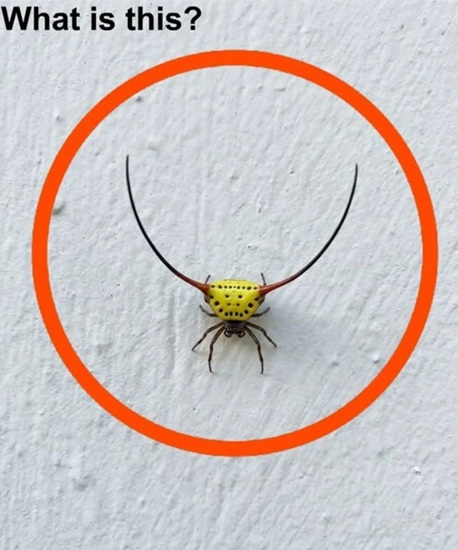
Last night, I walked toward my garage expecting nothing more unusual than grabbing a few tools before heading back inside. The evening had been completely normal, quiet, and uneventful until the exact moment I froze in the doorway after noticing something strange attached to the wall near the light switch. At first glance, my brain refused to process what I was seeing. The creature looked so unusual and unnatural that I honestly thought somebody had glued a fake insect onto the wall as part of some bizarre prank. For several seconds, I simply stared in confusion.
Then I realized it was alive. The tiny creature remained perfectly motionless against the wall, almost as if it knew blending into stillness made it even more unsettling. Its body was bright yellow with bold black markings stretching across its shell-like back in sharp geometric patterns. Even stranger were the long dark spikes extending outward from its body like tiny curved weapons. The spikes gave the creature an armored appearance that instantly triggered every survival instinct I had about dangerous insects and spiders.
It did not resemble any ordinary spider I had seen before. Honestly, it looked more like something designed for a science-fiction movie than something naturally existing in a suburban garage. The combination of colors, strange proportions, and dramatic spikes made the creature appear almost unreal beneath the dim garage lighting. For several moments, my reaction was not curiosity or fascination.
It was pure panic. My mind immediately jumped toward worst-case possibilities. Poisonous spider. Dangerous invasive species. Venomous insect. Something potentially harmful that absolutely did not belong inside a home where people and pets regularly moved around without thinking twice. I slowly stepped backward while keeping my eyes locked firmly on the creature.

The more I stared at it, the stranger it seemed. Its body appeared almost shield-shaped, flat and oddly symmetrical, covered with tiny black spots against a bright yellow background that made the contrast even more dramatic. The spikes extending from its sides created the illusion of aggression even though the creature never moved once. Somehow, its complete stillness felt even more intimidating than sudden movement would have been. It simply remained there attached to the wall.
Watching. At least, that was how it felt in the moment. I could practically hear my own heartbeat while trying to decide whether I should leave immediately, attempt to remove it, or search online for answers before doing anything reckless. Every instinct told me to stay cautious. Eventually, curiosity slowly began overpowering fear. I moved closer again, carefully and slowly, half expecting the creature to suddenly jump, crawl rapidly toward me, or spread hidden wings. Instead, it remained perfectly calm and completely motionless against the wall.
That was when I noticed how strangely beautiful it actually looked beneath the fear. The body had an almost polished appearance under the garage light. The yellow coloring appeared vivid and bright while the black markings created intricate patterns that looked surprisingly symmetrical and deliberate.
I cautiously reached for my phone and snapped several photos from different angles before immediately sending them to a few friends along with a message asking if anybody knew what this terrifying creature actually was.
The responses arrived quickly.
“Do not touch it.”
“That thing definitely looks poisonous.”
“Burn the garage down immediately.”
“Why does it look like an alien?”
Unfortunately, none of those reactions helped calm my nerves.
If anything, they confirmed my growing suspicion that the creature looked deeply unnatural compared to ordinary backyard spiders people usually ignored without concern. Even friends who normally loved insects admitted they had never seen anything quite like it before.

For several minutes, I genuinely believed I had discovered some bizarre invasive species hiding inside my garage. My imagination continued making the situation worse with every passing second while I kept staring nervously at the wall.
Then I finally decided to search online properly instead of relying on frightened group messages and dramatic reactions.
I carefully compared the photographs I had taken with various spider species listed on wildlife and nature websites. At first, nothing seemed to match because many spiders looked too plain or lacked the dramatic spikes covering this creature’s body.
But eventually, I found the answer.
The strange creature attached to my garage wall was something called a spiny orb-weaver spider.
And surprisingly, despite its terrifying appearance, it was almost completely harmless to humans.
Learning that information changed the entire experience instantly.
The spiny orb-weaver is a real species of orb-weaving spider known specifically for its bizarre appearance and unusually dramatic body shape. Unlike many spiders people commonly recognize, this species evolved to look intimidating as a defensive survival strategy.
Their bodies can appear in several bright colors including yellow, orange, red, or white, usually decorated with black spots and sharp-looking spikes extending from the edges of their shell-like abdomen.
The spikes look dangerous at first glance, but they are not weapons designed for attacking humans.
Instead, scientists believe those intimidating features help discourage predators such as birds, lizards, and larger insects from trying to eat them. In simple terms, the spider survives partly by appearing frightening enough to avoid becoming prey itself.
Once I understood that detail, the creature suddenly seemed less threatening and more fascinating.
Nature often creates animals with defensive appearances far more dramatic than their actual behavior. The spiny orb-weaver is one of the clearest examples of that phenomenon because its appearance suggests danger while its behavior remains extremely passive.
Despite its alarming look, the spider is not considered dangerous to humans.
Like most spiders, it may bite defensively if directly handled, squeezed, or threatened, but it is not aggressive and generally avoids human contact completely whenever possible. Most people never even notice them outdoors.
In reality, the spider’s daily life is much less dramatic than its appearance suggests.
Spiny orb-weavers spend most of their time building delicate circular webs designed to catch tiny flying insects such as mosquitoes, flies, and gnats. Their webs help naturally control insect populations in gardens, yards, and wooded areas.
That means the frightening little creature on my garage wall was actually beneficial.
Instead of being a dangerous invader, it was quietly helping reduce pests around my home without bothering anyone. The realization felt strangely humbling after the panic I experienced earlier that evening.
Once fear faded, curiosity completely took over.
I found myself examining the spider much more closely. The body shape looked almost geometric, as though carefully designed rather than naturally evolved. The spikes created an appearance unlike most spiders people commonly encounter around houses.
Its colors also seemed unusually vivid for something so small.
The bright yellow shell contrasted sharply against the darker wall behind it, while the black markings almost resembled tiny painted symbols. Under certain angles, the creature looked more artistic than frightening.
The longer I observed it, the more surreal it appeared.
It honestly looked artificial, like a tiny robotic spider created specifically to challenge human instincts about insects and danger. If someone had shown me a photograph earlier without context, I probably would have assumed it belonged to a tropical rainforest or fantasy movie.
That reaction reveals something interesting about human psychology.
People naturally associate sharp shapes, spikes, and unusual patterns with danger because evolution trained our brains to react cautiously toward unfamiliar creatures. Sometimes appearance alone creates fear long before actual threat exists.
The spiny orb-weaver benefits directly from that instinct.
Its dramatic appearance causes predators to hesitate, second-guess themselves, or avoid attacking entirely. Even humans experience that same hesitation despite the spider posing very little real danger.
Ironically, many truly dangerous creatures appear much less intimidating.
Some venomous insects and spiders have relatively plain appearances while completely harmless species develop elaborate defensive designs that make them look terrifying despite their passive nature. Nature does not always visually separate harmless animals from dangerous ones clearly.
As I continued researching, I learned that spiny orb-weavers are commonly found in warm climates across parts of North America, especially in gardens, forests, and areas with abundant flying insects.
They are especially active during warmer months when insect populations increase.
Most people probably pass these spiders regularly without noticing them because they are small, quiet, and often hidden within webs stretched between branches, fences, or outdoor structures.
But once you notice one closely, it becomes impossible to forget how unusual it looks.
Even though my initial reaction involved panic, the experience gradually transformed into fascination and appreciation. Something that first appeared terrifying became one of the most visually interesting spiders I had ever encountered.
It also reminded me how quickly fear can shape assumptions.
Within seconds of seeing the creature, my brain created stories about danger, poison, and invasion despite having absolutely no evidence supporting those fears. Appearance alone completely controlled my first impression.
That happens constantly in nature.
Animals evolve strange colors, patterns, and body shapes partly because survival depends on influencing perception. The spiny orb-weaver survives not through aggression, but through convincing larger creatures that attacking it might not be worth the risk.
And honestly, judging from my reaction, the strategy works extremely well.
Looking back now, I’m actually grateful I paused long enough to learn what the spider truly was instead of reacting impulsively out of fear. Many harmless animals are killed unnecessarily simply because people misunderstand them initially.
Education changes fear into understanding remarkably quickly.
The creature I almost viewed as some dangerous alien intruder turned out to be a harmless little architect quietly building webs and controlling insects around my home without causing problems for anyone.
That realization made the experience strangely memorable.
The garage encounter also reminded me that nature often appears most incredible precisely when it feels unfamiliar or unsettling. Some of the world’s most fascinating creatures initially seem frightening simply because they challenge expectations about what animals are supposed to look like.
The spiny orb-weaver certainly does that successfully.
Its sharp spikes, vivid colors, and strange body shape immediately capture attention in ways ordinary spiders rarely do. Yet beneath that intimidating appearance exists a tiny, peaceful creature simply trying to survive another night.
So if you ever walk into your garage, garden, or backyard and discover one of these bizarre-looking spiders attached quietly to a wall or hanging inside a web, try not to panic immediately.
You are not looking at an alien creature, dangerous monster, or mysterious invasive species preparing to attack your home.
You are looking at a spiny orb-weaver spider — a harmless, unusual, and surprisingly beautiful example of how extraordinary nature can appear when viewed closely for the very first time.
And honestly, once the fear disappears, it becomes difficult not to admire how something so tiny can look so incredibly dramatic while simply existing peacefully in the background of ordinary life.
