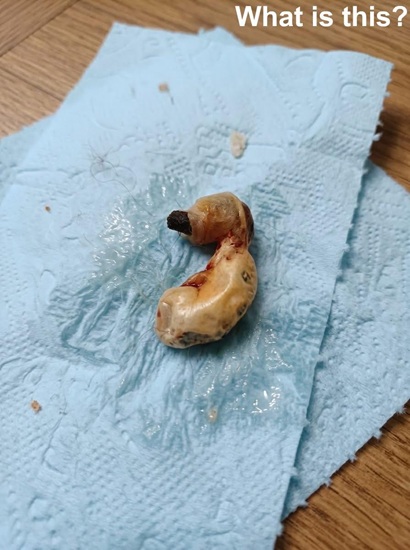
At first, I truly believed I had found something alive. The moment my eyes locked onto that pale, curved shape lying quietly on the dusty floor, something inside me tightened. It was tucked near the edge of the room in a way that made it look almost intentional, as if it had chosen that exact hidden corner to exist unnoticed. The lighting from the nearby window barely touched it, which made the shape seem even more uncertain and difficult to define. The longer I stared at it, the more my mind refused to settle on a rational explanation.
It looked soft at first glance, but the longer I observed it, the more unsettling it became. There was a darker tip at one end, slightly bent, and the texture seemed uneven, almost organic in a way that made my imagination immediately jump to uncomfortable conclusions. I felt a brief hesitation, caught between stepping closer or simply turning away and pretending I hadn’t seen it. My thoughts quickly began filling in the gaps.
I considered every possibility my mind could produce in that moment. It could have been something living, something dead, or something that had been forgotten long enough to decay into an unrecognizable form. The silence of the room made everything feel more intense, as if even the air around it had changed. The stillness gave the object an exaggerated presence, making it feel far more significant than it likely was.
My son stood behind me in the doorway, watching carefully.
He didn’t move closer at first, as if waiting for my reaction to determine whether he should be worried. His curiosity was obvious, but so was his hesitation. When he finally leaned forward slightly to see what I was looking at, I noticed the confusion on his face. He couldn’t identify it either, and that uncertainty made everything feel worse. If both of us didn’t understand what we were seeing, then the mind naturally fills in the blanks with fear.

He asked me what it was in a quiet voice.
I didn’t have an answer. Not one that made sense, at least. I only shrugged slightly, still focused on the object as if it might suddenly reveal its true nature if I stared long enough. But it remained completely still, unchanged, and silent. That silence made it feel even more unsettling, as if it was waiting for something.
For several long seconds, neither of us moved.
The room felt frozen in that moment, suspended between curiosity and caution. A part of me wanted to walk away and forget I had ever noticed it, but another part felt strangely compelled to understand what I was looking at. It wasn’t logical—it was instinct. Something about the unknown shape demanded attention, even though nothing about it suggested immediate danger.
Eventually, I decided to act.
I reached for a tissue nearby, holding it carefully between my fingers as if it could protect me from whatever I was about to touch. My movements were slow and deliberate, almost overly cautious, as I leaned down toward the object. My son instinctively held his breath behind me, watching every movement closely, ready to react if anything changed.
The closer my hand got, the more ridiculous my imagination became.
I briefly considered pulling back, convincing myself it might not be worth the discomfort of finding out what it was. But curiosity pushed me forward. The object still did not move, did not react, and yet it felt strangely “present,” as though it had a story I was about to uncover whether I wanted to or not.
Finally, I picked it up.
The moment I touched it, I felt an odd combination of firmness and fragility. It was not alive, not soft in any natural way, but it wasn’t entirely solid either. It bent slightly under the pressure of the tissue, revealing its lack of structure. Even then, I still couldn’t identify it immediately. My mind was still bracing for something unpleasant or disturbing.
Then the realization came suddenly, almost anticlimactically.
It wasn’t anything alive. It wasn’t an insect, a creature, or anything remotely threatening. It was simply an old piece of chewing gum that had been left behind and forgotten. Over time, dust, hair, and debris had collected around it, completely changing its appearance. What had once been something ordinary had slowly transformed into something unrecognizable through neglect and time.
The relief that followed was immediate.
All the tension that had built up in my chest released at once, replaced by a wave of embarrassment and disbelief. I actually laughed, though it came out slightly shaky, as I processed how far my imagination had gone over something so simple. My son, seeing my reaction, relaxed as well and let out a small laugh too, realizing that the “mystery” had been nothing at all.
We both stood there for a moment, looking at it in disbelief.
It was almost funny how something so ordinary had managed to create such an intense emotional reaction. A few moments earlier, it had felt like something unknown and possibly alarming. Now, in hindsight, it was just a forgotten object that had lost its identity over time. The transformation had happened not in the object itself, but in the way we had interpreted it.
As I disposed of it, I found myself thinking about how easily the human mind constructs fear.
When something is unclear, the imagination rushes to fill in the missing details, often choosing the most extreme or unsettling explanation. It is not the object itself that creates fear, but the lack of understanding around it. Once clarity arrives, the fear disappears almost instantly, leaving only embarrassment or relief in its place.
My son returned to what he was doing, still amused by the situation, while I stayed for a moment longer, smiling at how dramatically my perception had shifted in such a short time. The room felt normal again, lighter and calmer, as if nothing unusual had ever happened.
In the end, there was no mystery and no danger.
Only a simple, forgotten object that time and neglect had turned into something unrecognizable.
And yet, for a brief moment, it had convinced both of us that it might be something far more serious.
Sometimes fear is not about what we see.
It is about what we think we see before we understand it.
And sometimes, the most frightening discoveries are the ones that turn out to be completely ordinary all along.
