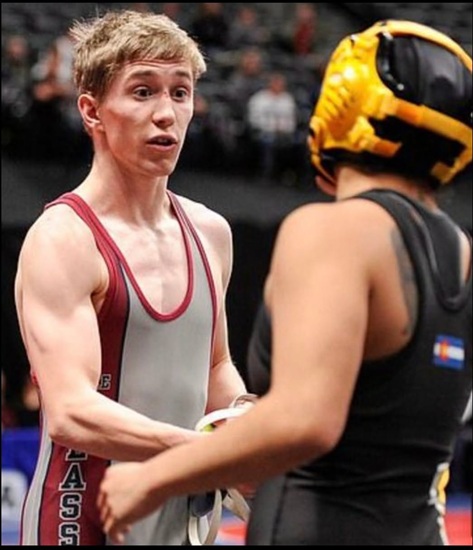
In February 2019, Colorado high school wrestler Brendan Johnston faced a decision that would bring national attention to the final tournament of his high school career. Johnston was an 18-year-old senior at The Classical Academy in Colorado Springs and competed in the Class 3A 106-pound division. He had worked toward reaching the state tournament and had hopes of finishing his senior season with a state title. Yet when the tournament bracket placed him against female competitors, Johnston chose to forfeit rather than wrestle them.
His decision was based on personal and religious beliefs he had maintained before reaching the state tournament. Johnston’s first scheduled opponent was Jaslynn Gallegos, a senior from Skyview High School. Gallegos was an experienced wrestler who had participated in the sport since childhood and had competed against both boys and girls. Instead of taking the mat against her in the opening round, Johnston forfeited. The decision meant Gallegos advanced without the two athletes wrestling each other.
It also immediately placed Johnston in a difficult competitive position at the most important tournament of his season. Later in the tournament, Johnston encountered another situation involving a female opponent. In the third round of the consolation bracket, he was scheduled to face Angel Rios, a junior from Valley High School. Johnston again chose not to compete. That second forfeit effectively brought his high school wrestling career to an end. Rather than changing the position he had previously taken in order to improve his tournament result, he accepted the competitive consequences of refusing the match.
Johnston explained afterward that his discomfort involved the physical nature of wrestling. Unlike sports where opponents remain separated by significant distance, wrestling requires sustained physical contact and aggressive competitive movements. Johnston said he did not feel comfortable engaging with a young woman in that manner. He also explained that his Christian faith and the way he had been raised influenced his position. His comments made clear that, from his perspective, the decision was about personal boundaries rather than questioning whether Gallegos or Rios had worked hard enough to compete.
The distinction was important to Johnston because he knew his decision could be interpreted as disrespect toward his female opponents. He maintained that this was not what he intended. He said he recognized the work and commitment required for Gallegos and Rios to reach the state tournament. At the same time, he believed that respecting them as athletes did not require him to participate in a match that conflicted with his own convictions.
Johnston also addressed questions about equality. He said he did not consider women less valuable than men. Instead, he described his belief that men and women can be different while still possessing equal value. That distinction formed part of the reasoning he offered when reporters asked him why he would sacrifice a potential state-tournament result rather than compete.
For Gallegos, however, the situation looked different. She had spent years competing in wrestling and wanted to be evaluated primarily as an athlete rather than according to her gender. She told reporters that her goal had been to establish herself simply as a wrestler. Being treated differently because she was female therefore frustrated her, even though she said she respected Johnston’s right to make his decision.
Gallegos had started wrestling when she was only five years old. By the time she reached the Colorado state tournament as a high school senior, competing against boys was nothing unusual to her. She told NPR that she wanted to be regarded as a wrestler rather than specifically as a “girl wrestler.” Consequently, an opponent declining to face her because of her gender conflicted with the way she viewed her own athletic identity.
Angel Rios also had experience with Johnston’s position before the state tournament. Reporting at the time indicated that Johnston had previously forfeited matches against Rios during the season rather than compete against her. The state tournament was therefore not the first time he had confronted the issue or made this decision. His approach had been established before national attention focused on the story.
In fact, Johnston had faced a similar decision during the previous year’s state tournament. In 2018, he declined to wrestle another female competitor, Cayden Condit, during the consolation rounds. Johnston later recalled discussing the issue at length with his coach before deciding that maintaining his beliefs was important enough to accept the consequences. That earlier episode demonstrates why describing the better-known Gallegos and Rios incident as occurring in 2018 is inaccurate: the two forfeits that generated widespread coverage happened at the 2019 state tournament.
By his senior season, Johnston already understood that his position could cost him important matches. According to reporting at the time, he finished the season with 37 wins in 43 matches, and several of his recorded losses were forfeits rather than defeats on the mat. Four forfeits during that season were against Rios. His state-tournament decision was therefore consistent with choices he had already made during regular competition.
That consistency mattered to Johnston because the stakes at the state tournament were significantly higher. Winning the tournament had been one of his goals. He had completed a successful senior season and arrived knowing that every match could determine how his high school career ended. Changing his position at that moment might have preserved his competitive opportunity, but he decided that doing so would conflict with a principle he had already followed when less was at stake.
Johnston summarized his perspective by explaining that wrestling was something he participated in rather than the entirety of his identity. He believed other priorities could outweigh success in the sport. That reasoning helped him accept the fact that his final high school tournament would not end as he originally hoped.
The forfeits also became part of an important moment for Gallegos and Rios. Rios ultimately finished fourth in the Class 3A 106-pound division, while Gallegos finished fifth. Their results made them the first girls to place at Colorado’s state wrestling tournament. The Colorado High School Activities Association reported the historic achievement on February 23, 2019.
Gallegos did more than advance through Johnston’s forfeit. During the tournament, she also earned victories on the mat. CHSAANow reported that she pinned Moffat County’s Hunter Fredrickson in 59 seconds and earned a 9-5 decision over Eaton’s Alex Castaneda as she progressed through the consolation bracket. Those results are important context because her historic fifth-place finish cannot accurately be described as simply the product of another wrestler declining to compete.
The broader environment surrounding girls’ wrestling was also different in 2019 from what it is today. At the time of the tournament, girls’ wrestling was not yet a separately sanctioned high school sport in Colorado, so female wrestlers could participate in the state competition alongside boys. Colorado had a pilot girls’ wrestling program, but Gallegos and Rios chose to compete in the established tournament against boys.
That historical context is important when evaluating the story. Johnston was not creating the tournament rules, nor were Gallegos and Rios doing anything improper by entering the competition. The existing structure permitted them to compete. Johnston then exercised his choice not to participate in particular matches and accepted forfeits as the consequence. The disagreement concerned the athletes’ different personal perspectives within the competition rather than whether Gallegos and Rios were legitimately present in the tournament.
Girls’ participation in wrestling was already expanding nationally at the time. The Washington Post reported that nearly 17,000 high school girls were participating across the United States, citing Wrestle Like A Girl. Twelve states then recognized girls’ wrestling as an officially sanctioned high school sport. Those figures describe the sport as it existed in 2019 and should not be mistaken for current participation totals.
For Gallegos, competing against boys was something she had been doing for years. She recalled hearing male opponents underestimate her before matches, only for some of them to compliment her wrestling afterward. Experiences like those helped shape her desire to be viewed according to her ability on the mat rather than primarily according to gender.
That explains why she could simultaneously respect Johnston’s decision and feel disappointed by it. Those reactions are not contradictory. Gallegos could recognize his ability to make a personal choice while also believing that the choice prevented her from being treated in the way she wanted to be treated—as another wrestler who had earned a place in the tournament.
Rios similarly acknowledged that Johnston’s decision belonged to him. She had no ability to force him to compete once he decided to forfeit. Her own response was to continue through the tournament, where she eventually earned fourth place.
The episode consequently contained two legitimate personal perspectives that were difficult to reconcile. Johnston believed participating would violate religious and personal boundaries he considered important. Gallegos wanted opponents to evaluate her as a wrestler and felt frustrated when gender prevented a match from occurring. Reporting the event accurately requires preserving both perspectives rather than turning either athlete into a caricature.
It is also important not to expand Johnston’s statements into claims he did not make. He did not argue that Gallegos and Rios lacked athletic ability, nor did he claim that their participation was illegitimate. His publicly stated reasoning centered on the physical contact and aggression involved in wrestling and on his personal and religious convictions.
Likewise, Gallegos did not respond by attacking Johnston’s faith. She acknowledged that she respected his decision while explaining why the experience was frustrating to her. Her response focused primarily on her desire not to have her identity as a wrestler limited by gender.
The story therefore does not need exaggerated claims about either side. It is already an unusual example of what can happen when deeply held personal convictions intersect with the rules and expectations of competitive sports. Johnston knew forfeiting would hurt his chances at the tournament. Gallegos and Rios knew that some male wrestlers might have reservations about facing them. All three nevertheless continued according to their own choices.
For Johnston, the price of that choice became particularly significant because it happened at the end of his senior season. There would be no future high school state tournament where he could try again. Once he forfeited his consolation match against Rios, his high school wrestling career was effectively over.
He later indicated that he did not regret the decision. Even though the tournament had not ended the way he originally hoped, Johnston said that if he had the opportunity to make the choice again, he would make the same one.
Gallegos, meanwhile, left the tournament having made Colorado wrestling history alongside Rios. Her fifth-place result and Rios’s fourth-place finish represented the first time female competitors had reached the state podium in Colorado. Their accomplishment was recognized as a significant development for girls participating in the sport.
The event received attention precisely because there was no simple interpretation that captured everyone’s experience. To Johnston, forfeiting represented consistency with his faith and personal boundaries. To Gallegos, the same forfeit represented another occasion when gender affected how an opponent treated her despite her desire to compete simply as a wrestler.
Neither perspective changes the tournament record. Johnston declined the two matches. Gallegos finished fifth. Rios finished fourth. The two female athletes became the first girls to place at Colorado’s state wrestling tournament. Johnston ended his high school career having accepted the competitive consequences of refusing to wrestle female opponents.
Those documented facts are enough to explain why the story attracted national attention in 2019. It brought together competitive ambition, religious conviction, personal boundaries, changing participation in high school wrestling, and the experiences of female athletes competing in a traditionally male-dominated environment.
Rather than treating the episode as proof that one side of a broader social argument was automatically right, the historical record shows something more specific. Three young athletes reached an important competition with different perspectives. Johnston made a decision based on beliefs he had expressed before the tournament and accepted the resulting forfeits. Gallegos and Rios continued competing and achieved historic placements.
For Johnston, the tournament demonstrated how much he was willing to sacrifice for a conviction he considered more important than a wrestling result. For Gallegos, it reinforced her determination to be recognized for what she had trained to become: a wrestler. Their different reactions are part of the same documented story and should be preserved together.
Years later, that balance remains essential when retelling the event. Johnston’s religious explanation should be represented accurately rather than mocked or exaggerated, while Gallegos and Rios’s athletic achievements should not be minimized. The most accurate version does not require readers to adopt one athlete’s viewpoint over another.
The 2019 Colorado state tournament ultimately produced a result none of them could have predicted when their wrestling careers began. Johnston finished his high school career by refusing two matches he believed crossed a personal boundary. Gallegos and Rios reached the podium and became the first girls to place at the state’s wrestling tournament.
That combination of conviction, disappointment, competition, and history is what made the episode memorable. It remains an example of how organized sports can bring people with very different beliefs into the same competitive structure—and how the decisions they make within that structure can have consequences extending well beyond a single match.
